A unique exhibition is on display at Museum of Christian Art, Old
Goa which focuses on a sin gle object, an 18th Century Bible. After working on
the first series that focused on the Advent season, the second part of the
exhibition will interpret the last phase of Jesus Christ’s suffering, for this
Lenten season.
‘Engraved Treasures Part II’ continues a
meaningful interaction with, and interpretation of engravings from the 18th
Century Belgian Bible in the Museum collection. In a synergy of tangible and
intangible expressions, the showcase brings together a diverse range of works
that also reflect unusual yet complementary pairings of aesthetic languages.
The compilation reveals a balance between both conventional and experimental
approaches; a meeting of classical western art with indigenous art and craft
practices; and a sense of acknowledgement for tradition as well as
contemporaneity.
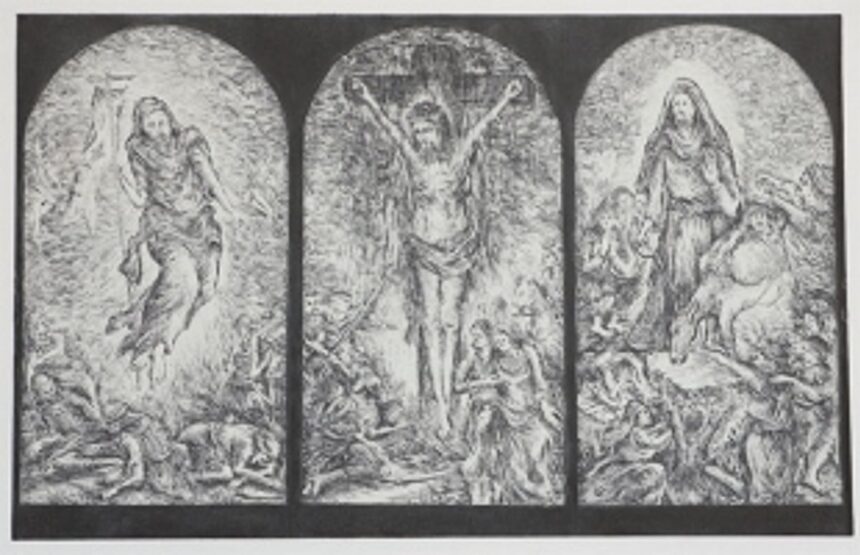
The exhibition curated by Lina Vincent, features artworks by
Vijay Bhandare, Sandesh Naik, Clarice Vaz, Sachin Naik, Leticia Alvares,
Nishant Saldanha, Sonia Rodrigues Sabharwal, Swapnesh Vaigankar, Sagar Naik
Mule, and performances by Impana Kulkarni, Arundhati Chattopadhyaya, Sonia
Rodrigues Sabharwal, Pragya Bhagat, Divesh Gadekar, and a choir and orchestra
conducted by Fr Romeo Monteiro.
The choir and ensemble will present a programme, ‘Concert of
Sacred Music’ (with meditations on the Mystery of the Incarnation of Our Lord)
at the concert. The singers and musicians will render 12 sublime choral
compositions of this invocation that were set to music by composers down the
ages, in various languages and different musical traditions and eras. There
will seven compositions in Latin, and one each in Aramaic, the language spoken
by Jesus, Russian, Greek, Sanskrit and Konkani. The conductor of the Choir and
Orchestra is Maestro Fr Romeo Monteiro, a Catholic priest of the Archdiocese of
Goa and Daman, and presently the Chancellor of the Archdiocese.
There are two central investigations that frame and support the
concept of this exhibition: the first involves the artists’ responses to formal
pictorial and visual aspects of the engravings, along with their physical
history, and the other concerns the theoretical, socio-cultural, philosophical
and spiritual essence of the scriptural teachings that transcend all boundaries
of religion and become universal considerations through the medium of art.
Several sacred moments that are iconic to the telling of Jesus’s
adult life are prominently captured in the prints and paintings. Being a
narrative that is fraught with a range of human emotions and behaviours, the
artists have taken cues from the engraved images and explored aspects of the
suffering and crucifixion of Jesus, the last supper, His death and
resurrection. Some have referred to personal experiences in depicting elements
of worry, anxiety, weakness and betrayal – even alluding to the pressures of
politics, peoples’ expectations and their apathy.
The subject of hope and salvation, and the solace that spiritual
thought can offer also comes alive in several works. The miracles of Christ:
the marriage at Cana when water was turned into wine, the incredible moment
when the multitudes were fed by the simple act of sharing five loaves and two
fishes, -indicate the power of service, and that there is wonder in life;
something beyond the ordinary.
It can be noted that these episodes are widely discussed and
visible, not only in the context of a region like Goa where Christianity is
part of the cultural fabric, but also in terms of art history, with familiar
and popular renditions of specific religious scenes by master artists of the
Renaissance and Baroque periods, and after. The techniques of printmaking –
engraving, etching, and woodcut – practised by several artists in the show,
draw attention to the history of the medium and its use in the dissemination of
religious material through reproductions or otherwise.
The engravings themselves represent much that is performative,
in the dramatic settings, manipulation of scale and figuration as well as light
and shade. The narratives lend themselves to other forms of expression that
have come into play with this exhibition – poetry and dance, sound, puppetry
and theatre, all resonating with the theme of the Bible and its engravings.
Politics and conflicts of power are deeply entwined with the
discussion of any evolving society. Colonisation is never a comfortable subject
and yet time allows for varied cultural remnants to mingle and become richly
complex. Therefore, in a Museum like this one, the reciprocative aesthetic
languages of Indian and Portuguese art come together to create a new genre. To
add another layer, contemporary art has the ability to squeeze into unknown
spaces and occupy grey areas to create newer and more colourful
interpretations.
In this beautiful mix of forms, techniques and cultural motifs,
a meaningful bridge between past and present becomes apparent. And there are
lessons to take away – to be human, to have compassion and care, to have hope.
Sagar Naik Mule worked on his interpretation of the ‘The Holy
Journey’. “I always treat my work as a museum piece. All thanks to Heta Pandit,
Natasha Fernandes, curator of Museum of Christian Art and Lina Vincent, curator
of Engraved Treasures – Part II. They gave me the opportunity to execute my
work in this beautiful show. This is their second edition of the exhibition
based on the Bible at MOCA and the theme was the Last Phase of Jesus. I have
done a three panel work title called ‘Holy Journey’. The top panel is about the
‘Sacred Heart’, the middle is about ‘Last Supper’ and the bottom is about the
‘Last Walk’. It is made with Kaavi Style in a unique way on wood. Though the
concept is western, I gave it an Indian art touch which makes the work special
and I am definitely happy that my Last Supper is different than other ‘Last
Supper’. This was an awesome and a different experience with a new topic,” says
Sagar.
The
exhibition will be on display at the Museum of Christian Art, Old Goa till
April 30 from 10 am to 4.30 pm.