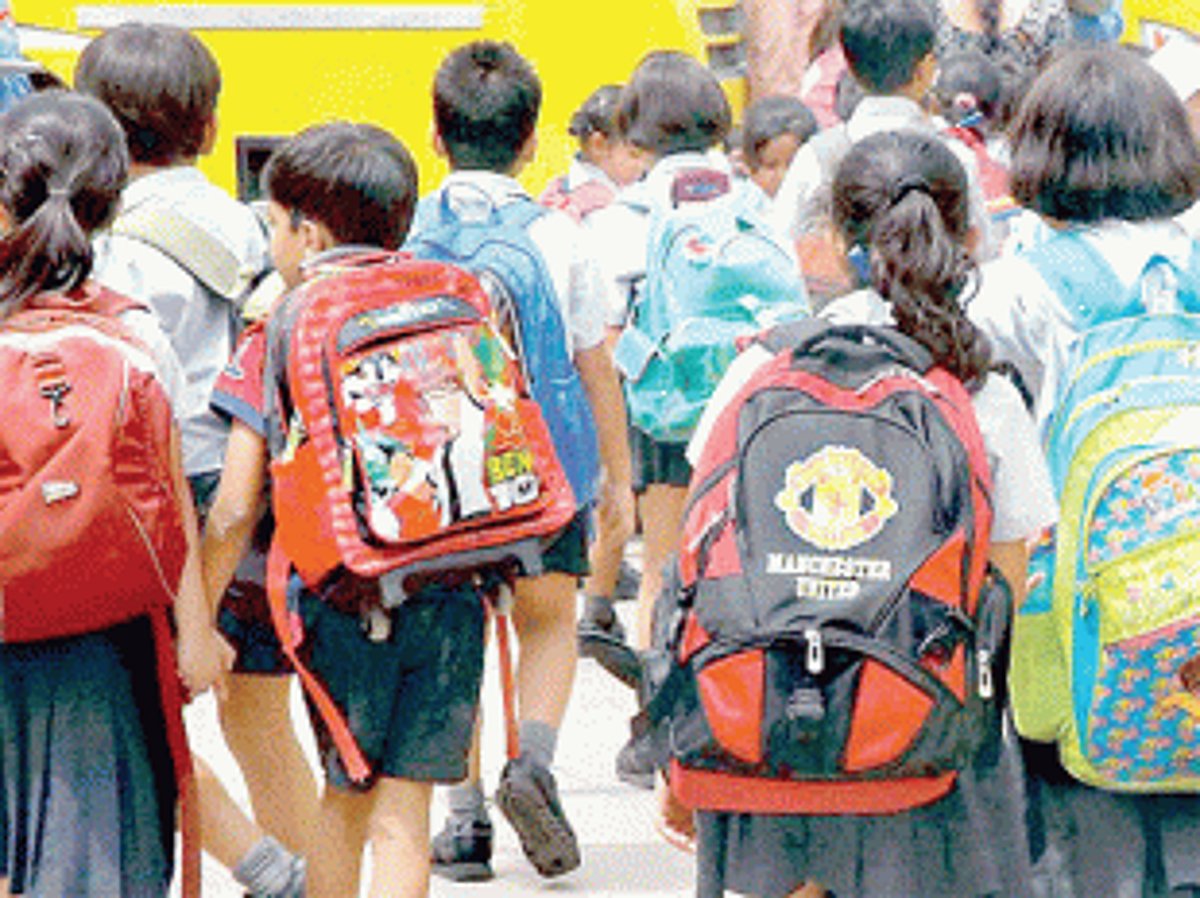
Carrying the
back-breaking heavy bag to school has been a painful ritual for students since
decades.
Despite changing
times and advent of newer technologies, the ground situation has not changed.
Parents have started
pleading with the Government to reduce the weight being carried by their little
ones. Not only does this weight have an adverse effect on the children’s
physical well-being in the long run, but also also causes fatigue, muscle
strain, back pain, rounding of the shoulders, poor body posture and short
attention spans.
The parents have
demanded that the government should make a serious effort to reduce the weight
that the children have to carry.
Gandhali Bhat, a
teacher at the Holy Cross Institute, Quepem expressed her disapproval at the
blind eye the government was taking to this issue.
She said, “These
school bags are definitely heavy. I believe that this problem needs to be
addressed by the concerned authorities. I really feel terrible when I watch my
son lugging his large backpack and carrying such a big load on his shoulder.”
Parents pointed out
the children are not carrying this weight just twice a day but every single day
and this was them with a bent posture resulting from trying to balance out the
heavy load. They also made a point that it is not only the weight of textbooks,
notebooks and other stationary but children have to carry necessities like
tiffin, water bottle and other material. Deepali Naik Thakur, a mother of 2
from Margao, shared her children’s struggles since the reopening of schools.
She shared,” I have 2 sons who just finished their primary school and always
complain to me about their pain because of their school bags. And it’s not just
one day complaining, it’s almost every day. I try to advise them to take less
books if the teacher doesn’t use it but they say that the teachers suddenly
require textbooks or notebooks so they have to carry everything. And I cannot
tell them not to carry water and food to reduce their weight.”
The forgotten policy of 2020, the School Bag Policy, protected
children from this burden but it has shown no effect in schools due to the last
two years being online and now the schools have forgotten it.
Rajesh Rao, a father of two in Margao, compared the heavy school
bags to bricks and supported the technology in the educational system. He said,
“Carrying a lot of books that feel like bricks over the child’s shoulder, makes
no sense. Also, today, there are a lot of technological advancements and the
fact that today’s children are quite familiar with it, they can have all of
their textbook material compiled into a PDF format, have activities, quizzes
etc. through online portals. And any books that they ‘need’ to carry can be
kept in school lockers and brought home during exams. Carrying these heavy bags
also takes a toll on the child’s spine.” Meanwhile Rajesh’s wife, Megha Rao,
disagreed with him with regards to the online method of learning while also
providing a solution. She said, “Well, I wouldn’t recommend the online method
or the technology for the young children because they must comprehend the
concepts of books, pen, paper, and pencil. To alleviate the burden of heavy
backpacks, schools should demand students to bring only the books they need for
that day.” Small Risham Rao, 4th std student, also chimed in with his parents
saying, “It is not fair. My shoulders hurt.”
Gayatri Naik, a mother from Curchorem, spoke about the practices
being implemented in other states and questioned why it is not being implemented
in our own state despite the policy being implemented in 2020. She stated, “I
heard from my fellow friend who’s from Bangalore where her kids just keep their
books on their individual desks instead of carrying it back home. Schools can
easily adopt this strategy and build their desks in such a way that students
won’t need to bring any books home. It’s like we don’t bring our office home.”
Gayatri also shared her suggestions on the possible solutions
and steps the Government could take to help the young students. She said,
“Schools should forbid students from taking any books home with them. Each
student should receive a locker that was placed in a certain section of the
classroom and used to hold their books and other miscellaneous belongings. Homework
should be done in class, and encourage students to ask their teachers questions
in class rather than outside of it.”
Gandhali Bhatalso spoke about some options, saying, “The
textbooks and notebooks could all be kept at the school, I suppose, as a good option.
And if there is homework or a test the next day, only send back one or two
books.” Mangaldas Bhat, teacher at Guardian Angel Higher Secondary School,
Curchorem also agreed with Gandhali saying that schools should bring rapid
reading books instead of voluminous text books and that books either need to be
more concise as teachers often mark selected lines and paragraphs or these
textbooks need to be broken up into several parts to ease the weight for
students.
It is evident that parents and teachers are worried with the
plight of young students. The awareness is already there. But the
implementation of the solution is still yet to see the light.
All these suggestions show that Goans are serious about the
wellbeing of their young ones and are quick to stand up against the negligence
of the Government and authorities towards these Goan children.
What needs to be seen is when will the administration wake up to
this serious problem, which has life-long ramifications.