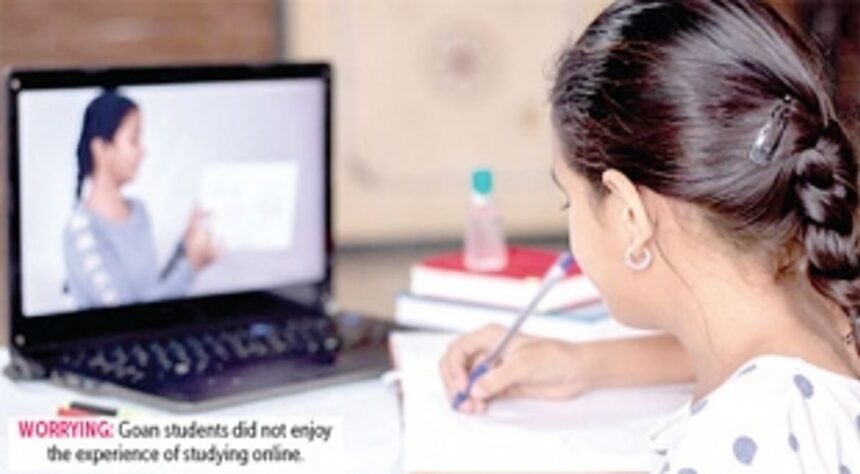
It was meant to be the only way forward to ensure the process of educating the young continued. But that it seems now was not quite right. A survey conducted by two researchers in Goa has revealed that 77 percent of all students were not satisfied with classes being conducted online. Poor Internet connectivity has been a major challenge faced by school students in Goa during the online classes, which are being conducted presently in the absence of physical classes due to the COVID-19 pandemic period.
Educationists and students in the state had much to say. Father Jose of the Don Bosco Orphanage said they had children with them for 365 days because they could not go home. Students he said wanted to go offline because they wanted to interact with their friends. He said the students would ask questions online if they had any doubts but they made it very clear they wanted to go back to class. After all he said the classroom experience was what all of them were comfortable in. The students are missing a lot of interactions with their teachers, colleagues, friends, he said. Studying, he said, was taking place from the books but much was learned by interacting, working in a team. Father Jose said he was aware of the third wave which was coming but colleges were going to open from September 1 and perhaps after the holiday they could go offline and have at least one term in school.
The people of Goa have passionate opinions. And Vishal Rawley who conducted online classes for students who were struggling had quite a lot to say. He said “I have taken online classes for children who were struggling with online classes and also conducted online classes for college students. I also ran a program from January to May to create a digital literacy program for children who are on the other side of the digital divide to get up to date with digital technology. From my point of view the way online classes are conducted is a complete sham and does not work at all. Children have problems with their personal devices; they don’t have a personal space where they can do it. The school gives them that space. At home, the dog is barking and so it can be quite chaotic”. Networks not being good he said were a very big problem. Even with good technology the voice is not clear he said and there was the problem of call drop. Students who were shy or backbenchers may not be able to prompt the teacher or stop the class to clear their doubt. He said he strongly believed that 77 percent could in fact be actually higher. If they were asked to sit for a test more than 95% would fail. He said in a year and a half he had seen children falling back on the little progress they were making in the critical middle school years with reading, writing and math, they had fallen back. The lack of rigor of every day school he said had really hit the students. He felt it was important that education itself ought to be rethought and conducting classes in a room would just not work. It had to become more exploratory and project work focused. Collect samples of fruits, or the fishes that were caught during the monsoon, they had to be encouraged to step out. He said this had to be done in one’s villages. The old format was just pasted online and students instead were getting addicted to violent games like PUBG, TIK Tok videos. Overall he ended by saying the digital experience had been a very negative one.
Brenda Lobo a young student in a school in Aldona said she really did not mind online classes but when pushed a little she was also open to the idea of attending classes in a room. She said she did not have a problem understanding what was being discussed during an online lecture but her father Valentino had an entirely different point of view. He said “I would like her to sit in a class and learn. Getting connectivity is a problem especially during the rainy season. And then when it gets windy it can get really bad. Class interaction is so much better. The kids remember it longer.”
Saisha Bagkar, a final year student said she was absolutely fine with an online lecture for the theory part of her subject but when it came to practical’s she wanted to experience the classroom atmosphere. She admitted during the rains, it was a problem accessing the network and she was sometimes forced to move about to be able to get a good connection.
Abhidnya, a student awaiting her final year results, said she did not enjoy the online experience. Connectivity was a serious problem, she said. According to the report, a total of 21 per cent of students said internet connectivity was poor, while around 53 per cent said they experienced moderate connectivity. That’s that
The experience from the other side was interesting. Sarita Khandeparkar, a computer teacher said she did not experience much of an issue. She said “Yes, I will say, those below the poverty line had a very tough time accessing lectures. With regards to students having doubts, it is up to them to ask us. I answered if I received any queries. With regards to practical’s, yes in an ideal world, it should be conducted in a class but it was done online. Last year I made the students prepare powerpoint presentations and they all did it”.
The report highlighted the fact that in order to adjust to the mode, 30 percent of the students approached their elders for guidance and attended tuitions. The study also shows that students prefer face-to-face mode of learning after the end of the pandemic with a combination of ‘blended classroom’ added to it.
These findings can have far reaching consequences for a society and for a country as it tries to find its way out of this Covid pandemic. The competitiveness of the state can be at stake. One can only hope the people that matter are taking the necessary steps to ensure the gaps are fixed.