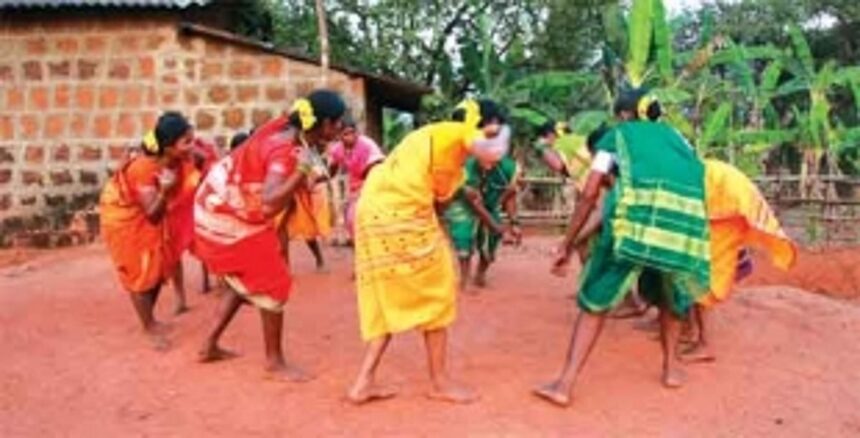
The
folk art of any place is the best representation of its cultural
and historical heritage. Indigenous to the place, this art passes
culture from one generation to another. Goa too has its cultural
heritage preserved in the form of a number of folk songs and dances.
It’s the dance that appeals to the common people. However, the
once-popular folk dances of Goa are lagging behind Indian classical
and western dance forms, that are much preferred by today’s
generation.
Today,
there are hardly any dance classes in Goa that teach folk dances. The
very few classes that teach these dance forms receive a much lower
number of enrolments as compared to other dance forms. Nalini Souza,
a documentary filmmaker who has worked with Goa’s folk dancers and
has carried out extensive research on Goan folk dance feels that in
order to draw more youngsters towards folk dances, they need to be
presented in a way that would suit their interests. “Folk dance in
its pure form can be very repetitive and long. It needs to be changed
to adapt to the new generation of youngsters who are bombarded every
day with music videos loaded with special effects,” she says. She
admits that it’s very rare to find young people as members of folk
dance troops.
According
to Kanta Gaude, the president of Rangamel group and Goa State
Cultural Awardee, folk dances are meant to be passed from generation
to generation, and not taught in a formal setting. “Folk dances are
associated with different festivals, communities, etc. They are
hereditary,” he expresses. The village people, he says, are still
preserving the dance forms. However, the youngsters don’t seem to
be taking much interest. He feels, “There are some dance forms,
like ‘Perni-jagor’, that are soon to die out because people have
stopped performing them due to lack of encouragement as well as
earnings. Youngsters have seen their fathers and forefathers
dedicating their lives to these arts and not getting anything in
return. If the artists get enough financial assistance and motivation
from the authority, people would come forward to keep the folk dances
alive.” Nalini too feels that much more can be done by the
government to promote this endangered art. “The Mando festival is
quite alive and it has been there for a long time. I think that the
Department of Art and Culture could organise workshops for schools to
learn Goan folk dances so that the same could be performed during the
annual day and other events.”
One
more step, that would help in the promotion of folk art in Goa is
linking it to tourism. “Instead of just projecting our beaches,
food and casinos to the tourists, if we show them our rich folk
tradition, they would be interested in visiting our festivals and
villages, which in turn would help us promote our folk dances, not
just in Goa or India, but across the world,” Kanta opines.
In
conclusion, it’s very important to preserve folk dance as it is a
very important part of our heritage and identity. As Kanta Gaude
expresses, “We got the folk dances from our ancestors. It’s
necessary to keep them alive so that we can pass them on to the next
generation. If they get extinct now, it will be an injustice to our
future generations.” He continues saying, “Folk art is the story
of our life. It’s treasure that has to be preserved.”