The hillock was inhabited in the long past by the ‘kumbhars’ so it is known as the ‘Kumbhar waddo’. No one knows for sure when the ‘Kumbhars’ came to Goa. Some say they came from the Chota Nagpur Plateau in 3,500 B.C. “The Goan ‘Khumbar’ may well have affinities with ‘khumbars’ from Orissa, Andhra and Karnataka as they crossed the Gangetic plains and Andhra across Deccan and then up River Kalinidi into Goa” (Cabral e Sá, Mário ‘The Kumbhar community’) settled where the preconditions for their work were available.
The ‘Kumbhars’ needed special mud and abundant fuel for their furnaces. They consider the soil as its god. No activity of the potters, whether religious or occupational, starts without saying a prayer to this element of Nature. They wait with great expectations for the feasts of the churches and of the temples as these are occasions for the traditional fairs. They eagerly display an array of items used in the households in the past, before the influx of plastic and aluminum. They mould and bake pots and pans, idols, lamps, toys, pitchers that help to keep the water cool in the hot summers known as ‘gorgoleta’, jars and vases for gardens and indoor plants, figures of soldiers and cocks that till now embellish rooftops and compound walls. Traditional musical instruments like the ‘Ghumot’ and the ‘Mhadalem’, the lamps used in the temple rituals, the small pots used to burn incense and the ‘tulsi vrindavan’ are made of clay till the present day.
As per the records available in the writings of Gomes Catão (Arquidiocese de Goa, Damão e Diu) and Father Moreno de Souza in his book in Konkani ‘Bardescho Igorzo’ The chapel of Our Lady of Candelaria in Kumbar waddo in Pilerne has a history of faith that dates back to 1755. Pio Ribeiro and Francisco Britto e Rosario were businessmen and friends and sailors and in one of their seafaring journeys they brought an image of Our Lady and placed it in the house of Francisco Brito. A few years later, Francisco married Monica, the daughter of Pio Ribeiro. Misfortune struck Monica’s life as she became a widow at an early age. Monica returned to her father’s house and never forgot to take along with her the image of Our Lady of Candelaria. Her house was situated close to the site where the chapel of Candelaria is seen today.
The Image of Our Lady was placed in a small hut of palm leaves built by Monica. Her faith grew with every sunrise and the hut became a place of prayer for the people of the vicinity. Money poured at the feet of Our Lady so they built a chapel with the contributions. In 1752 on March 15, the construction of the chapel was ready. But the then Archbishop Dom Antonio de Neiva de Silveira (1750-1773) did not allow it to be opened as it was built without the consent of the Church. The Image was taken from the chapel on the hillock and placed in the Church of Pilerne. Later, in the year 1775, the Archbishop Dom Franciso de Assunção e Brito went up to the hillock and maybe, inspired by God, re-opened the chapel. Money and offerings overflowed from all the villagers and the Church itself. It was time for a new and bigger chapel to be constructed. A chaplain was appointed who used to reside in the quarters near the chapel of Candelaria. It would not be out of place to mention that there existed a seminary of Nossa Senhora de Candelaria close to the site of the Chapel and it trained many a priest who later joined various parishes. Unfortunately, the seminary fell into oblivion due to the epidemic in the village.
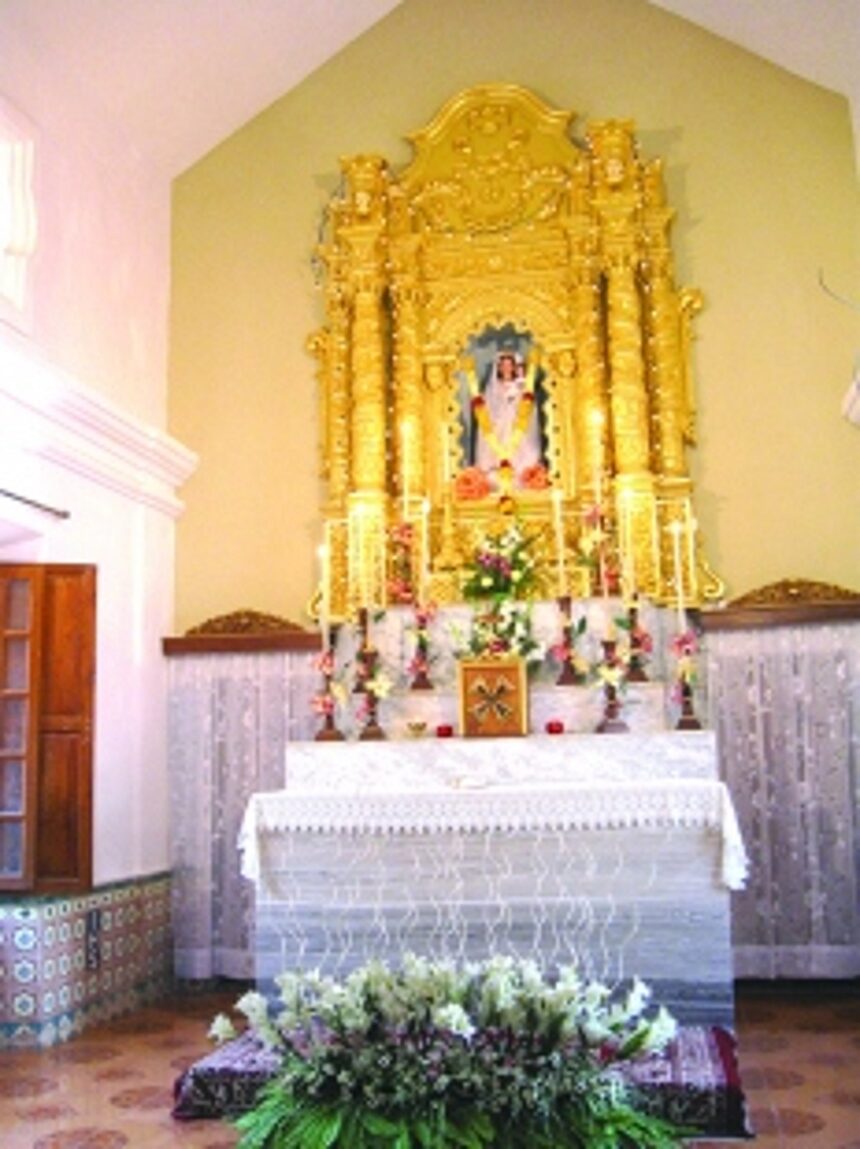
The new chapel situated in the old ‘kumbhar waddo’ has an octagonal shape. It resembles The Capelas Imperfeitas in the Mosteiro de Batalha in the north of Portugal. The Capelas Imperfeitas with the octagonal shape is located behind the main altar. The chapel of Candelaria is accessible by a ramp that is 270 feet long and this leads you to 30 masonry steps, weather-beaten after centuries of use, that wind up at the entrance of the chapel. Two statues of angels and two imposing figures of the order of St Francis beautify the landing. The façade has a phrase in Latin inscribed on it. The chapel has one main altar where the image of Our Lady of Candelaria is placed. There are two side altars but not yet in use.
The Feast of Our Lady of Candelaria is one of the most ancient feasts of the Church. It started about two thousand years ago. It commemorates the purification of Mary, 40 days after the birth of Christ, according to the Jewish law and the Presentation of Jesus in the Temple of Jerusalem. It is the Christian Festival of Lights and on this day of the year all the candles to be used in the Church in the coming year are brought to the Church and prayers are said over them. Hence it is called Mass of Candles or Candlemass. A white candle of wax is distributed to all devotees who attend the Candlemass. Many Churches in Goa celebrate this feast with a Mass and blessing of the white candles. However, the village of Pomburpá, in Bardez, is renowned for its celebration.
The name ‘candelaria’ is derived from Latin ‘candela’, which means ‘a candle’. This term was later absorbed in languages of Latin origin viz; Spanish and Portuguese. So the feast of Candelaria is a feast of candles.
The origin of this feast goes back to the year 1392 in the islands of Tenerife in Canaries, where Our Lady of Candelaria is the patroness. The Portuguese and the Spanish missionaries introduced the feast of our Lady of Candelaria in Goa. The ‘Kottianchem fest’, which is celebrated in the Chapel of Our Lady of Candelaria, is unique. It is celebrated on the Sunday preceding Ash Wednesday. People of all faiths and age climb the ramp to pray to Our Lady. The faithful sweep the ramp and clean it on the previous day. Some devotees go down on their knees over the slope, to fulfill a promise. Others sweep the gradient with their long hair. All along the access ramp and the steps, young and old, Christians and Hindus sit with coconut shells (Kottio), asking for alms. The coconut shells are the cheapest and easily available and nature friendly containers used to collect money. Not today, of course, as coconuts are scarce and hordes of beggars have multiplied. Talking to some of the devotees, they revealed that they came there to thank Our Lady for saving them from a terrible accident, others to express gratitude for a healthy child. Some said that they come to the Chapel Feast every year as Faith and Trust in Her have helped them to live peaceful lives. Devotees ask for favours to Our Lady by making a vow “Hanv borin zalim zalear bhik magon farik kortelin” (if I get cured, I vow to beg and give the alms to you). Whatever money they collect in the coconut shell is offered to Our Lady as fulfillment of a promise. Novenas precede the Feast Day. People book the novenas in the previous year to be able to offer a Mass to Our Lady. On the feast day there are low masses and a Feast Mass.
The Chapel Square is filled with devotees from Pilerne and nearby areas, who carry with them white candles of wax, ‘abolins’ and ‘rosans’ to offer to this Miraculous Lady on the hill of Pilerne.