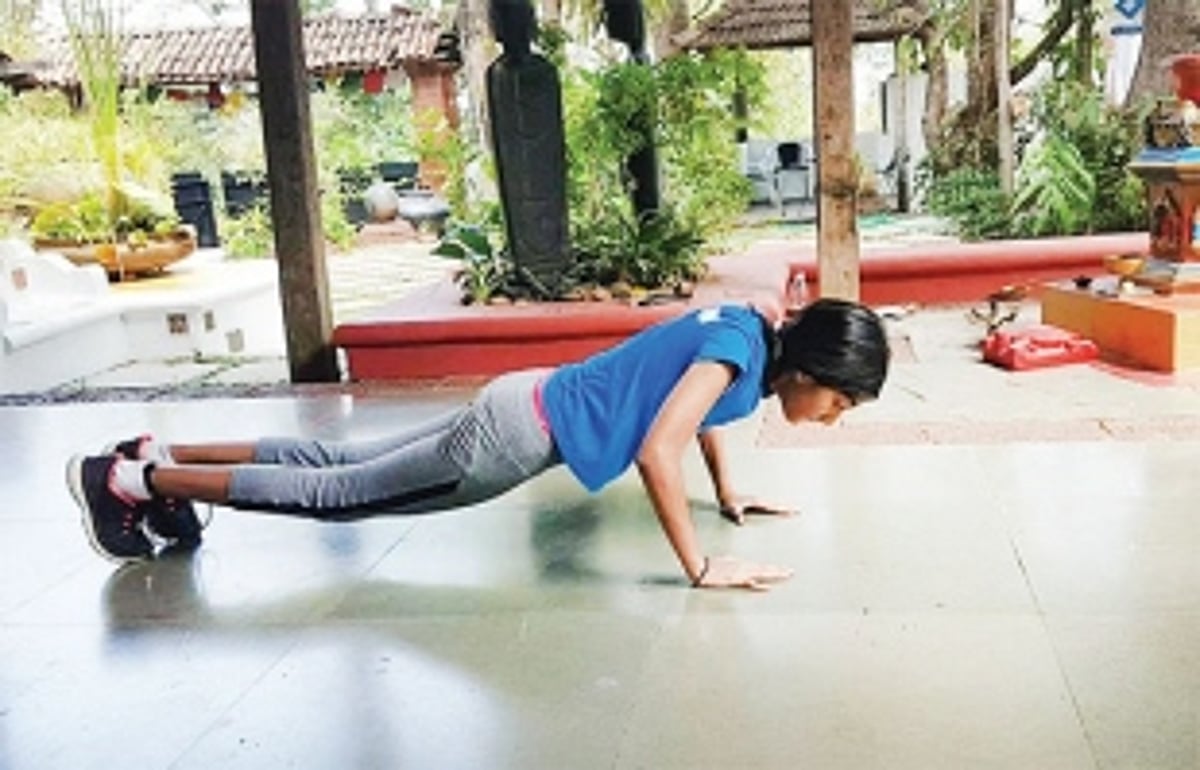
It’s been 20 days since lockdown and going by social media, it is evident that the universe’s exercise of making us go inwards or staying still indoors isn’t going as per plan. People, in general, seem to be working like hamsters, in an overdrive to make themselves productive – some post pictures of exotic dishes, others are taking an online course in learning to play the guitar while most are taking on weird unchallenging challenges, including making a frothy Dalgona coffee or posting pictures of themselves in a sari. It’s like ‘life is normal’ in a dystopian world. But humans have vanquished pandemics in the past so we will get through this even if the timeline seems uncertain.
For certain though, is the fact that a sneeze is going to create a seismic wave of panic among humans within a short distance. Masks are definitely going to be the new fashion accessory and social distancing will have to be a cultivated habit for some – a fact that may make women happy, especially around over-familiar men. Santanu Borah, an artist-writer who admittedly lives a ‘self-contained life’ even before Covidtimes chuckles at this proposition, “It’s going to be even easier to avoid people now. Earlier there was no way to do that – you were caught and had to make polite conversation.”
Always count on women, to say it like it is and Asheen Laljee, a well-known wedding planner based in Panjim doesn’t disappoint. “I am dying to get to a salon, the first thing I want to do, once things ease up. It’s been crazy at home, dealing with the housework and coping with two men in the house – my husband who is progressively lazy and the teen son, who is regressively so.”
She blazes on, “I could kill the person who said 2020 is my year! It seems to be everyone’s year of disaster.” She is on point and speaks for the privileged lot, for whom the realisation of how dependent they are on outsourced conveniences has been a revelation.
There’s been another unplanned impact to this pestilence. Humans locked indoors have made a considerable impact on the environment, the world over. Within a few weeks, the skies have cleared up and birds and animals are rightfully and without fear, reclaiming their space. In India, people in states less beautiful and more toxic than Goa are for the first time breathing clean air. There is an assumption that this scenario will spur governments to focus on the environment, post the pandemic.
Puja Jawahar, an environment researcher scoffs at this proposition. “There is no space for environmental thought since the government’s priority will continue to be on the economy and now, even more so. This situation can be compared to the Beijing 2008 Olympics when the country was spruced up and made super clean for the event. Post that, it just slid back to the norm so let ‘s just enjoy the good impact right now,” she says pragmatically.
What is clear is that the power of the state with greater control and surveillance on citizens will be the new normal. Laurens Postma, a Dutch national living in Goa is alarmed at the likelihood of this phenomenon. “World over, governments are getting more control with dictatorial surveillance apps. Coronovirus is pushing us over the edge, institutionalising these systems and in the process, making us a more paranoid community.” He also adds, “This is a great time for Goa to focus on health tourism and not just rely on vanilla tourism. It is a time to spruce up health care systems and invest in it.”
If this is too grave a scenario to digest at this time, it is to be said that uncertainty also has a way of throwing caution to the wind. “If the world is at the brink, no better time to try and do all those crazy things I wanted to; my appetite for risk has definitely increased,” confides Puja. Through this lockdown period, her biggest learning was the fact that we outsource so much of our food supply. “I am definitely going to rear hens in my backyard. I can’t deal with eggs and chicken being banned and having to scour around for food,” she amusingly adds, banishing all righteous thoughts of going vegan.
Die-hard party people which includes most of Goa, are waiting to hit the pubs. Rohan Barbosa, who is rated among the top 10 mixologists in Goa is chilling his heels at home in Moira while his hands can’t wait to get back behind the bar. “Even once the lockdown is eased, people will be scared to come out for some time. We are going to lose this whole tourist season to the pandemic,” he muses. It is an especially tough time for this Instagram and Selfie seeking generation. Says Rohan, “I so want to get back to work, make cocktails and connect with friends”
One thing is clear, the medical call to wash hands will definitely make us all borderline OCD. While we may all think that this introspection time will have changed us significantly, the resulting impact on the world sadly isn’t going to be as radical, except for a mild increase in the kindness quotient. It is also definite that even if we escape the coronavirus, we won’t be able to escape the hit from a declining economy. Asheen agrees, “There’s no escaping it. Most of us will also be cutting down on discretionary spending.” That is a reasonable fear, given that the wedding industry has also taken a huge hit.
“This pandemic has only made humans understand what caged animals feel like,” suggests Tom Cherian, a filmmaker based in Nachinola. He jokes, “Namaste will be the global greeting for a long time”.