As the showers descend across Goa, the landscape acquires a carpet of varying shades of green. The monsoons awaken the festive spirit as locals ready to celebrate the season. June brings a host of feats and festivals like St Anthony, feasts of St Peter and Paul, and not to mention Sao Joao.
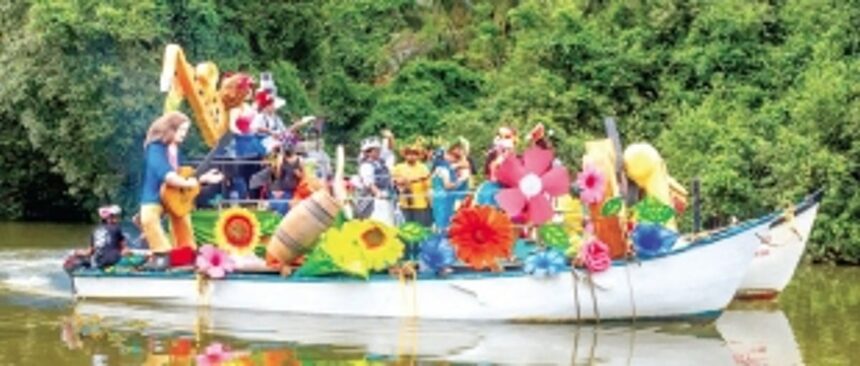
Celebrated on 24 June across Goa, festivities acquire a unique tradition in the picturesque village of Siolim. It attracts enormous interest from tourists and locals alike for the traditional boat parade. Local boats decked wind their way through the rivulet, local decked in kopels or flower crowns wait for the arrival, and there’s music and prizes to be won.
But the celebrations weren’t always this grand. Efforts by cartoonist Alexyz revived the tradition to what we know it today.
Almost three decades ago, Alexyz and his wife, recently married, made Siolim their home. “I had heard about the decorated boats that would stop at the big cross near the Church. They would come in with the tide and people would offer prayers. I went to take a look,” he recalls about those early days.
Back then, as custom, the boats made their way from the surrounding villages of Anjuna, Assagao to pay respects at the cross. After speaking to the locals, he learned that the tradition was almost at an end. Alexyz decided to do something about it.
Along with his friend, the two thought about a revival that would turn it into an event. “We went door-to-door and asked people in the villages to participate. We offered prizes for the best-decorated boat, kopel, and songs. In those days, the groups would sing a few religious hymns as well,” he explains.
Thus, Sao Joao grew to become one of Goa’s much-awaited days in the festival calendar. But, the boat parade isn’t the only attraction.
The center point of the day’s attraction is the jumping in the well by locals. It correlates to the Biblical reference of John the Baptist, jumping in the womb of his mother.
Tracing the folk culture behind the festival Dr. Pandurang Phaldesai in his book Goa: Folklore Studies, states, ‘Festivities commence at the St Anthony Church, near the bridge. Prayers are offered at the cross by the Sao Joao revelers from Waddi-Keri, followed by other groups arriving there in well-decorated twin-boats, locally known as sangodd.’
The teams come from neighboring Chapora and Zor in Anjuna, Badem in Assagao, and from Siolim. They carry a traditional basket of fruits and sweets locally called dali. Seasonal fruits are distributed by those gathered.
He further notes that local instruments like ghumot and kasalem create rhythmic festive beats.
Sao Joao celebrations continue in other parts of Goa like Cortalim. The day’s festivities start with a meeting on the banks of the river Zuari. A decorated boat with flowers, bamboos greets the faithful. After the prayer, it moves down to a point, and the occupants move around the village.
The festival holds a vital place for the newly married couples in the villages. It is also called the zanvoyam porob (feast of son-in-law).
In the words of the famous Goan musician and songwriter C Alvares, ‘Sao Joao-chem fest mhunnon ami mavoddea aileanv, Mateak him kopelam ghalun udok navonk bhair sorleanv,’