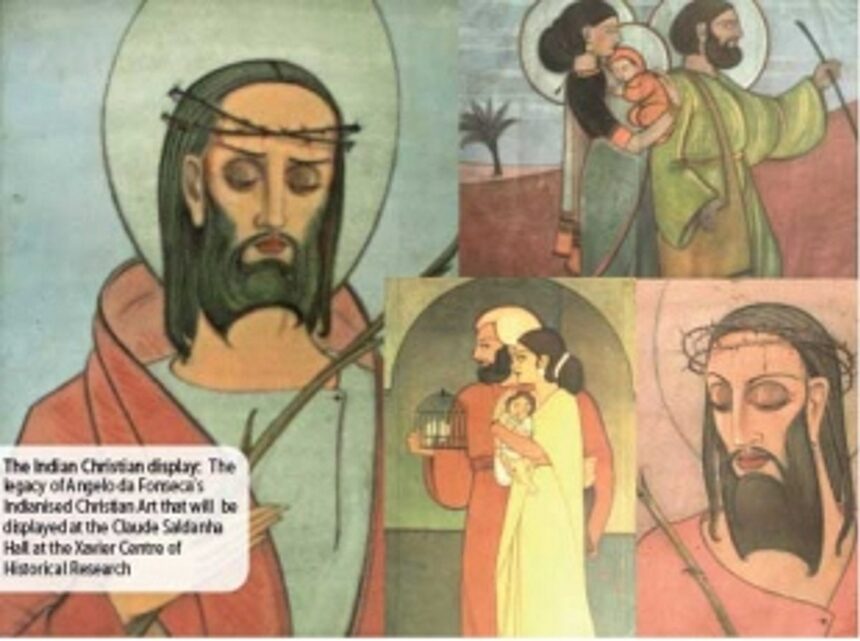
Although he pioneered the Christian cultural renaissance in India, Angelo da Fonseca’s art was to find very little acceptance in his own homeland – Goa. In a turnaround now, this modernist painter is hailed as one of India’s best, with his works showcased in private collections and galleries around the world, including the Vatican, Canada, London and Goa.
With donations from the Society of Jesus, Pune as
well as Fonseca’s wife Ivy, the Xavier Centre of Historical Research (XCHR), Porvorim has one of the largest collections (250) of this artist’s works. “Fonseca was closely associated with the Jesuits as he studied at various Jesuit institutions and his art flourished thanks in large part to the encouragement of the Jesuits, particularly Fr Heras and Fr Lederle who gave him several commissions abroad,“ explains Fr Savio Abreau, SJ. On its part, the Jesuit society, and XCHR in particular, have now been making concerted efforts to give Fonseca his due recognition. “Fonseca pioneered the Indianisation of Christian art, but he suffered a lot as his paintings were not accepted or given importance. His influences were shaped during his studies at Shanti Niketan which was then experiencing the first wave of modernism in art. In the 40s and 50s, Fonseca was way ahead of his time. He was the first to paint Mother Mary in a sari. In fact, the
‘inculturation’ of the Vatican came much later,” explains Fr
Abreau.
Over a period of three years since 2011, the XCHR,
which has been holding various exhibitions of the artist
– Christmas Story, Passion and Glory and Maiden, Muse
and Madonna, will now unveil an ‘Angelo da Fonseca
Retrospective’ of all three exhibitions. “Those who have
missed out on earlier exhibitions can catch up and it is also
an opportunity to showcase it to a wider audience during
the forthcoming exposition,” he adds.
Having curated all the exhibitions including the
forthcoming retrospective, art historian and artist, Savia
Viegas sheds more light on Fonseca’s works. “Fonseca was
a pioneer to make Christianity Indic. He worked primarily
with religious iconography. He painted Mother Mary in all
her manifestations, but from the Indian angle. He wanted
Christianity to reach Indic regions, so that after colonialism,
people would relate to Christianity as a religion,” observes
Savia. What proved to be Fonseca’s undoing were the
conformist Church and ruling Portuguese elite who refused
to accept Christian religious figures in this Indian avatar. “In
this exhibition of about 65 works, we have tried to show
how he has depicted Christianity and how he was trying to
reach out to his own people as a Christian,” she emphasises.
The true essence of Fonseca is indeed reflected in his
pioneering art.
(Angelo da Fonseca, Retrospective an exhibition of
selected works will be on display at the newly inaugurated
Claude Saldanha Hall at the Xavier Centre for Historical
Research in Porvorim from November 13, 2014 to January
12, 2015)