The
unrest growing across the world with the Black Lives Matter movement is in
response to police brutality against black people and was triggered by the
death of the 46 year old African American man George Floyd by police officer
Derek Chauvin in Minneapolis, Minnesota in May. The hash tag Black Lives Matter
has gone viral and the growing protests are rapidly gaining in international
attention and momentum. Alongside this, an image of the 15,000 strong crowd
that gathered at a rally for Black Trans lives in Brooklyn left me stunned. The
size and scale of these concurrent protests, and the fact that the latter was
held in the midst of the Corona pandemic and outside an art museum got me
thinking about how art really does provide a historical perspective by
documenting and recording these stories of dominance and control, violence and
autonomy.
In
the wake of India’s own inherent issues of casteism, racism and the
heartbreaking stories of migrants that we have seen and heard recently, there
are so many instances of oppression – cultural, social, political, economic and
accounts of just plain survival in the face of all these. The freedom to choose
how one wants to live, seems to be an unattainable ideal for a large part of
humanity. Visuals of some of these uncomfortable truths hit home harder and I
cannot help but reflect on Goa’s own history of slavery, which flourished as
recently as the 19th century, when brought face to face with some of
the images created by Goa’s contemporary artists.
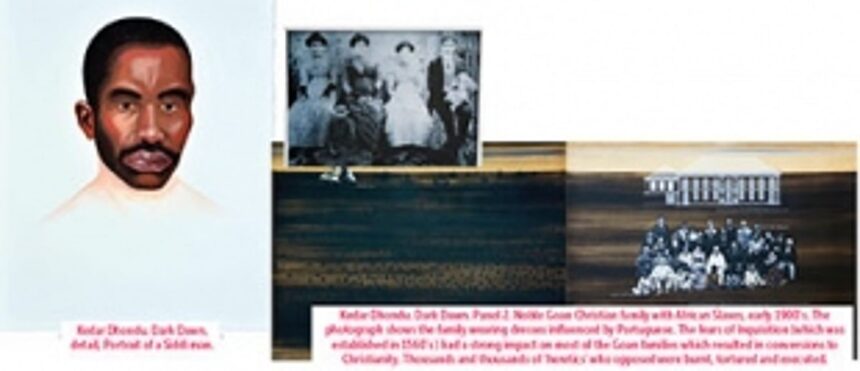
Noted
artist Kedar Dhondu traces the routes that brought slavery to Goa and what it signified
in terms of trade and commerce. He looks at the arrival of the Portuguese in
Goa in 1510 and how they soon began to bring in African slaves to do all their
manual work. Kedar’s artwork, ‘Dark Dawn’, exhibited in the show titled ‘The
Lay of the Land’, curated by Anushka Rajendran at Gallery Latitude 28, New
Delhi in 2015, is based on slavery and Christianity in Goa in the early 1560’s.
In
the huge diptych, with tea wash and gouache on paper, the artist includes
references to coffin ships (used for slave trade and in which hundreds of
slaves actually perished) and paints portraits of Siddis, the descendants of
African origin that relocated to Karnataka from Goa over the years.
Of
his work, Kedar writes, “The Portuguese began to keep imported Africans (called
as Kafris or Cafres) in their houses as slaves. The Slave Ships, which brought
these slaves, were nicknamed as navios tumbeiros (Coffin Ships). The journey of
the slaves inside the ships was hell. They had to spend days together in the
dark pit of the ship, urinating, excreting, sleeping and eating whatever crumbs
were thrown at them. Many of them died aboard the ships due to the unhygienic
conditions. There was active slave trade between Mozambique and Goa and the
Portuguese found it very profitable; there was constanttraffic of slaves
between Lisbon and Goa too till the 17th Century. On average every Portuguese
house owner in Goa had ten slaves. African slaves were used as domestic servants,
agricultural laborers or in other such occupations. The portraits depicted in this
work, Dark Dawn, are a systematic
survey of actual images of Siddis whose ancestors were slaves in Goa. They ran
away from Goa and settled in the Yellapur district in Karwar, out of sheer fear
of torture from the Portuguese. This black African Siddi community still speaks
Goa’s Konkani language.”
The
artist has included text alongside the images and one of the panels includes
this instruction, “Slaves, obey your earthly masters with fear and trembling,
in singleness of heart, as you obey Christ; not only when being watched, and in
order to please them, but as slaves of Christ, doing the will of God from the
heart. Render the services with enthusiasm, as to the Lord and not to men and
women, knowing that whatever good we do, we will receive the same again from
the Lord, whether we are slaves or free. And, masters, do the same to them.
Stop threatening them, for you know that both of you have the same master in heaven,
and with him there is no partiality (Ephesians 6:5 – 9).”
Referring to the terrifying Inquisition, Kedar
writes about how the ruling colonial regime also enslaved minds. “In Goa, the
Catholics are amongst the most pious Christians of the world. The Portuguese
forcibly converted many Goans into Christianity during their rule. The fears of
Inquisition resulted in conversions to Christianity; some of the new Christians
lived freely while the ones who refused and who performed hidden acts of Hindu prayers
and worship were burned, tortured and executed. The Inquisition was established
in the 1560’s and abolished in 1812. Among the families, which were converted
to Christianity, most of them, worked closely with the Portuguese. These newly
converted Goan Christians adopted the lifestyles of the Portuguese and were
given houses as rewards.
“In
Goa’s historic background, the Portuguese associated the ‘black image’ with
oppression, alienation, emasculation and abuse. The black skinned people of
Goan origin were also tortured and burnt in the flames of Inquisition. The shackled
slave body of the Africans, which were brought to Goa, were used to display the
supremacy of whites (Paakle: Portuguese white men were referred as ‘Paakle’
which means ‘white
skinned’,
the blacks are referred as Kafris or cafres or Khaapree : Black skinned
people).
Even in today’s time the words ‘Paaklo’ and Khaapri are used to discriminate
within
religion and caste. This supremacy is still being identified in most Goan
families.
“The
dark ocean in my work resembles the ‘dark’ body of a slave, the ‘blackened
bloods’ of the slaves, the ‘dark journey’ and the abhorrent acts of cruelty
(murder, torture, suicide, rapes, fear etc). The dark ocean brings out the
histories of the horrifying past of Goa on the shores of Goa, the waves, the water,
the watersplash, water drops, have a story to tell. My work brings out the
issues of sadism; brutality, sexual perversion, innocence, stoicism and the
metaphysics of hope.”
Kedar’s
Dark Ocean, a huge canvas of
overwhelming darkness, was exhibited at the Museum of Goa’s inaugural
exhibition some years ago. MOG was founded to showcase Goa’s multilayered
history through contemporary art, and founder artist Subodh Kerkar has also
worked on a number of artworks to focus attention on the rampant slave trade of
the time, a major revenue earner for the Portuguese and a means by which
prominent native families also profited. His sculpture titled ‘Chicken Cafreal’,
constructed from fiberglass and rubber tyres, references one of Goa’s most
popular dishes and its origins.”African slaves were also recruited in the
Portuguese army. In one such army camp the slaves cooked some chicken using
local spices and coriander. (Coriander came from Europe). The Portuguese
officer liked the chicken and named it ‘ChickenCafreal’. It was called Cafreal
because the black Negros were called ‘Kafirs’ by the Arabs. Chicken Cafreal has
become the most popular dish of Goa as well as Portugal.”
In
the same exhibition at MOG, academic and writer Savia Viegas presented her collection
of archival photographic prints in ‘Moments, Memory, Memorabilia’. The
presence of slaves in some of the prints as requisite symbols of landlord
wealth emphasises the truth telling nature of the photographic medium. Young
artist Sachin Naik also presented a critical comment on the inhuman practice of
slavery in a massive woodcut.
All
of these images and artworks tell a dark tale, one that nevertheless needs to
be told. These stories need to be uncovered and revealed, their horror unmasked
so that history doesn’t get a chance to repeat itself.