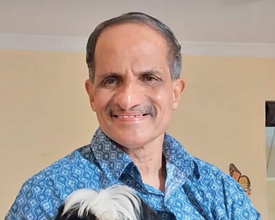
At 84, one would have thought that Mark Tullyji, synonymous with the BBC 25 years
after he ‘retired’ had walked into the sunset, soaking in real sunsets with his
friend, companion and partner Gillian Wright, sipping his beer and looking back
at a broadcasting career which made him the “voice of India”.
The truth is, that Padmabhushan Sir
Mark Tully can never sign off, his lilting voice, his ready smile and his
endearing but correct hindi, still warms the cockles of many hearts, especially
those who witnessed the drafts of history in India first prepared through
Tully’s broadcasts in the BBC.
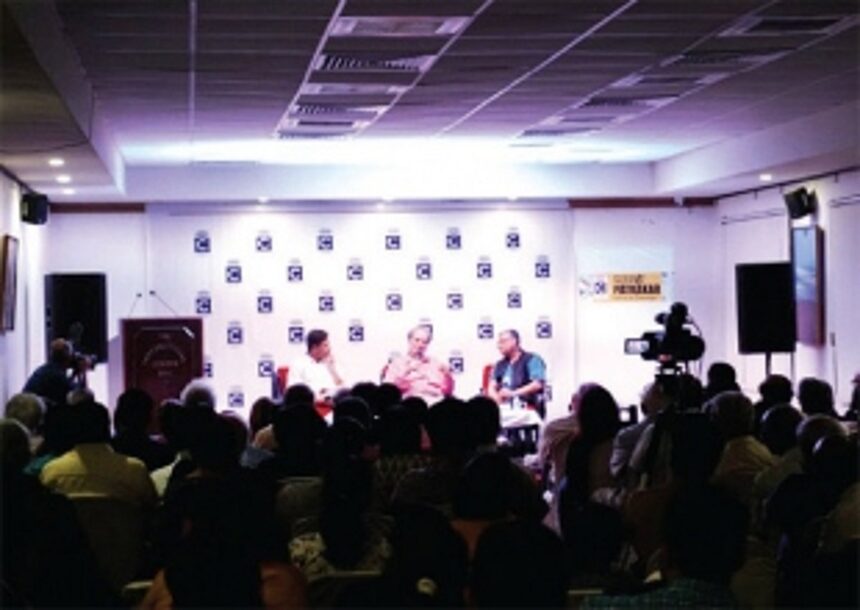
So when Dr Pushkar, the Director of
the International Centre Goa invited him for the ‘Patrakar’ programme, where
the work of a renowned journalists who has also written books, is discussed in
a q and A format, people living in Goa from all walks of life were thrilled and
the response was overwhelming.
Sujay Gupta, Consulting Editor
Herald along with Dr Pushkar took Tully down his own memory lane, reading and
quiting from his incisive reporate based stories from his books, Heart of
India, No Full Stops in India, India in Slow Motion etc
Sir Mark kept a jam packed hall
fully engrossed with his many anecdotes about India and his interesting
journalistic career.
Terming Prime minister Modi has an
“extraordinary publicist” Tully said, “Modi, quite like Indira Gandhi has his
good points and bad points. For starters, I would like him to speak up against
atrocities when they happen.” According to Tully, the BJP was deficient in
implementing administrative reforms and needed to correct this immediately. He
also criticised Modi for constantly distracting the people from the problems at
hand. “Modi expertly side-steps real issues by talking about some new tamasha,
thereby distracting the people,” Tully said.
Replying to a question from the
audience, Tully agreed that India had become far more intolerant in recent
years. Referring to the many incidents of lynching across the country, Tully
said, “We have certainly become a more violent society in recent times.”
One of the distinguishing features
of Tully’s journalism in India was that he travelled extensively across the
length and breadth of India’s vast rural hinterland and reported from there. “It
is in rural India, that you can see the government at its worst. The
fundamental problem is that of bad governance. There is an urgent need for
massive administrative reforms here,” Tully said.
Citing examples, Tully bemoaned the
fact that genuinely poor people were not getting the ‘below the poverty line’
(BPL) cards and that the Swach Bharat programme was a sham in many parts of
rural northern India. “In a village of Haryana for instance, the implementation
of the toilet programme was only on paper. In a bid to tick off the compliance
box, the government had placed a set of dilapidated and unclean toilets a short
distance away from the circuit house,” Tully said.
Tully was critical of Indian
bureaucrats stating that they were simply carry forward the legacy of the Raj.
“Most bureaucrats seem to think that they are some kind of rulers, when
actually they need to be the servants of the people,” Tully said.
However, all was not lost in rural
India according to the veteran journalist. He pointed out the good work of some
NGOs in both Rajasthan and Gujarat, who according to him had done some
excellent work in the field of water conservation.
Speaking about the Indian media,
Tully expressed his disappointment at what he called the ‘commercialisation’ of
Indian television ownership. “Sadly, the owners of these TV channels are
dictating news policy keeping their own vested interests in mind,” Tully said.
He also felt that the national print media was too soft on the Kashmir issue.
“More media criticism was certainly needed in response to the Kashmir issue.
The national press has to be the watchdog and needs to criticise the government
when necessary,” Tully opined.
Admitting
that it was India’s ability to be a pluralistic society that appealed to him
the most, he felt that the Congress party had lost the plot many years ago,
when they called themselves a secular party. The veteran journalist said that
the word secularism had anti-religious connotations to it. According to him
this approach began to hurt the Congress as India with its Hindu majority
population was never indifferent to religion. “BJP capitalised on this point
when they declared themselves the representatives of the Hindu majority and
unleashed their brand of Hindutva on the country,” Tully said.