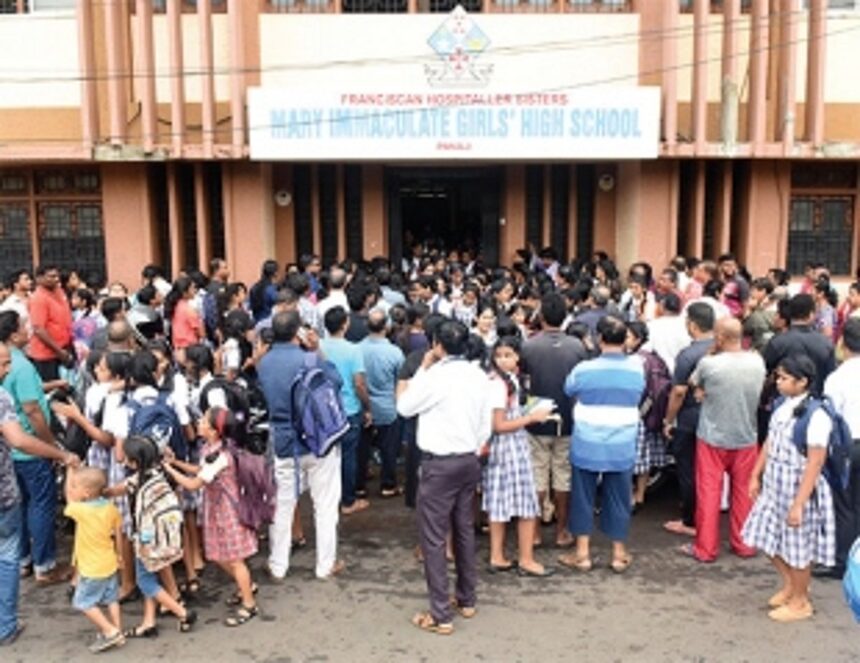
Earlier in the month, the state was shocked when four school
children out on a school sojourn drowned in a waterlogged stone quarry in Tuem.
The victims were later identified as Danesh Shaikh (14) and Frederick Fernandes
(15) from Mumbai, and Jonas Mendes (14) and Prince Dias (15) from Goa. After an
operation lasting several hours, the bodies were salvaged. It is heartbreaking
no doubt, but could it have been avoided if zero tolerance to children’s safety
was followed? (SEE BOX)
The views of members of staff from various schools in the state
were collated to ascertain the general modalities followed by them to ensure
the wards under their care were safe:

The students are under the constant supervision of the teachers
when they are in school. The teacher in the class will leave only when the next
teacher has entered the class. The students are like our children. We keep the
student back in school if no one we recognise comes to pick them up. We are
very strict when it comes to the safety and security of our students. If a
visit to a spot is planned, then one of the teachers will go and conduct a
recce to check if it is safe. We check if there are toilets and other
facilities. We do not make any concessions; the safety of our students comes
first.
Cynthia D’Souza, Promoter, Divine Mercy School, Mapusa
The directorate has given us several guidelines. Before we go
out of the school for a picnic or any journey with the students, we have to
inform the police, the local hospital, etc so that they are aware and can be
prepared for any emergency. We have to take the permission of the parents,
provide them with all the details of the spot, the facilities available as well
as get their contact details in case of an emergency. What happened in Tuem was
unfortunate. They should have been more vigilant. All the guidelines are in
place, the question is whether everyone following them.
Preeti Mhalsekar, Primary Teacher, St Marys Primary School,
Mapusa
We have toddlers, primary, junior kindergarten and senior
kindergarten class in school starting from children who are one and a half
years old. We follow the Canadian syllabus and according to the unit, we visit
a place that has to be explained to a child. This time, my unit required a
visit to a plant nursery. We don’t take parents along with us as the children
start crying, looking at their parents. On their own they are more smart and
independent. I handle a class of nine junior kindergarten students and we take
a maid along with us. We take the signatures of all the parents before taking
them out. Since the group is small our attention is completely focused on the
children. We have two field outings and one picnic in the annual year.
Karen D’Mello, JKG teacher, Maple Bear Canadian
Pre-School, Dona Paula
We usually have a picnic for the students in December and we
take the full school from class 5 to 10 for the outing on the same day. We are
a total of 17 teachers out of which one teacher is asked to stay back at
school. The students are taken to a Kulagarh (farm) in Sattari taluka itself.
We scout for places that are safe for the group of students. From my
experience, the students that study in village schools are more obedient on
field trips or outside the school. They don’t carry mobile phones to click
photos and actually enjoy their time out of school.
Shweta Chari, teacher, Government High School, Morlem,
Sattari
I am also a lecturer for NSS and as we plan our cleanliness
drive or field trips, we also inform the police about it and involve the local
people to accompany us. Within an annual year, we have three visits to
different venues. Last year we visited Pali waterfall, Sarvane waterfall and
Brahmakumari waterfall in Valpoi, Sattari. These visits are usually organised
post monsoons on different Sundays. We take two classes at a time and the
students are accompanied by a female and male teacher. The teachers know their
students very well and it is important to keep track of them.
Namrata Mopkar, lecturer, St Xavier’s Higher Secondary
School, Mapusa
Don Bosco College, Panjim has different initiatives throughout
the year. We collaborate with other organisers especially for awareness
programs or cleanliness drives. Students have to organise group projects for
small events. In an annual academic year, we have four events outside the
campus with approximately 60-100 students with 20 students for one teacher.
There is also a team leader for the group of 20 to keep them together. Many
faculty members volunteer to guide the students. Safety is our priority and
taking them out of campus gives us a different perspective of the students.
Glenda
Mascarenhas, Don Bosco College’s Ecotiva club in-charge
These are unfortunate situations. Nobody can be blamed. The
blame cannot be laid at the door of the teachers. The students may not listen
when the waters are very tempting. Excursions are also required. Field trips,
adventure trips cannot be done away with. They are a part of practical studies.
The solution lies in educating the dangers involved and practical tips to deal
with emergent situations.
Cleofato
Almeida Coutinho,
advocate
A snapshot of the state government guidelines
All the schools in
the state of Goa are under the jurisdiction of Directorate of Education.
a) Boundary wall or double fencing with plantation, with
provision of a gate which can be located.
b) The schools need to check the background of the drivers and helpers
engaged in the school buses/vehicles therein, which should be categorically
verified by the local police. School managements may also be encouraged to hire
women helpers on the vehicles, as an additional safety feature for girls.
c)
Whenever schools organise excursions and trips, for any reason whatsoever, the
onus of safety and security of the children is totally upon the school
authorities. The transportation used must be verified, for road worthiness and
the driver, for antecedents and experience. Sufficient number of male and
female teachers must be deployed, so that boys and girls are adequately
supervised. Arrangements for board and lodging should be made, keeping in view
the security and safety of the children.