68years ago, in his electrifying public debut with the essay
Nirvana of a Maggot – it was published by Stephen Spender in Encounter –
Francis Newton Souza described his feelings after a summer in Saligao: “I
patted the earth and thanked heaven that there was at least a small plot of
land left on this planet which has not been poisoned by our ghastly
civilization, if it can be called that, with its mechanised fangs that were
simply and surely sucking the life out of us.”
Obviously, that lull did not last, but
there’s something else Souza wrote in 1955 that remains entirely apt, which is
his acute summary of artistic motivations for painters like him with something
to communicate: “I want to say something, to make just a sound, even a guttural
sound or a grunt, an onomatopoeic sound emitted with a clearance of the throat.
What I’d want to do is to suspend my vocal ‘cords’ on the nib of my pen like a
mouthful of food at the end of a fork; to throw my voice like a
ventriloquist’s, but over a page; to emit sounds with gummed backs like postage
stamps which stick firmly on paper; to make the split point of my pen the
sensitive needing of a seismograph, as I can easily do when I draw.”
Those lines have come to my mind many
times in viewing and experiencing the spontaneous, and often deeply moving
responses by many artists and writers of Goa to the shocking betrayal of
“Mother Mhadei” by the state government, which has meekly acquiesced to
destroying our ancient riparian ecology by diverting billions of cubic feet of
water, in yet another “match-fixing” for the BJP’s selfish political gains. It
is an inherently desperate situation, as the state runs roughshod over public
sentiment, and citizens left effectively voiceless.
It was in that atmosphere of collective
helplessness that I first encountered Miriam Koshy’s heartfelt मãi : Mhadei’che Rakhondar in the
unexpectedly thought-provoking Poetry in Colour group exhibition last month at
the gorgeous Instituto Camões premises on the Mandovi waterfront.
In her accompanying note, the artist
explains that “my art dwells on the interconnectedness of all beings in nature,
human and more than human. It is an excavation and examination of layers, a
deeper understanding of self and one’s environment. It is through the process
that reconciliation, catharsis, and a spiritual, psychological, energetic shift
happens. I strongly believe in the power of public art, taking art from less
accessible spaces like galleries and museums with the intention of holding
space to process ecological grief and evoke awareness and meaningful responses
to climate change and environmental issues.”
Powerful sentiments, but can mere art make any difference when
opposed by armies of bulldozers and the unbridled might of the state? Here in
Goa, the answer is yes, and we already have the example of #MyMollem, the
brilliantly innovative campaign that has – so far quite successfully – fought
the most pernicious oligarchic interests and their destructive plans to carve
through the Bhagwan Mahaveer Wildlife Sanctuary and Mollem National Park with
three patently unnecessary giant projects.
This highly inspirational millennial-led movement’s leader, Dr
Nandini Velho once explained to me that “the business and politics of nature
conservation should no longer just be in courts, and conducted by environmental
groups and scientists. These art-science or nature-culture dichotomies belong
to a different era. Art creates a bridge that is understandable, relatable and has
longer staying power. It conveys stillness and sense of place. The art for
forests under threat including Mollem, Dehing-Patkai in Assam, Etalin in
Arunachal Pradesh, and Vedanthangal in Tamil Nadu are some of the best forms of
activism I have seen, and it makes me super hopeful.”
It is in this context that Koshy’s fragile, lovely guardian
spirits – which is what “rakhondar” means in Konkani – are best understood, as
another iteration of her complex environmental installations that first gained
national recognition with Mangrave: (En)circling the Loss, an anguished group
artwork – attribution is to “the Earthivist Collective” – in the ruined khazan
lands of Merces, of which an unforgettable drone image later appeared on the
cover of Outlook magazine in June 2022.
Mangrave’s spine was a spiral installation of prayer flags made
of gauze, that visitors had to wade out to visit in an apocalyptic dead zone of
ruined mangroves. Koshy says that site, and the myriad associated activities
that brought hundreds of people into the mangroves, were “an invitation to
pause, witness, experience, engage and add to the much-needed collective
healing in the face of the constant onslaught of ecological grief we face with
each passing day.”
These is such a lovely aspiration, and I was struck by how
substantially it has been achieved in my second viewing of Koshy’s rakhondars,
in the soft evening light (see picture) at the lovely Fundação Oriente premises
in Fontainhas, during this week’s World Heritage Day commemorations in collaboration
with the Goa Heritage Action Group (of which both Koshy and I are members).
There
was lots of emotion in the audience, as we listened to an urgent presentation
by the senior engineer Sandeep Nadkarni, and poems by Salil Chaturvedi (see
attached box) and Rochelle D’Silva (accompanied by Ben Ferrao). Meanwhile, in
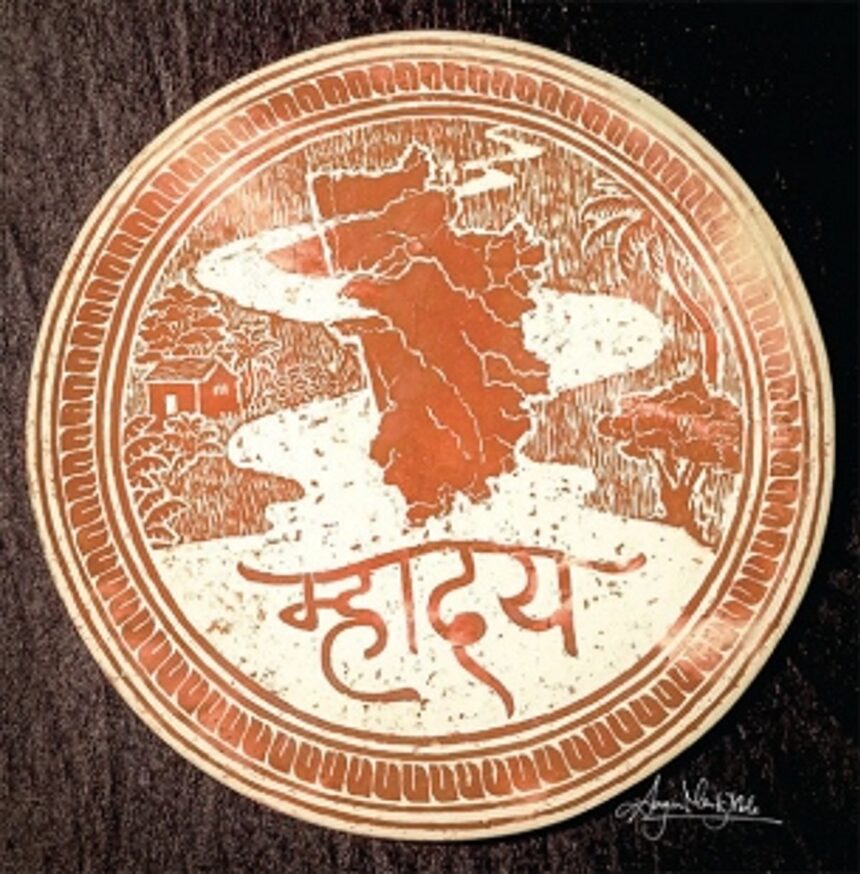
one corner of the room, Sagar Naik Mule worked on the lovely contemporary Kaavi
artwork that you also see alongside this column, and when I asked him to
explain what was on his mind, he told me this: “Our Goa is full of greenery and
it depends on the Mhadei as well as other rivers, due to which we are having a
good life and healthy atmosphere. So I have shown the water flow of our most
important river, and in the centre there is our land, which is totally reliant
on it. Sadly, because of dirty politics and their corrupt minds, our leaders
forget the importance of it, and they are playing dirty games which will harm
nature. This is my prayer for better wisdom to prevail.”