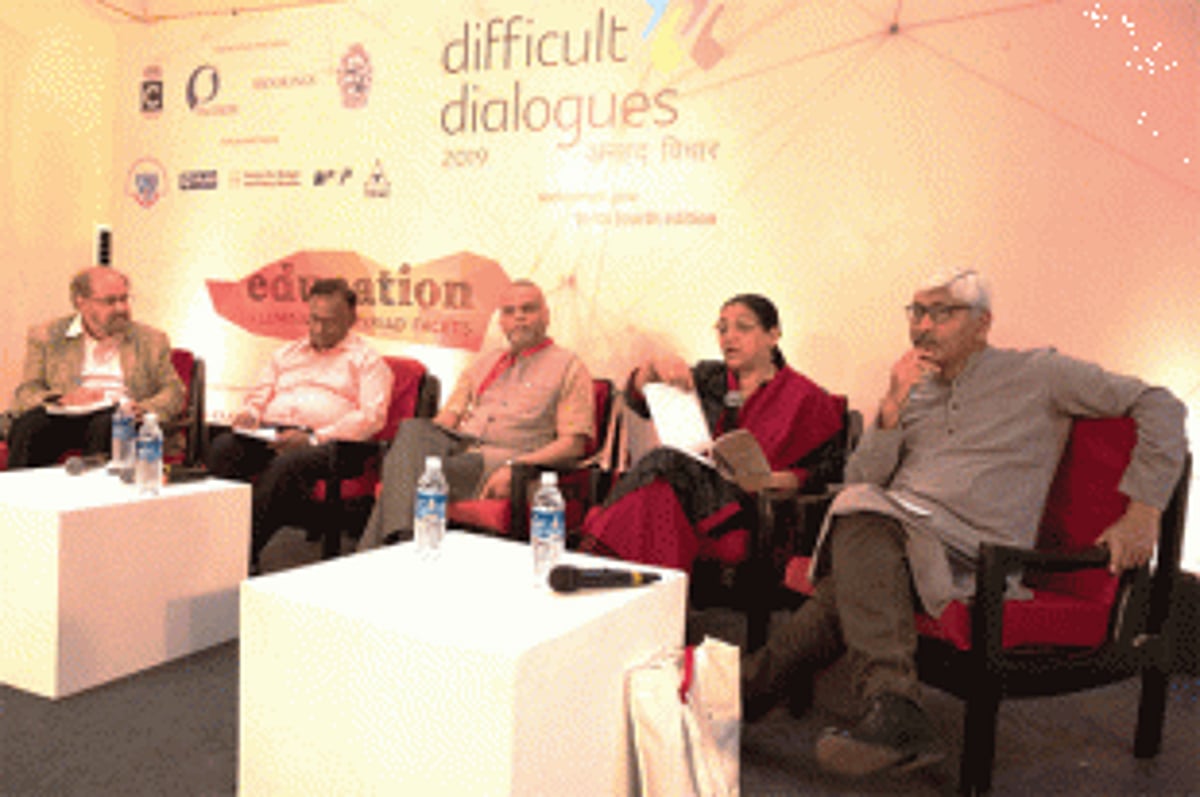
The
fourth annual edition of Difficult Dialogues hosted
a series of discussions on education and the myriad
challenges in improving quality standards across
our vast country. International experts from leading
educational institutions in India and the UK including
Oxford, development experts and politicians spoke
on panels over three days, at the International Centre
Goa (ICG) from January 31 to February 2.
Some
of the challenge areas addressed in the discussions
include a sweeping lack of funding, weak political
will to prioritise education from successive governments,
a severely overburdened curriculum, disparate
priorities in developing curriculum including political
pressures, producing graduates that are not employment-ready,
threats to academic freedom under
the current administration, inculcating values
and
life skills along with education, the lack of autonomy
of educational institutions, and bureaucratic powerlessness
Some
of the key speakers and participants were additional
solicitor general PinkyAnand, AAP member Atishi
Marlena, Congress MP Renuka Chowdhury, journalist
BarkhaDutt, actor PoojaBedi, former cabinet minister
Arif Mohammed Khan, Vice Chancellor of Goa University VarunSahni, YaminiAiyar (Centre for Policy Research),
Yasmin Ali Haque (UNICEF), Ashok Misra (Former
Director – IIT Bombay), Srinivasan Vadivel (NCERT),
ApoorvanandJha (University of Delhi), Deepa Narayan
(former World Bank advisor), David Mills (Oxford
University), RashmiMisra (Vidya), Poonam Mehta
(PLAN India), Victoria MukerjiChowgule (Dempo
College) and ArathiSriprakash (University of Cambridge).
Regarding
the lack of financing for education,Dr.Sukanya Bose, Faculty at the National
Institute of Public Finance and Policy, New Delhi, said there is no financial
roadmap in place for financing education which would lead to what was laid out
in the Right to Education act of 2009. There are around 146 million children in
the public education system and 15 million outside the system, which is the
government’s responsibility
to bring them back. So there is a need to spend 1.5% more of the GDP.
Dr.
Yasmin Ali Haque, the UNICEF Representative in India, said “Only two per cent
of the education budget is spent on teacher training so we’re not spending on the
human resources for this sector. Government funding is being supplemented by
CSR or grant funding.”
The panel on ‘Curriculum and Pedagogy’
underlined the need to “create curriculum material in local languages, resist politicisation
of textbooks and the involvement of specialist institutions to develop such books.”
The
macro environment for academia posed concerns around reprimanding public university
professors for expressing their anti- stablishment views. Speaking on the panel
‘New Threats to Academic Freedom’, Hindi Professor ApoorvanandJha of Delhi
University cited many examples of professors including AnandTeltumbde from Goa Institute
of Management, who have been arrested, hauled up or suspended for minor reasons
that have been branded as anti-national or anti-army. “This culture is new… the
majoritarian, Hindutva view. The branding of professors NiveditaMenon and RomilaThapar
(is serving to) dumb down universities. The threat is this party BJP and its
parent RSS which has been rallying against academics. What’s new is this organized
attack on intellectuals.”The panel suggested starting critical
thinking and freedom of expression modules in schools itself, the erecting of
memorials to free speech on campuses and encouraging
the media to celebrate academics brave enough to raise their independent
voices.
At
a panel about Elementary Education, AamAadmi Party (AAP) memberAtishi Marlena
said “What has really changed is that there is political will, where the
government in power cares about private schools. Someone should research the
links between politicians and private schools. Arvinder Singh Lovely is a
politician who owns a private school. If the people in power have incentives in
private education, then why would they improve public education?”
A
multi-city college debate competition called Daring Debates, moderated by actor
PoojaBedi, on the topic, ‘Is the Indian curriculum and its teaching methods
redundant?’ was won by students Anmol Kang from Manipal Institute of Medical
Sciences in Gangtok, Sikkim, and P. Lokeshwari from Pondicherry Institute of
Medical Sciences.
All
the conference rooms of ICG were filled with academic experts, teachers, Goa
University students, activists and people working at the community level with
government and non-governmental organisations. Actionable policy papers will be
produced from the intellectual discussions of the conference by Brookings
India, a non-profit policy research institution.