In the COP26 2021 United Nations Climate Change Conference held in Glasgow, Scotland, United Kingdom countries debated on the need to cut down emission of greenhouse gases. Establishment of Glasgow Financial Alliance for Net Zero of US dollar 130 trillion of private capital was announced to accelerate transition into net-zero economy and deal with climate change.
However, achieving the zero emission target is a cumbersome, lengthy and expensive process. While the world works towards reducing its carbon footprint through various means like using clean energy, the Council of Scientific and Industrial Research (CSIR) laboratory NIO, Goa has proposed a simpler Geo-engineering method of iron fertilisation to reduce carbon dioxide in the atmosphere.
“We came to this conclusion while conducting a study on lack of productivity in the ocean. Macronutrients like nitrates, phosphates and silicates are required for ocean productivity. It was observed that 30-40 percent of the southern ocean near Antarctica and even Arabian Sea, despite having enough macronutrients was not productive enough. Photosynthesis should have been taking place and marine life should have been flourishing. But this was not happening. The researchers came to the conclusion that it was happening due to lack of iron,” Director of CSIR-NIO, Sunil Kumar Singh told Herald.
For photosynthesis, the presence of iron is a must. If it is not there, then photosynthesis won’t take place, thus ocean productivity won’t happen. But measuring the presence of micronutrients, such as Fe was a very difficult task.
During photosynthesis, plants take in carbon dioxide (CO2) and water (H2O) from the air and soil. This transforms the water into oxygen and the carbon dioxide into glucose. The plant then releases the oxygen back into the air, and stores energy within the glucose molecules.
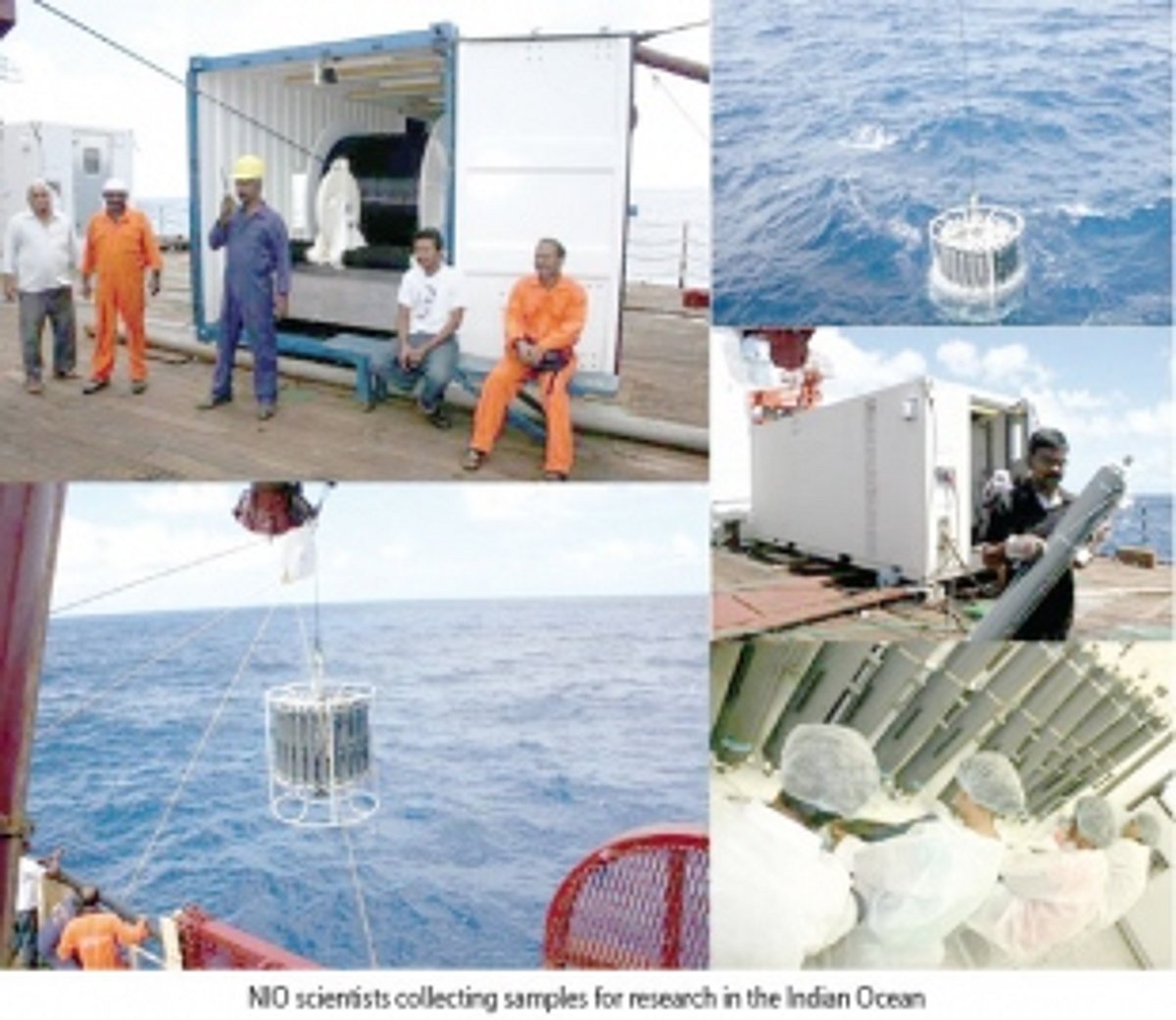
But there wasn’t much information about the exact presence of micronutrients. Then a programme was started called GEOTRACES to work on the measurements of micronutrients in the global ocean. The Pacific and Atlantic oceans were being analyzed by western world. The Physical Research Laboratory, National Institute of Oceanography and a few other labs started work on the Indian Ocean with the help of the Ministry of Earth Sciences.
“I was leading the programme during my tenure at the Physical Research Laboratory. I continued with this research after joining NIO. We started this work on a significant part of the Indian Ocean. We found that in the southern and north west Arabian Sea (near the Persian Gulf), iron concentration was very low. This was partly happening because the water from the southern ocean was bringing less iron into the Arabian Sea,” NIO Director said.
“There are iron deficient areas in the ocean, due to which marine productivity is less. By artificial iron seeding, the productivity can increase as it will enhance the photosynthesis process in which plants draw atmospheric carbon dioxide. Simultaneously, it will remove CO2 from the atmosphere and tackle the problem of global warming. ” he said.
Either you can put desert dust in the water or iron waste or iron powder under this process. All the nutrients are in the water. Once you put iron in the water, productivity will increase and atmospheric CO2 will be converted into organic matter through photosynthesis. Such experiments have been already tried earlier and are ongoing in some part of the ocean. We want to implement this strategy in the iron-deficient region of the Arabian Sea,” Singh said.
There is a flip side to this though. Environment NGOs like Greenpeace are contesting this method as according to them this will increase marine pollution. Also, if there is too much productivity then it can lead to exhaustion of oxygen in the ocean.
“This can be controlled by checking the impact on marine ecology through conducting pilot study in some portion of the sea and then deciding on the proportion of iron that is needed to be put in the water to serve the purpose without harming marine life,” the NIO director said.