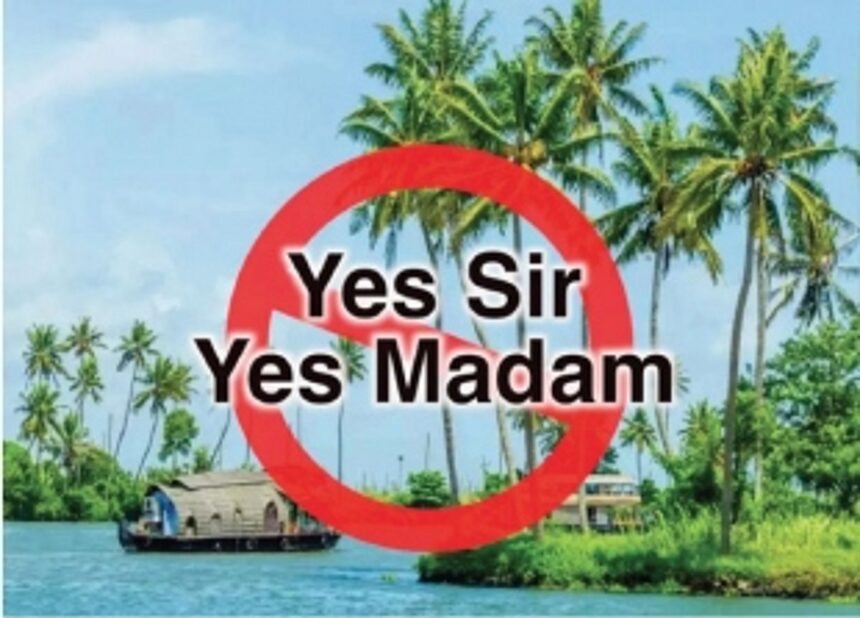
Late last week residents of Angamaly and Paravur in Ernakulam district which is located in Kerala decided to ban the use of salutations like “Sir” and “Madam.” This move comes after the Mathur grama panchayat in Palakkad district became the first local body in the country to ban such salutations after the panchayat council termed it as “remnants of the colonial rule”.
People reaching Angamaly and Paravur block panchayats will no longer have to call officials or elected representatives ‘Sir’ or ‘Madam’. Visitors can call them by their designation or names. Trust the Malayali’s to do something like this. Thinking outside the box and moving on in life. Now what if something like this happened in Goa. Would the average Goan be open to initiating a similar move? Or will they prefer to focus on more “serious” matters.
Dr Annie Gomes, an educationist said the argument to justify this move to remove the salutation is insensitive” as remnants of colonial rule”. She said “In Goa, people have a broader outlook and use English as a medium of instruction. Goa has a fusion of languages, cultures, food and blended well as Goan in such a way that question of remnant does not arise. So I feel it should not be followed in Goa”.
Zainab Quadri, a young Goan smiled when she was asked for her reaction and whether this move should be initiated in the state. She said “According to me, I feel salutations such as Sir and Madam are used as an expression of respect. Yes, we do use this to address people held in high regard or those that hold an important position, and it’s not wrong to give somebody the respect they deserve. The usage of these also determine a sense of morality hence they shouldn’t be banned. I think in Goa we always follow the motto “Mog Asun” or living in harmony and one way towards achieving this is to give and take respect”. She went on to say that since the origin of these words was from colonial times they instilled an important emotion of high regard within people. As Goans she felt it was important to continue being morally zealous.
Beverley Mendes, a marketing and strategy consultant, laughed and asked if Goa could first ban plastic, the use of firecrackers and then worry how everyone could greet officials in administration.
Aditi Shanbhag, a marketing professional felt words like Sir and madam denoted respect in the English language, just like there were titles in other languages. She said “English instead of being a remnant of colonial rule, in fact became a strength during the start of globalisation and the call centre revolution in India. Seems like a case of much ado about nothing”
Maria Victor felt it was a cultural preference and rather than enforcing, it could be encouraged to address everyone by their names.
Diksha Nanda Gawas agreed in her own way with the move in the offices in Kerala. She said “ In my perspective, Goa should ban saluting as sir and madam because as Kerala’s Mathur village Panchayat banned saying Sir and Madam in respect to their language, they started saying ‘Cheta’ (elder brother) and ‘Chechi’ (elder sister) in a friendly and endearing way. Goa was under Portuguese rule for so many years and has changed a lot. We should start saying ‘Saib’ (sir) or ‘Didi’ (elder sister) and Bhaiya (elder brother) in friendly but respectful terms in Konkani. But, if we are talking in English then we can use Sir and Madam”.
Gauravi Keni Khaunte however had a more nuanced answer. She said “ While banning salutations with the pretext of them being remnants of the colonial rule may seem like a path to escaping colonial influence, it is a dodgy decision to take. The question to be considered here is whether the salutations being banned altogether or are they being replaced with more Indian salutations? Creating a sense of hierarchy through salutations has always been the norm, so if the hierarchical structure remains despite of doing away with words like sir/madam I personally wouldn’t feel like the purpose is served, but the state can definitely give it a try:”
Conal Lobo laughed and said it was but natural the people of Kerala would initiate a move like. Goa however he felt would prefer to stick to notions of respect which had served them well in the past. Konrad Rodrigues felt it was a very good move and signified the end of slave culture.
Perhaps yes, it is a cultural thing, what seems right in one culture may seem odd or inappropriate in another. Perhaps this move may find more takers in other parts of Kerala or not. Who knows, time will tell.