Advocate Shriniwas Khalap spoke about the implications of CAA, NRC and NPR
issues organised in Assagao as part of ‘Thus’ event that encourages critical
thought. For the audience that was clued in to understanding laws that could
help them fight and protest against the Government’s proposed Citizens
Amendment Act and the National Population Register, Adv Khalap chose the
precautionary route. Advising those gathered to veer on the side of caution, he
said, “I believe that citizens should be aware of what this law entails and
keep their documents ready for any eventuality. I am not campaigning for or
against the proposed Act but I want to advise people to shield themselves with
the right documents. Get your birth certificate and that of any one of your
parents. Be prepared with these documents in one hand and with the other, if
you want to protest, do so but within the law.”
He went on to make a
shocking revelation that a detention centre was already inaugurated in Mapusa
and that the National Population Register (NPR) exercise was to commence from
April 1 to September 30, 2020. Sharing the implications this had on Goa in
particular, Adv Khalap went on to explain, “For Goa, it isn’t about illegal
Bangladeshis but about Nigerians who are living here illegally as also local
Goans who have opted for the Portuguese passport and who have an OCI status,
stand to be termed ‘illegal’. What happens to their right to property? What
happens to the local tribes or the marginalised lot? The basic foundation of
the country is questioned and our most fundamental rights are not permitted by
this law.”
On efforts that could
be made to put pressure on the Goa government to desist implementing this
CAA-NRC and NPR in Goa, he said, “If 10 states that include Kerala, West Bengal
and even the BJP-ruled state of Karnataka can take this step, we as the public
can collectively protest and pressurise the government to not be partisan.” Adv
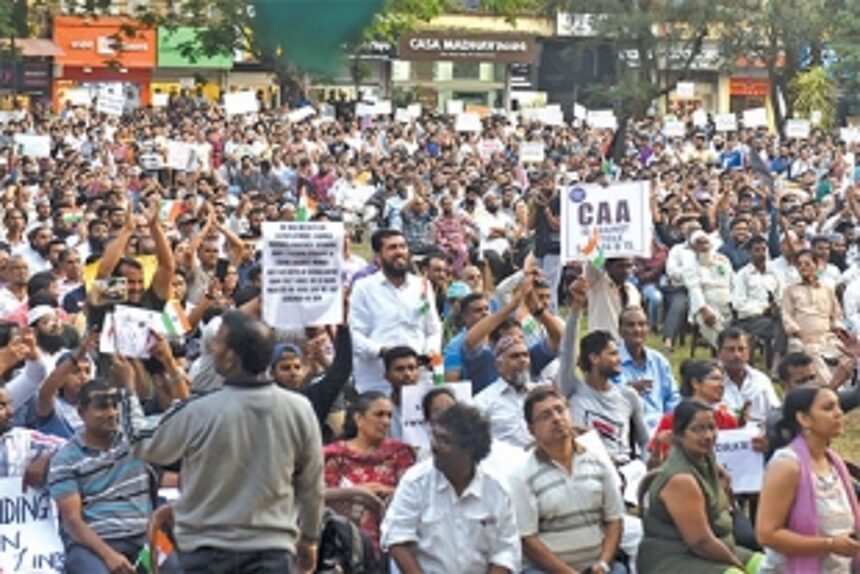
Khalap urged, “People have to come together to peacefully protest. The four
anti CAA protest rallies that were held at Azad Maidan were four times larger
than the single pro CAA rally organised by the government. While we protect
ourselves, we must continue the protests through our village panchayats in
keeping the pressure on.” He concedes, “With the pressure on, we can only hope
that the government will have to listen to the public.”
The arguments against CAA and NRC have
also moved from the typical Hindu-Muslim binary to incorporate concerns of
historically disadvantaged indigenous communities that are adversely affected.
Rama Kankonkar, a member of the GAKUVED Federation that works for the rights of
tribals in Goa, rightly questioned, “We, the tribal community, have existed on
this land for more than 7000 years. How can the government ask us proof of our
citizenship? The government cannot impose their ideas of Hinduism on us. We
have our own belief systems. Till today, we don’t have water or electricity
connections.” He adds, “So many of my family members were born at home and none
of us have birth certificates. To us, this government is worse than the British
or Portuguese. They alienate their own people and can actually come up with
laws to remove us from our own land.”
Rama perhaps has the best option when he says, “None of
us should comply and make any documents accessible.” This could well be the
civil disobedience movement of our times.
Advocate Cleofato Coutinho, columnist writer and social
activist, spoke last Sunday to a
gathering at MOG Sundays at the Museum of Goa. He mainly outlined the
following:
Our founding fathers gave us a country that encompassed all
faiths. India has not signed the UN convention on refugees nor does it have a
law or policy on refugees, but we welcomed the Tibetans, Kenyan and Ugandan
refugees of Indian origin, Tamil refugees from Sri Lanka, and in 1989, 3,000
Rohingyas.
Even though the idea of India and the foundational principle of
our Constitution is based on Sarva Dharma Sambhava—all religions are equal in
the eyes of law—the CAA wishes to confer citizenship on six communities (mainly
Hindus) and deny citizenship to South Asian Muslims. It seeks to protect those
who claim persecution without any proof of persecution; an affidavit, by the
one who claims persecution, suffices.
Protection based on religion will not pass the principles of our
Constitution nor of basic fraternity.
Importantly, in Goa, the issue of birth certificates issued
before 1961, and therefore not by the Indian government, may arise only with
regard to the NCR and NPR, because the documents being sort to determine the
same are not specified yet.
NCR was conducted only in Assam and a cut-off date of entering
the state was used to determine citizenship. If birth is used as a determining
factor, it would not affect the pre-1961 born in Goa, if their place of birth
is Goa. It could affect those whose place of birth was Africa or some other
colony of the Portuguese.
With
inputs from Nadia Menezes