Joana Alvares is a veteran teacher in a well known higher
secondary school in Vasco. During the period when Goa was in the green zone she
visited her close relatives home in Utroda. During her stay in Itroda, cases in
Mangor hill cropped up and she was advised to stay put. Recently she was
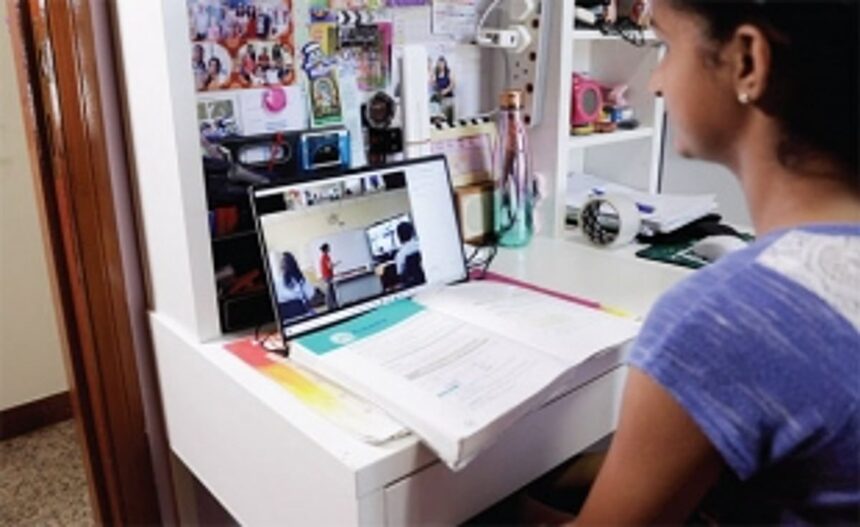
asked to report to her school and prepare online classes for students and send
them on WhatsApp.
She says “There is hardly any net connectivity in my school.
Sending messages on WhatsApp is not easy. And due to the situation, many
teachers are forced to prepare the lessons at home but this too is fraught with
challenges. Internet connections are not very stable in many of their homes in
the interiors and therefore simple research to prepare lessons is difficult.
Another teacher in a prominent girls college in Salcete, who
lives in one of the coastal villages laments “We understand our duty but it
should be realised that we, the teachers are also running a risk h travelling
to schools. She points to circular (D O letter to the Chief Secretary of the State)
of the Ministry of Human Resources and Development of India dated Jule 6
which states “ Essential teaching/ non- reaching staff or research scholars
should continue to work from home and as far as possible SHOULD NOT be called
to schools/ colleges/ institutions”
Vanessa Dias a teacher at Don Bosco higher secondary school said
it was a new experience for everyone. There were issues like connectivity but
everyone was in together to ensure that the task would be completed.
A clearer and nuanced response was given by Lynette Goes,
Headmistress of the Lower Primary school at Don Bosco who said it was a very
tough situation for everyone involved. Lynettte said “It is a problem for the
teachers because connectivity is poor. It is very upsetting. It is also very
stressful for the students. I have talked to parents and they are struggling
with the entire scenario. Some of the families have two kids and the classes
sometimes clash and it becomes a problem. It is an absolute mess”.
She said it would be better to go ahead with virtual learning
where videos would be forwarded to the students and notes could be sent too. It
is not possible to get all the students online at the same time because
connectivity she emphasised was so poor in the state. Asked how the teachers
were coping with the situation, she said it was stressful for them. She said “I
had a three-day training session and came face to face with things I had never
heard of. Now if the teacher is conducting a lecture online and a student’s
internet access is disrupted, can he or she ask the teacher to repeat it again,
no. The best is face to face interaction but that is not going to happen for a
while and we will have to learn to live it”.
Asked if the syllabus ought to be reworked because
of the strange situation she said if it happened it would certainly help
because as and when the students return to school, the teacher will run fast to
complete the syllabus. She felt content that was not important should be
removed and this would help everyone.
Tanuja Jaju Headmistress Littles Pre-Primary and Primary school
based in Fatorda said since the children were very young, they were using
videos and worksheets which were emailed to parents. They had also reduced the
syllabus by deciding to focus on grammar for example in English and reducing
the syllabus in literature. Mathematics, however, had not been touched.
The teachers, she said had been trained and were being helped by coordinators.
She admitted it was difficult for everyone involved be it the parents or the
teaching staff but it needed to be done.
This new situation has not enthused Sagar Govekar a parent with
three children studying at Mushtifund High school. He said “My eldest is in the
9th, the second in the 7th and the youngest in
standard 2. The school is sending videos for the children in the 9th and
the 7th standard. It seems like it is being done with half
interest. The children are not keen to learn. You give them a device at
that age, one does not know if it is being used for study or for play.
Sometimes there is a problem when both my children have an online class at the
same time. Then there is that issue of accessing the net. It is a difficult
experience. No one seems interested in sorting out this problem”.
He said online teaching was nothing new and was big in
other parts of the world but it was helped by systems that were in place. That
was not the case here. It was possible he said to have one host ie the teacher
connecting with up to 100 students at the same time. The technology was all
present. No one it seems he said was interested in sorting these problems when
solutions were available.
Another parent who had a son in the junior college felt the
syllabus had to be reduced if it had to be completed on time. Neha Khadpe said
apart from net connectivity, the power supply was also interrupted which made
for a very stressful time. It was not possible for everyone to afford the
gadgets required to study online and studying from home was not very conducive
as opposed to a school. The absence of one to one interaction was also not
present and she hoped the situation would improve and face to face interaction
would commence soon.
It is quite obvious online classrooms are here to stay but that
will require investments and also adjustments in one’s mindset to adjust to new
circumstances. It remains to be seen how this will pan out.