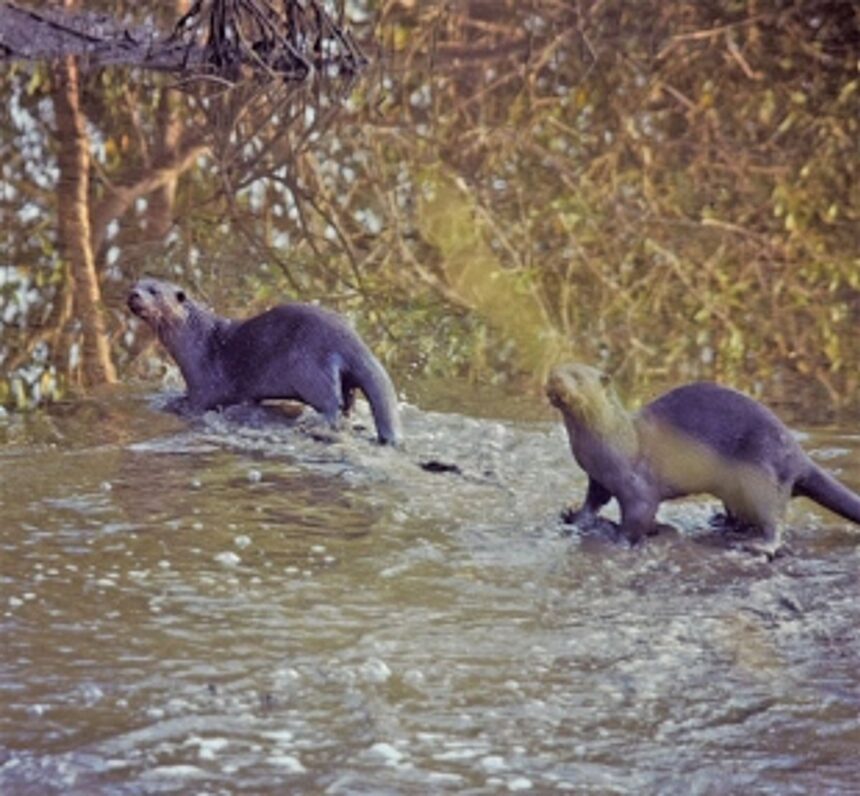
Katrina Fernandez and her team from Wild Otters who are keeping a close eye on these
wonderful creatures and their adaptation to the environment today.
Goa is one of the eight bio-diversity
hotspots on the planet. Most people seem to be unaware of this fact. There are
however, people who are constantly and tirelessly working on safeguarding Goa’s
ecology.
Among a wide range of people working
zealously towards the betterment and conservation of the environment, the Eco
Champion social media organisation of Goa showcases Katrina Fernandez, an
Ecologist and Director at Wild Otters Research Pvt Ltd studying the issues of Otters
in Goa.
Katrina was born and raised on a farm in
the Western Ghats that has now become a part of Bhimgad Wildlife Sanctuary. “I
grew up knowing nothing else, my lifestyle, my passion and my job is all one in
the same.” she says.
Katrina has been a part of huge otter
projects; she has worked on the Small-clawed otter in the Western Ghats, the
Hairy-nosed otter in Malaysia and Cape-clawless otters in Malawi. Apart from
these species, she generated her time working on hyenas, leopards, and servals.
All of these studies involved understanding population presence, habitat and
food preferences.
What is Wild Otters organisation? ‘Wild otters’ is a research
organisation working on Smooth-coated and Small-clawed otters in Goa and
Karnataka.
Katrina brief’s about the Wild Otter Organisation and its work,
“We try to fill in the gap in regards to data deficiencies (for both species)
as well as investigate behaviours and habitats of Smooth-coated otters in Human
dominated landscapes.”
Apart from this the organisation gives an opportunity for young
biologist to learn field work challenges, data collection methods, data
analysis and many other applications through their internship programs and
workshops. They provide customised programs and training’s specific to people’s
universities, schools, corporate, and wildlife departments’ needs in regards to
Wildlife research.
Expressing her thoughts on the environment today, Katrina
professes, “We live in the age of the anthropocene. I don’t think we realise
how much plastic dominates every aspect of our lives and in turn how it affects
so many other species around us. It is aesthetically displeasing and
unimaginable damaging.” Katrina spends her days in struggle daily trying to
understand what can be done to improve this situation.
There
was a specific purpose behind creating the research on Otters in Goa. According
to Wild Otters organisation, in Goa, Smooth-coated otters are living primarily
in human modified/dominated landscapes and most of the people unaware of this
fact. Otters are very elusive and will not be easily seen unless you know what
to look for, hence making it difficult for people to discover. Katrina assures
that is better to leave them unseen, so that there is no extra human pressure
on otter populations.