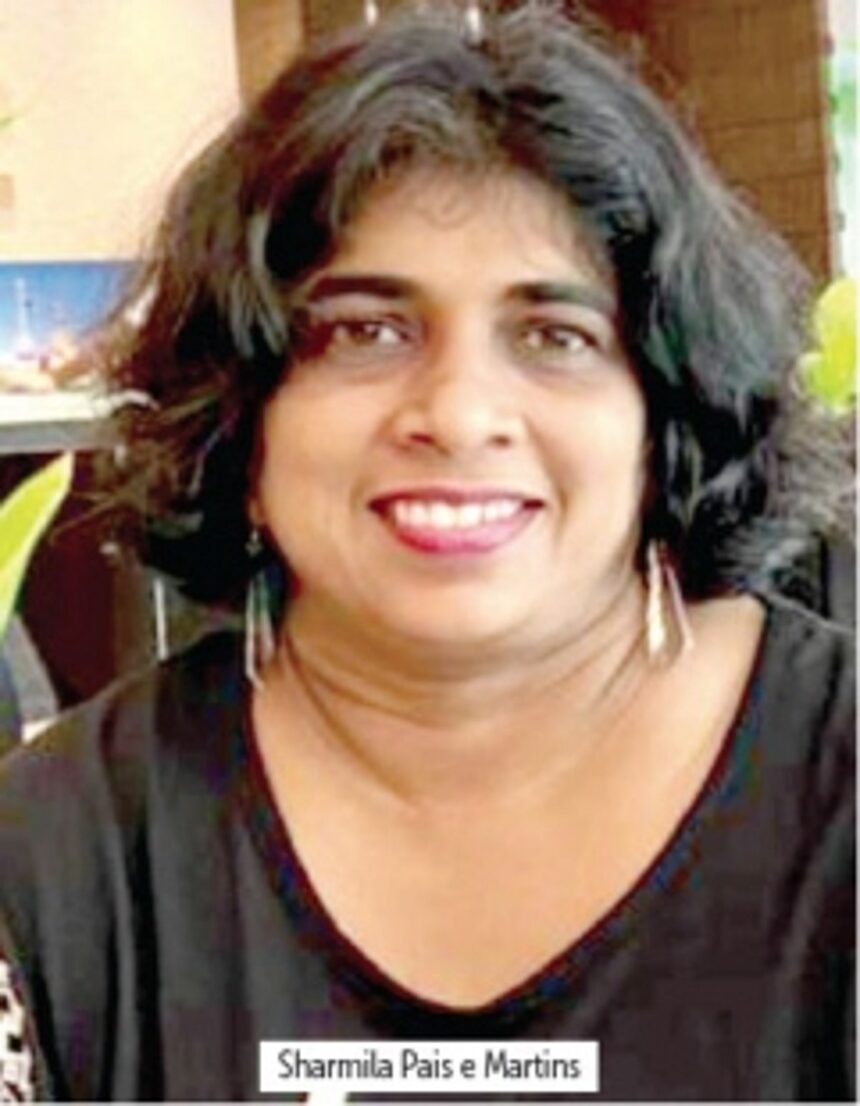
It is one of the most important aspects of democracy, meaning the conducting of elections. It has been held down the ages. Now a faculty in history at St Xavier’s College, Mapusa, Sharmila Pais e Martins, has written a book called The Encounter with the Ballot in Colonial Goa: A Historical and Analytical Study (1821-1961). The work is based on archival manuscripts and other secondary source material in Goa and Lisbon.
She said many people in Goa were not aware that elections and the system of representation existed in colonial Goa. The book explains the subject of elections at various levels: parliamentary, legislative assembly, municipal and parochial.
Asked what prompted her to write this book, she said her book had its foundation in the doctoral thesis she submitted in 2018. She said it was important to remember that a thesis was a more academic work that demanded a certain structure, unlike a book that may not require this benchmark. Having worked for a substantial period, she felt her findings had to be known to readers and Goans in particular. To gather all this information Sharmila said the journey was rather prolonged. She said “In historical research, data remains hidden in manuscripts, legislation, reform, contemporary periodicals, folklore and so on. In 2014, I began plowing through published sources in English and Portuguese in all public libraries of Goa. Archival research is even more challenging but is essential to enhance the quality of one’s work. Knowledge of Portuguese gives one the advantage that many researchers may not have. A month spent in Lisbon was extremely gratifying. I discovered manuscripts on poll records from 1836 onwards. It helped to understand who voted and contested elections in Portuguese India. Additionally, contemporary newspapers and periodicals in Goa and Portugal threw light on party politics, caste rivalry and the ground realities, which are often a stark contrast to the vision provided by the government”.
Asked how elections were conducted all those years ago, she said the rules of suffrage in Portuguese India, as in the rest of the Portuguese dominions, privileged a select body of qualified people to vote and contest elections in Goa. They were largely defined by patterns prevailing in other parts of Europe and depended on citizenship, domicile, taxes paid, literacy and prerogative of being the head of family. Methods of conducting elections varied at certain intervals. From 1822 to 1851, most of the parliamentary elections held in Goa were indirect. But after 1852, elections were conducted directly and remained so till 1961.
Speaking about the elections from those days, she said the nomination of local candidates to contest elections was generally done by active and influential citizens who had the right to vote. The party in power in Lisbon would also thrust its official candidates (candidatos do poder) into the electoral fray. With the establishment of local parties in Goa in the second half of the 19th century, loyalties became divided along party lines. During the republican era, a candidate seeking to contest polls had to be proposed by certain voters from his constituency.
Speaking about the election of the greatest Goan, Francisco Luis Gomes to the Portuguese parliament, she said Francisco Luis Gomes made his foray in the elections when more structured parties were formed in Portugal; the Regeneradores and Históricos. Gomes supported the Partido Regenerador and this alliance helped him to win elections in Goa, but it brought him in conflict with the Partido Histórico. He along with Bernardo Francisco da Costa boldly voiced the injustice rendered to Portuguese India, putting forth various proposals when the Históricos were in power. Additionally, she said Gomes was supported by metropolitan deputado, António Rodrigues de Sampaio, who was a supporter of the Regeneradores. Naturally, the opposition, Partido Histórico was gunning for his defeat and its agents in Goa waited for an opportunity to cause a setback. The cohesion exhibited by the local representatives for about four decades was an eyesore to their opponents in Portugal and Goa. This was evident in 1861 when Goan voters elected Francisco Luis Gomes against the official nominee (of the Partido Histórico) and the government-backed nominee.
Asked whether the elections were free and fair she said parliamentary elections in Goa were marred by fraudulent electoral practices, scandals, party rivalry and wide-ranging malpractices which prevented Goan parliamentarians from taking their seats in parliament on time. The frequency of electoral malpractices reported from colonial Goa was simply startling.
Asked for her opinion on the massacre of 21 people in Margao before the elections, she said the massacre of 21 people in Margao took place during the municipal elections of September 1890. She said “One must remember that the year 1890 was gripped with two elections, one parliamentary and municipal, and both elections are interlinked. This election brings out the nexus between one of the local parties and the government in 1890, the Machiavellian role played by Governor Vasco Guedes, party and caste rivalry and economic stagnation plaguing Portuguese India in the aftermath of Anglo-Portuguese Treaty of 1878”.
Finally when asked if there were anything that’s truck her as an eye-opener she said “I was amazed to know that qualified voters and contestants irrespective of religion; Catholic, Hindu, Parsi, and Muslim could participate in the electoral process from 1822. Records of participation of Hindus in elections are available since the 1830s. Several Muslim voters actively took part in elections during the First Republic. It was astonishing to learn that a Muslim served as a member of the legislative assembly of colonial Goa in the 1950s”.
This should make for a very interesting read.