‘Wah Wah Kitti
Anand Zala’. People of Goa are gearing up to ensure that no virus or scare comes in the way of them
singing this tune, as a Romtamel (folk dance) procession returns, during this
weekend’s Shigmo parades through the state
The colours of Shigmo
are spreading throughout the state, with different villages of Goa having
different traditions to mark the festival of Holi. Shigmo marks the beginning
of spring and the end of the winter season. People of Goa celebrate it with
colours, folk music and dance, invoking blessings for a good produce.
With nations being
extra cautious and even on lockdown due to the Coronavirus pandemic, the youth
in Goa seem to be taking all measures to ensure their safety without
compromising on their big performances for Shigmo. Shom Khandeparker from
Mollem in Dharbandora travels nearly 28 kilometres to participate in the Shigmo
processions along with the Shigmotsav Samiti of Khandepar. “We had two
performances so far and we are excited to perform in Panjim on Saturday. There
are nearly 140-150 participants in our group and all show the same zeal. We
will be performing the Romtamel. There are a few young boys who are not
participating this year but it is not because of Coronavirus; they are either
busy with their board exams or couldn’t get time off from work for practices
and performances,” says Khandeparker.
The Romtamel consists
of the group’s leaders singing a ‘Naman’ (praise) ‘Chala Javuya Re Mahalsache
Bhetteak’ and while returning, singing, ‘Wah Wah Kitti Anand Zala’ to the beat
of drums. The biggest group consists of nearly 4000 to 5000 men. These are
traditional processions where the ’tarang’ or flags head the procession,
followed by ‘satrio’ (colourfully decorated umbrellas), ‘haftagir’ (heart
shaped decorations) and trees of the village like betel, banana and pineapples,
followed by men wearing orange ‘fetea’ (turbans) and playing different musical
instruments like ‘tashe’, ‘dhol’ and ‘kalas’.
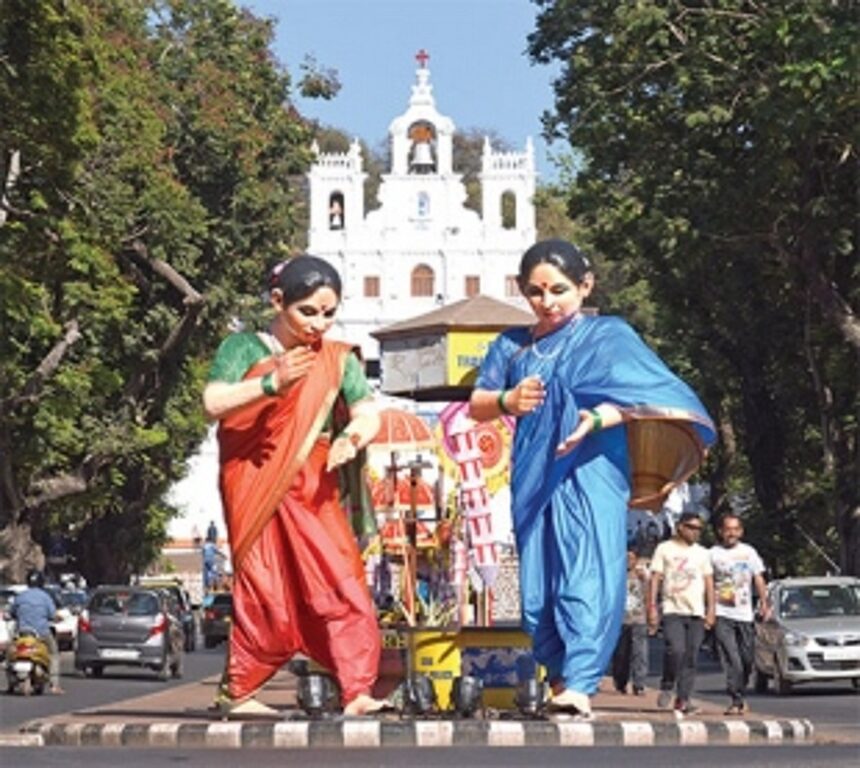
In the cities, the
festival is celebrated with folk dances like ‘Dhalo’, ‘Fugdi’, ‘Goff’ and
‘Ghoddemodni’ that are danced to the beat of the ‘dhol’, ‘tashe’ and ‘kalas’.
Drawing inspiration from the Bhagavad Gita, Ramayana and Mahabharata, floats
with special light and sound effect, depict mythological figures enacting the
victorious fights of the Gods against demons and other mythological stories,
form part of the parade. The folk dances that are part of the parades include
‘Mushal’, ‘Ghodemodini’ – a horse warrior dance signifying war victory,
‘Talgadi’, ‘Hanpet’ – sword dance, ‘Goff’, ‘Romtamel’ and ‘Fugdi’ dances, which
are beautifully performed.
Shantaram Naik,
Secretary, Panaji Shigmotsav Samiti explains how this year will be different
for the parade in Panjim. “People are concerned about Coronavirus and though
the forms are gone out, we are yet to see if there is a drop in the
participating groups this year. We have advised the groups that those who are
affected by cold, flu and fever should not participate in the parade. We are
following the guidelines issued by the Health Department and we will be making
the necessary announcements before the start of the parade. The cities usually
get a higher response compared to the villages. The parade will begin at 4pm
from Caculo Circle to Café Aram and then turn left to Azad Maidan. Those
troupes that arrive late will not be allowed to participate as we have a
deadline to follow and end the parade by 10pm,” explains Naik.
Sainath Raul is part
of two groups, Shree Swar Sai Shigmotsav Mandal Mapusa and Bardez Shigmotsav
Mandal Mapusa. “There is no fear of Coronavirus because once we are one with
the beat of the ‘dhol’ and ‘tashe’, there are no other thoughts that come to
mind. We have 150 members in the Bardez group and 250 members in the Mapusa
group. Many parents are supporting their children in joining the groups at a
young age and this year the number has grown. We will be participating in
Shigmo all over Goa,” says Raul.
This year, the
Department of Tourism, Government of Goa, is conducting celebrations at 15
centres around Goa, including Curchorem, Bicholim, Quepem, Sanguem and Pernem.
The
State Government Shigmo float parade will be held at Shiroda and Curchorem on
March 13, Panjim on March 14, Margao on March 15, Bicholim and Mapusa on March
16, Sanquelim on March 17, Vasco and Cuncolim on March 18, Pernem on March 19
and Valpoi and Dharbandora on March 24.