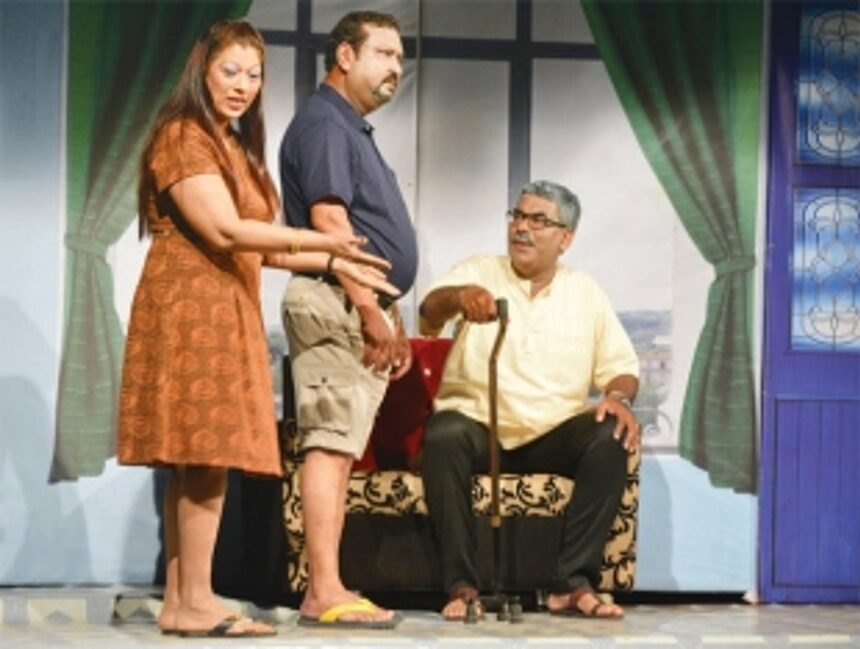
The the delight of tiatr lovers, the 25th Anniversary of Tiatr Celebration
Committee and Tiatr Academy of Goa, in collaboration with Kala Academy,
Ravindra Bhavan Margao, Vasco and Curchorem have commenced staging four classic
tiatrs of noted senior tiatrists of yesteryears.
Many among the present generation have not
had the privilege of enjoying those tiatrs that stood out for having unique
stories relevant to those times, depth in the script and overall presentation.
The immense contribution made towards the tiatr stage by those dedicated senior
tiatrists was truly out of selfless love for theatre and art.
Today, while some tiatrists continue to
contribute towards the tiatr stage with their acting, singing, directing and
staging of their own productions, the focus has shifted from pure love for art
to commercialisation, thus losing the essence of theatrical art.
Hence, it is
heartening that some of our present tiatrists have chosen to pick four classic
tiatrs of tiatrists of yesteryears to showcase them for the audience of today.
Those tiatrs chosen are Prem Kumar’s ‘Jivit Ek Sopon’, M Boyer’s ‘Ekuch Rosto’,
Remmie Colaco’s ‘Ghorachem Sukh’ and Nelson Alfonso’s ‘Ghorabo’. These hit
tiatrs are being directed and presented by Agnelo de Borim, Tomazinho Cardozo,
William Fernandes and Michael Gracias respectively.
Agnelo de Borim, who
has presented his productions for the annual Kala Academy’s tiatr competition,
feels honoured to direct highly acclaimed tiatr ‘Jivit Ek Sopon’, which was
beautifully scripted by late Prem Kumar. “It has also been a challenge,” he
reveals, “as Prem Kumar was known for his innovations in stage craft skill,
full direction and unique way of presentation.”
“The tiatr lovers
have high expectations as many of them have witnessed this show,” states Agnelo
de Borim. “It’s a dream come true for me as I could rope in the best available
talents from the tiatr competitions,” he adds. According to Agnel de Borim, the
unique concept of old tiatr and old songs with new artistes will definitely be
a trend setter towards revival of authentic tiatr in its original form.
Michael Gracias, who
recently ventured onto the professional stage from being a part of the tiatrs
competitions organised by Kala Academy annually, picked up Nelson Afonso’s
tiatr ‘Ghorabo’. This tiatr was originally staged in the ‘60s and served as a
mirror of Goan society.
“In this tiatr, Nelson
portrays Goa and how Goans socialised in late ‘60s and early ‘70s, wherein
awareness is created with regard to job opportunities in the Gulf, especially
Kuwait. It also focuses on the joint family, wherein the father was the head of
the family and children had to do everything in the family,” reveals Michael.
“How the familial
scenario changes when the head goes to work abroad is well portrayed in the
tiatr,” he states, adding, “The virtues required to keep the family going,
especially the virtue of forgiveness, are highlighted here.”
Michael states that
the tiatr has a lot of laughing pills in it and the cast comprises 11 members,
out of which, 5 characters have comic overtures. As a director, he says that he
had to understand the era of the 1960s and recreating that on stage today was a
big challenge. “To my good luck, my artistes belong to the entire troupe of
Prince Jacob, so it already includes senior artistes like Prince Jacob and
Diana, besides Santan Pegado, who does not belong to Prince Jacob’s troupe.
“Having senior artistes around is
invaluable. Moreover, since we have been working together for quite a long
time, building up a team was not that difficult,” he states.
As the depth of the tiatr script is
intense, Michael has also released this tiatr in book form at the first show
was at Ravindra Bhavan,Vasco on February 26, 2018. Tiatr ‘Ghorabo’ has six
cantos and 13 songs wrapped in it, except the opening, which is composed by
Nelson Alfonso’s son, Tommy (Jr Nelson), and revolves around 125 years of tiatr
and the life of late Nelson Alfonso.
Tomazinho Cardozo is directing and
staging late M Boyer’s ‘Ekuch Rosto’, which is one of the masterpieces in the
realm of Goan tiatr. “It was a first of its kind in the history of Goan tiatr,
reveals the present director, adding, “‘Ekuch Rosto’ was based on communal
harmony of Goa in the Goan atmosphere of 1970s. The aim of the tiatr was to
create awareness among Goans and promote communal harmony.”
Tomazinho feels honoured to direct such
a great tiatr of a great writer and director of yesteryears. “It is not an easy
task to match the expectations of the audience as this tiatr was performed by
the stalwarts of Konkani stage, namely Jacinto Vaz, Alfred Rose, Rita Rose,
Antonette Mendes, Premanand Sangodkar, Prem Kumar, Ulhas Buyao, M Boyer and
others in 1978 when it was first staged. My artistes have made all possible
attempts to do justice to M Boyer’s script and direction and I am confident
that the present day tiatr audience will like the modern presentation of ‘Ekuch
Rosto’,” he adds.
“Today’s cast in ‘Ekuch Rosto’
includes versatile artistes in Pradeep Naik, Irene Cardozo, Anthony Carvalho,
Shivanand Naik, Comedian 64, Selza Lopes, Dulcin Borges and others, who have
not left any stone unturned to do justice to their roles,” states Tomazinho.
Besides Sucorro de Santa Cruz, Sheik
Amir and T Briton, Kala Academy’s award-winning singers will render classic
songs (kantaram) of artistes of yesteryears.
William Fernandes, who is presenting
Remmie Colaco’s ‘Ghorachem Sukh’, states, “I was a part of the original
‘Ghorachem Sukh’ directed by Remmie Colaco so directing the same is a great
experience. However, the present artistes, who are performing in this tiatr,
had to adjust to the entire gamut of old traditional tiatr. The scripts of
these four tiatrs are the best and it’s really an experience for each us to
direct them.”
Although the tiatr lovers will be entertained with these
four classics, it is sad to note that none of Pai Tiatrist Joao Agostinho
Fernandes’s tiatrs feature among them. It would be good if senior tiatrists or
their family members share some of their tiatr scripts of their yesteryears
classics so that they can be kept alive through such festivals.