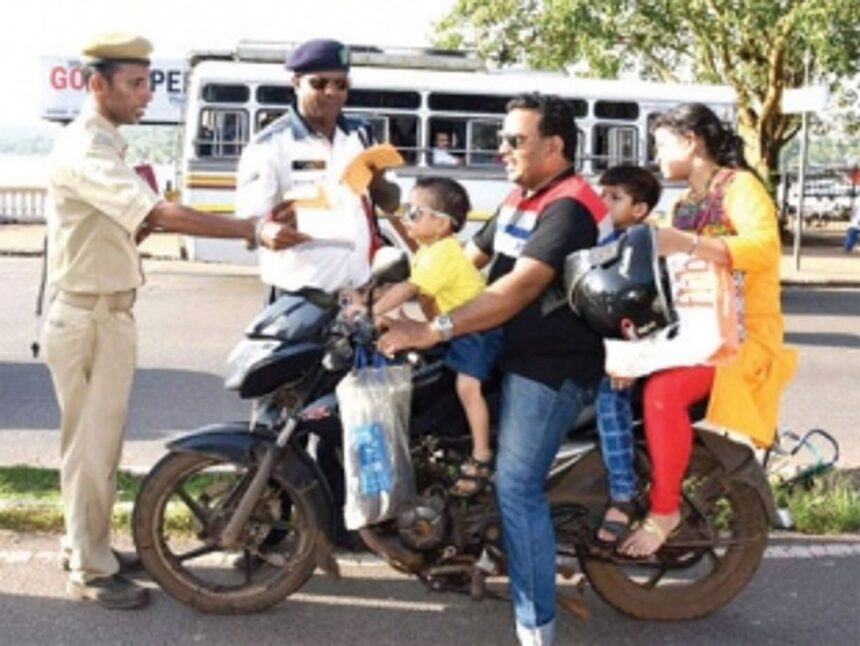
In a village in Salcete, a young girl and her mother left home
by bike to buy a locket for the girl’s 21st birthday. At a bend on the road
barely a kilometre from home, another two wheeler rider came in from another
road and hit the mother-daughter duo. The mother, who was riding pillion,
wasn’t wearing a helmet; she cracked her head, bled profusely, suffered brain
damage and finally succumbed. The shocked daughter fell too, but since she was
wearing a helmet, she survived the fall. But she, her father, who himself was
in hospital, and her two brothers will face a life without their pillar, their
emotional crutch.
This was not just another life being taken; it was about another
home being ripped apart.
Helmet for your head, no your bike
Transport Assistant Director Sudeep Desai shares his grief on how he witnesses so
many people not wearing the helmet even though they have it with them. “It’s
not a joke, a lot of things can happen.”
He narrates an incident he once found ridiculous. “Long time
ago, I remember an accident where a young person was going on a two wheeler
from Shirdao without a helmet. Near the Mangueshi junction, his motor-cycle
dashed a divider. His body had less injuries but he got a severe head injury
and died. His bike was torn apart but his mirror was not touched because he put
the helmet on it. If only if the helmet was on his head and not over his
mirror.
Silly excuses can lead to death
Desai says that most people, especially the youth, only wear the
helmet out of fear of the RTOs and Police. He has come across people breaking
the traffic rules and making silly excuses like – ‘We are going here only to
buy milk,’ or ‘I have Spondylosis.’ “They may be going here only, but the
accident doesn’t say they are going here only, it just happens right… so why
risk it?” says Desai.
He feels that there is less awareness. Instead of taking the
young to college picnics and treks, they should take them for a visit to GMC
hospital. “They should bring them there so that they have a look at all the
admitted patients who have met with accidents. It is only then they will
realise how precious life is.”
It’s a myth that accidents happen only on
highways and in major towns
Traffic Dysp of North Dharmesh Angle explains that in the cities, the density
of vehicles is more, hence there are cops everywhere, and people have to
compulsorily wear the helmet. When they move further to the inner roads, they
feel no one is there to watch them, hence they take off the helmet. “This
ultimately leads to an accident. The worst part is you never know when an accident
can take place.”
However, according to Moses Pinto, author of ‘Practice Traffic Yoga’, the main reason for this are the badly
planned roads in the villages that have a mixture of different terrain,
inconsistency of the tarring layer on the road, narrowing near the compound
wall of the residence of a village ancestral house, uncovered gutter paths
along the road, cattle being herded on the same village roads and shrubs and
thorny bushes growing along the road that may reduce the usable surface area of
the road at different points along its length.
Angle admits that the department is trying to help Goans in
every possible way but need the public’s cooperation too. Since 2017, Goa
Traffic Police has been organising Road Safety Summer Camps as an educative
initiative to train young minds in Road Safety. Soon the traffic department
will be beginning the Rule of the Law on the Road regarding Helmet.
Helmet – A burden?
Many youngsters have admitted that wearing a helmet is good, but
later it becomes a burden. “We have to carry it everywhere we go, into the
classroom, the theatre; sometimes there is no place inside our under-seat
storage for big helmets. Sometimes we even forget our helmets. Some who are
concerned, definitely wear them otherwise most of us just don’t feel like once
we reach inner roads,” a youth complains. Till they lose a family member or a
friend.
Some elders and parents are of a different opinion. “The young
boys and sometimes even girls don’t take wearing a helmet seriously because
they like to want flaunt themselves and their two wheelers,” says Dorris Janarthanan, a resident from Taleigao.
Advocate Yulette Coutinho agrees, “Wearing a helmet should not be a
burden and it’s not just about helmets, bikers feel a two wheeler is easy to
manoeuvre, so racing, overtaking, cutting through traffic is just practical.
Without realising that a slight touch of a moving vehicle can send you flying,
resulting in loss of life.”
No complimentary helmets
Moses Pinto says that it all does not come down to the
manufacturers; neither the manufacturer nor the dealer provides a helmet as
part of mandatory safety equipment. “The helmet is the most crucial and
significant equipment that should be supplied mandatorily by the manufacturer
to the purchaser of the two-wheelers as part of their Corporate Social
Responsibility commitments,” he explains.
Helmet is for protection, not fancy dress…
Nowadays, there is a growing trend of fashionable helmets with
open face guards and bigger visors, which have a reduced capability to
safeguard the head of the riders due to the shrinking of the surface area of
shock absorbent materials being used in the designing of such helmets. This is
particularly marketed as a feminine helmet but has been proven to be almost
ineffective in the event of a crash being experienced by the rider or pillion.
A properly designed and fully functional helmet can save the rider’s brain from
almost all the injuries of a road crash.
Every time a death like this happens, discussions start, and
they die… until another person in Goa dies a bloody dusty death.