Embracing simplicity at work and in life, Bombay-Goan award-winning designer Bonita Vaz-Shimray reflects on returning to her ancestral home
Thinking back on her bold decision to publish a poem of 19 lines, albeit beautifully illustrated, Bonita Vaz-Shimray didn’t hesitate to risk it. The award-winning designer knew in her bones that Namrita Bachchan’s enchanting book would resonate with readers and critics alike. A recent Federation of Indian Publishers Award for A Full Circle proves she was right to trust her gut. “In the profound words of Da Vinci, simplicity is the ultimate sophistication,” she said at the time of publication.
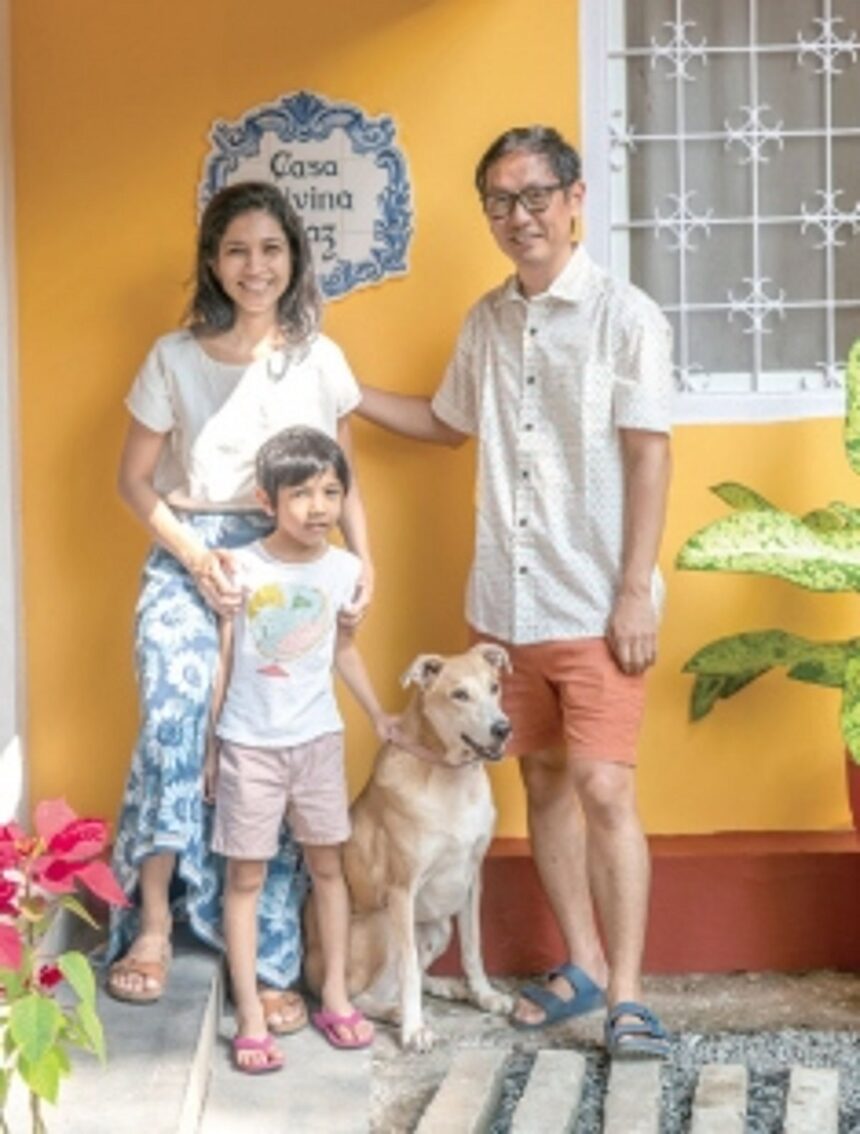
This inspiring thought is one of the threads running through Shimray’s life and was also the driving force behind her family’s move to her ancestral home in Navelim, South Goa, in 2020. She and husband Jofree, a broadcast designer with his studio based out of Goa, have breathed life into the home, adding to the restoration work done by her family in Mumbai. Their six-year-old son Isaac even helped paint the roof tiles.
“We got married in Goa in 2008 and Jofree has always been drawn to the simpler life,” Shimray shares. Work, however, took them to Delhi, a great base until the rising pollution made it an unliveable place. Their decision to move to Goa was accelerated by the pandemic. Ironically, the house has a story that harks back to another mass outbreak. “It was built in 1915 by my great-grandfather, but he succumbed to the Spanish flu in 1919 so barely enjoyed the fruits of his labour,” Shimray recalls, adding, “My orphaned grandfather went to Mumbai at the age of 11 and was raised by the Jesuits. So, we’re literally the first generation to have made it our home.”
Born in a Goan hamlet near Lilvati hospital, Bandra, Shimray grew up with fascinating stories of Goa. “A strange land, rife with ghosts, haunted houses and exorcism,” she remembers. In the city, the struggle to survive barely left room for the supernatural. Her paternal grandmother, who had moved from Betalbatim to Mumbai as a newlywed in the 1930s, was her primary caregiver and became a role model of tremendous courage. “When I was young, I witnessed for the first time a quiet resistance. With Mumbai quickly losing its few parks and open spaces, Granny thought it only right to protest the construction of the new hospital. One of my earliest memories is tagging along with her,” she recalls.
Shimray was a pre-teen when liberalisation transformed India, opening the door to the Western world and with it, growing aspiration. At the time, her interest in design was restricted to fashion—one of her aunts used to stitch bridal gowns to supplement her income and she and her sisters were keen apprentices. For a generation that was devoid of not just big brands but, also, in a sense, of materialism, repurposing everything in sight and upcycling leftover fabric came naturally.
“In high school, I stitched a plaid box pleat skirt for myself. I was so embarrassed to say it was made by me, I cut out a ‘Made in USA’ tag from an old garment and sewed it on the back. Such was the influence of an increasingly mechanised world,” she recalls.
Channelling Granny’s spirit, Shimray took her first step out of the pond when she was granted admission to the highly prestigious National Institute of Design, Ahmedabad. “It was a life-changing experience. I was soon going to get a sense of the many Indias we live in and also of the wealth of our art and craft,” she says.
The lure of home, however, remained strong. Almost every summer, the family made a trip to Goa, and it remains her fondest childhood memory. “Granny straining across the tracks, switching from the broad to meter gauge train. An uncle, who worked for the Indian railways, greeting us mid-journey at Miraj. Neighbours celebrating our homecoming with kanjee and tora (raw mango in brine). Pig toilets, collecting firewood and cooking in earthen pots in our outdoor kitchen,” she says, adding, “This is ‘the village life’ that I now romanticise in hindsight.”
Charting her own course through adversity from an early age, Shimray is shrewd enough to recognise that Goan life is no coastal idyll, back then and now. “It was not fashionable to be from Goa in the 80s, especially since the beaches and nightlife were almost entirely alien to most Bombay Goans. But, yes, the advantages were many—we were able to leverage our religion with the Christian institutions that created a sense of belonging. I cried my heart out when I read Lindsay Pereira’s Gods and Ends, which drew upon my world with profound eloquence,” she says.
With over two decades of experience working with top media and publishing companies, and winning numerous awards, Shimray is used to seeing the world through a designer’s eyes.
The values in making and creating go a long way for her and it is this aspect of Goa’s aesthetic, one that exists in pockets, that resonates. The concept of a ladies’ tailor making bespoke garments, lace making and crochet, the intricate patterns of cane-woven furniture, the use of a grinding stone in the kitchen. “These are traditions and tools that connect our hands to material and form. It instils a connectedness and rootedness in the world, as opposed to being mere consumers,” she explains. Fresh fish at the doorstep by a fisherman on a bicycle, the poi man, homes made with local stone, earth and terracotta roofs that are designed to work with the climate, intuitively designed pig toilets that connect humans to their ecosystems—these all teach us to live and respect nature. “I am reminded of the ‘banana leaf parable’ by design thinker Charles Eames, who, on his trip to India to set up the National Institute of Design at Nehru’s behest, determined that ‘function’ is the key to good design,” she says.
It was the desire for a more balanced, meaningful life that led her back to the family home. “Being married to a Tangkhul from Manipur, I have a ringside view of how systems closely connected with nature can witness rapid degradation in the name of modernisation. I love that villages in Goa and in Manipur have a sense of slowness and life with the bare minimum—this to me is a sense of freedom and luxury,” says Shimray. As part of slowing down, she and Jofree are choosing to home school Isaac. “The first brush with a flawed education system occurred at the onset of the pandemic when my son, who was three at the time, was having all his classes across a screen,” she says. Home-schooling is their design approach to nurturing a mindful and less market-driven way of life.
Allowing Isaac to simply participate in everything they did, from home chores to art direction, the Shimrays gave him a chance to learn without enforcing a routine or curriculum. “He taught himself to read and write gradually and spends hours drawing and making books.” In her opinion, there is something fundamentally wrong with an education system which does not account for individual learning styles. “Our creative background meant we had to unlearn most of our traditional schooling; we didn’t feel the pressure to conform to what is considered ‘normal’,” she states.
Today, for Isaac, nature is his biggest playground for learning. “We spend time on the beach, walking in paddy fields and discovering new places to star gaze,” says the designer, for whom life has, in a sense, come full circle.