Team Café
It was a routine quiet affair at the
offices of most media organisations in Goa in the evening last Sunday. The news
story of Vishwajit Rane’s visit to Hospicio in the morning, after a freak
accident injuring a woman, seemed absolutely normal, except for a few whispers
suggesting that an altercation had taken place. When contacted by mediapersons,
the minister admitted the incident but termed it unimportant enough to not
comment on it. Things were calm until a video of the altercation surfaced on
social media later in the evening, sending the newsrooms into a state of
frenzy. The video made it pretty obvious that the matter was much more serious
than it initially appeared to be.
This shouldn’t come as a surprise as in
most cases, the online world gets much more than a hint of things happening
around, hours before the media gets its info from its sources. In fact, the
sheer pace with which news is published on social media platforms has made it a
somewhat credible and quick source of information for journalists and general
public alike. Anirudh Jagtap, a marketing professional based out of Taleigao,
says, “That most of the youngsters consume news through social media platforms
and instant messengers, as compared to hard copies of newspapers and magazines,
is a fact that was established about half a decade ago. But, over time and with
changing technology, a lot has changed in the way news makes its way into the
public domain. Not only is the general public consuming news through various
digital mediums, but it is also initiating discussions and debates and
reporting incidents on social media channels.”
Several groups on Facebook – ‘Goa Speaks’,
‘Goans for Goa Forum’, ‘Ami Niz Goenkar’, to name a few, are forums where
people from all walks of life, across age, profession, geographical locations
and political leanings, discuss political issues, current affairs, art and
culture and anything and everything that concerns Goa. Furthermore, newer
groups are being created with a specific motive: to attract the attention of
civic bodies to address issues that affect the public on a day to-day basis.
This, in turn, has nudged the government authorities to sit up, take note and
initiate action because unlike the days of the past, the authorities now know
that people are watching and monitoring every action of theirs, though their
digital eyes!
‘Movement against potholes’ is one such
group that is said to have been incepted “to highlight the menace of potholes
and to make PWD officials accountable and liable for the bad roads.” Sanjay
Dessai, Vice-principal at VVM’s Shree Damodar College of Commerce and Economics
and the admin of the FB group, dedicatedly posts pictures of the bad roads that
he encounters, forcing the government authorities to take note and take action.
He, of course, is joined by others in the group who take turns to participate
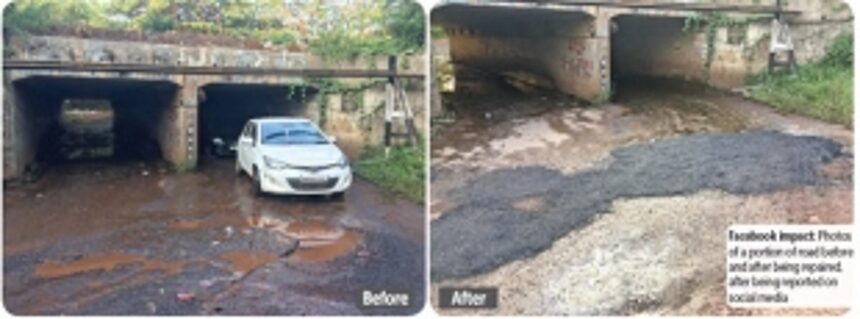
in this voluntary exercise. The group has proven to be effective as a few
members have posted pictures of roads before and after the matter was reported
on social media. Dessai says, “I’m a regular tax payer. And hence I have a
problem with substandard quality of roads that are built with our money. In the
past I had written letters to the ministers, government authorities
highlighting parts of roads that are in bad condition, but to no avail. I found
Facebook to be a far more effective means of reaching out to people and the
concerned authorities, thanks to the multiplying effect that is caused as
people share what is posted.”