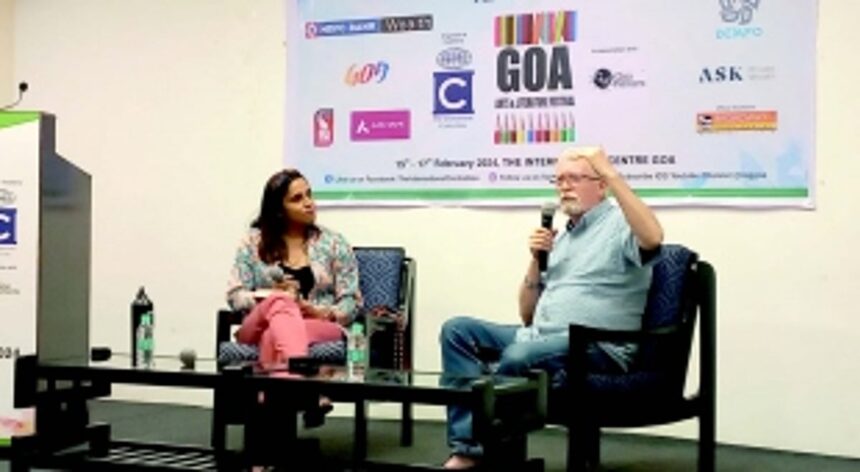
In ‘The Cobra’s Gaze—Exploring India’s Wild Heritage’, author Stephen Alter gives details about the wild spaces of India, about the different species he encountered, the local stories and folklore associated with it and also the people who are working hard on conserving these places. During a conversation with wildlife biologist, Nandini Velho at the event, he stated that he likes to write down his personal experiences rather than giving a message about conservation. “I don’t start with a message, I start with experiences. Hopefully, it will all add up convincing this is something worth saving,” he said.
Stephen mentioned that once while exploring drosera plant (carnivorous plant) species, he encountered a mountain goat. “The moment I realized that I was not alone and I looked up, and there was a mountain goat just few meters away from me. He also looked up and our eyes locked for probably for 20 seconds. It was truly a profound experience. I like to think that there was a shared consciousness of our surroundings and for few seconds we connected with it.”
Elaborating on the title ‘The Cobra’s Gaze’, he explained how cobras don’t have good eyesight and they interpret what’s going on in their surrounding through their tongue. “They read the world through its tongue. For me, this is something incomprehensible. It has an enigma around it. This book doesn’t have answers but such enigmas, puzzles, perhaps even half answers,” he added.
Stephen when asked about his opinion whether it is necessary to know names of species or just experiencing about them in wild is enough? He confessed that he also doesn’t understand Latin (botanical) names of species. But, he added that knowing names of species is important and especially learning stories behind those names. He gave examples of various local names which are funny and interesting.
To further it, he gave example of the rock art at Bhimbetka caves of Madhya Pradesh. “Those hunter gatherers certainly didn’t know the Latin names. The famous zoo rock of the caves has 19 species of mammals. They are like first filed guides of Indian mammals. Also, there are number of species which are no longer found in Madhya Pradesh. Similar is with petroglyphs of Ladakh. There are so many stories embedded in them.”
Revealing about the book, he said that it is not at all comprehensive as he didn’t mention places in Kerala, Tamil Nadu, etc. He is hoping to write next edition of it.
Interestingly Stephen starting his writing journey for this book from Goa when he went herping at Netravali Wildlife Sanctuary with naturalist Omkar Dharwadkar. They explored the forest for three nights discovering various species of amphibians and reptiles, however, one encounter stayed with him of discovering a spotted bellied eagle owl—that has a blood curling call. “It is one of the largest owls in India and Omkar had spotted it for the first time in Goa. So he was excited,” he added, further commenting that it is locally known as ‘chudail’ or witch due to its call.
Stephen also spoke about the politics of nature conservation in India. As his book mentions about Kuno Park, Madhya Pradesh, he spoke about introduction of African cheetahs in India. He opined that instead of spending crores of rupees on it, the money could have used in conservation of some endangered species. He said that this endeavor is just creating another venue for safaris. He also added that there is too much attention on the cheetahs and the mix of politics in conservation is similar to volatile mix of religion and politics.
When asked whether there is a need to spread local stories related to nature worship in order to speak about conservation, he said, absolutely. He gave example of sacred groves which he experienced in Goa, Coorg and Kodagu in Karnataka. “It was fascinating to see similarities in different sights. To me it speaks of indigenous conservation ethics. The idea that there is a space that needs to be protected and sacrosanct,” he added. He also suggested that the fact that there are so many sacred groves in Goa, it could be because of Portuguese rule as there were not many forest laws here compared to other parts of the country, so there were more local community jurisdictions over these critical areas.
He also spoke about sacred groves in Shillong, Meghalaya and also of one near Delhi called Mangar Bani. “It is amidst high rises and garbage dumps. Because somebody decided that it has to be protected and they maintained it.”
Lastly, when asked whether there is scope for nature writing, he stated that one can write about the science behind the wildlife, or one can write about the local stories, mythology related to it and most importantly write about the personal experiences. For him, those personal experiences are almost mystical and spiritual. He said that these experiences are mix of fear and awe. “Standing on a cliff when you look at snow-capped mountains, you are awe struck by that and then when you look down and there is a thousand feet drop and you are absolutely scared. That combination of fear and awe is at the heart of mystical experience and it is part of our connection to nature,” he concluded.