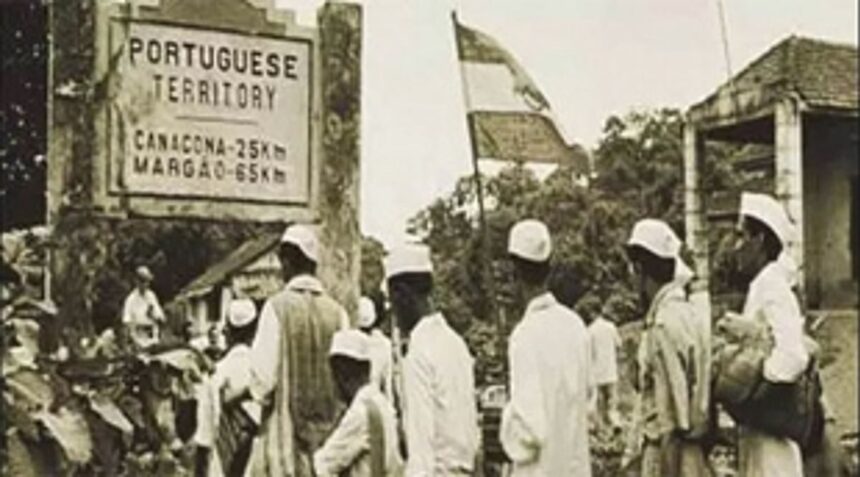
Revisiting Dec 19, 1961- By those who saw
and participated in Goa’s most historic day
90 year old Dr Margarida De Miranda from Loutolim was in her house
as her family was being divided between Goa and Portugal as Goa was liberated.
Her brother-in-law Dr Bonifacio Miranda was a Diplomat who represented Portugal
in the Permanent Mission of Portugal to the United Nations, New York. His
family including his wife, son and daughter were living in Panjim and had to be
sent to Portugal. Dr Margarida recollects that day, “It was a very cold day. I
was sitting with my three children in the hall and we were listening to the
news on the radio in the morning. I heard a loud noise and the news stopped. I
realised that Emissora de Goa has been attacked. My husband Dr Antonio was
dressing up to go to Panjim to bring my brother-in-law Dr Bonifacio’s family
who were staying in Panjim to Loutolim. We stayed at home that day and I also
told my husband not to go out as he could be attacked. We received a cable from
Portugal where Dr Bonifacio wrote in Portuguese ‘My heart is with you all.
Please do something about my family.’
My sister was earlier working with him in
the same office. The governor at night sent a taxi to my sister’s place in
Panjim to take the wife and children of Dr Bonifacio to the ship which would
then take them to Portugal. At that time of the night, she went to their place
and brought them first to Loutolim where I told them to pack their things. The
children were crying because they wanted to take my children along with them.
They went to Mormugao where the ships were going to Portugal, especially
carrying the wives of the Portuguese military. They were firing crackers in
Margao as people were happy that the Portuguese had left and the Indians were
coming.”
Meera Hiraba Sanvordekar was the first woman in Sanvordem to give a
speech in Hindi on the next day of Liberation. She later married Dr Sonnu Kamat
and is now 80 years old. Since her father, Hiraba was working in the Post
Office in Panjim under the Portuguese Government, she couldn’t participate in
the freedom struggle.
“I had passed my metric examination and I
wanted to study further but since there were no colleges in Goa, I couldn’t
pursue higher studies. However, I answered Hindi exams in Belgaum and I had
passed it. When the principal of New Educational Institute Sanvordem heard
about it, he offered me a teacher’s post for Hindi. I informed him that I
intended to complete my studies and as soon as Goa is free from the Portuguese
and a college opens here I will go back to completing my education. He agreed
and I was teaching Hindi for 2-3 years until 1962 when Dhempe College of Arts
and Science, Panjim opened and I joined as a student. On Liberation Day, I was
informed that I have to address the public at Sanvordem and I had to deliver
the speech in Hindi along with Dr Krishna Sanzgiri who would address the public
in Konkani. I was very happy and started writing the speech. This was a joyous
moment for me,” says Meera.
Adv Libia Lobo Sardesai played an instrumental role in running the
radio channel ‘Voice of Liberation’ underground for six years with her husband
late Padmashri Vaman Sardesai, former ambassador of India to Angola.
She remembers the glorious day vividly, “It is a very important
and significant day in our life and also the history of our motherland as Goa
was liberated and thereby the last vestiges of colonialism were uprooted from
the soil of India. It was for us the culmination and totally glorious
fulfilment of the daunting mission we had undertaken to raise the Voice of
Freedom (Goenche Sodvonecho Awaz), to devote all our energies and abilities to
free the people of Goa for posterity from the shackles of slavery that bound
them for generations since centuries, so that we all could unite with the
motherland and live in dignity as masters of our own destiny. It was such
unforgettable symbolic if not historic honour to make the last broadcast of the
Voice of Freedom in Portuguese and Konkani that Goa was finally free from
colonial yoke and united with the motherland after 450 years that too from the
skies in a plane over the Palacio de Idalcao to coincide exactly with the
hoisting of the Indian Tricolour and lowering of the Portuguese colonial flag
forever, an event which we can never forget. Jai Hind,” she says.
88 year old Rafael
Viegas from Curtorim was
working as an Assistant Chemist in the Goa Government Mining Laboratory in
Panjim when Goa was liberated. He sent that day by helping people find shelter
in his village Curtorim. “On December 18, when I was walking to church for the
feast at 8am, Dr Camilo Severino Rodrigues waved his arms and informed me that
the Indian army has entered on three sides. During mass, we would hear the
Indian Air Force planes flying over the church but the mass was not disturbed.
After coming back home, I along with a friend climbed up the
Curtorim hill in front of my house and we could see the planes bombing the
Navelim cantonment and later the Borim bridge was blown followed by the
Banastarim bridge and Sancordem bridge. My friend from Margao had come home to
meet me and we took his car and went back towards Margao. On the way, we saw
people from Margao coming walking to visit their relatives in Curtorim. We took
nearly 2-3 trips to drop people home.
Margao had become a ghost own. On December 19, 1961 evening, we
learnt that the Indian army troops had taken over Goa We were listening to the
Voz de Liberdade (Voice of Liberation and we were very happy to know that Goa
was liberated. The Emissora de Goa was bombed by the Indian Air Force at 7.3am
on December 19, 1961. Freedom fighters have gathered at the Margao police
station and they were shouting slogans of Jai Hind and they distributed bananas
and fruits to the Indian soldiers.
Rohidas (Daad) R Dessai is the owner of the restaurant chain Ritz
Classic in Goa but as a 15 year old, he was very active in the freedom struggle
supporting his elder brother, Late Rajendra alias Kushta Desai. “My elder
brother Rajendra was part of the Azad Gomantak Dal and we were working
underground until 1961. Everything in Cuncolim was captured on April 13, 1955
all the ammunition was taken by the Portuguese.
My whole family including my mother was involved in the freedom
struggle. I had dropped out of school as my father had passed away and since my
elder brother was fighting against the Portuguese, we too joined the movement.
Our home was raided every 15-20 days, to search for ammunition.
We
waited for my brother to come home and once we received the news that the
military was following him, we were overjoyed. Along with him, we went to the
Margao police station and joined the rest of the Goans celebrating there and
gave a speech. He then returned to the Cuncolim market before coming home. We
celebrated grandly at home,” says Rohidas.