120 years after he was born on the serenely beautiful Mandovi
river island of Santo Estêvão, the supremely talented modernist painter Angelo
da Fonseca is finally edging into the global pantheonof immortals where he
always belonged, even if historical vicissitudes barred it from happening
during his own lifetime and several decades afterwards.
That unjust drought of attention and
acclaim seems to be coming to an end in 2022, with an entry inthe new,
self-consciously canonical 20th Century Indian Art, edited by Partha Mitter,
Dave Mukherji and Rakhee Balaram for Thames & Hudson. More significantly,
there’s another landmark volume on its way right here in Goa,by the Jesuit
scholar-academic Delio de Mendonça, which contains 126 reproductions that will
finally placethis incredible, irresistible oeuvre in the hands of countless
more people than have ever seen them before.

Mendonça is my friend and close
collaborator, and I have contributed the foreword to his book, which is being
published by Gerard da Cunha forArchitecture Autonomous (see this:
angelofonseca.com). Together, we have shared many aspects of the unlikely
journey that began in 2006 – four decades posthumously for Fonseca – after the
artist’s indomitable widow Ivy gathered up her husband’s archive of surviving
works, which she had defended ferociously in their home city of Pune, and
entrusted it to the Xavier Centre of Historical Research in Porvorim, with the
understanding that the institution would safeguard, study, showcase and
celebrate this priceless treasure.
It didn’t happen quite that way, but it is to Mendonça’s immense
credit that he never wavered, kept persevering even after being transferred to
the faculty of the Gregorian University in Rome, and stayed the course to keep
his promise to the greatest extent he could manage. That utmost sincerity
shows, because Fonseca is an impressive achievement, and an essential
corrective to the tedious, tendentious historical narratives whichare being
constantly regurgitated in India today.
Thus, it was wonderfully moving and apt to hear Archbishop
Filipe Neri Ferrão – who will be elevated to the cardinalate by Pope Francis in
August as the first-ever archbishop of Goa to be so honoured in nearly five
centuries – warmly embrace and endorse Angelo da Fonseca’s work (at the new
book’s “soft launch” in Margao earlier this month) in a robust framework of
understanding thathas been sorely lacking in previous generations of prelates.
He acknowledged with great sensitivity that “such people have the courage to
face opposition from their contemporaries and to row against the tide, knowing
that they carry within them a seed that promises to grow into an exotic tree of
rare beauty which only future generations, and not their own, will know to
appreciate.”
Being unknown is one thing, that is quite different from being
pilloried and purged by your own family and community, which is how Fonseca
felt about Goa and Goans, which wound up ending up alienating him from his
beloved homeland for the duration of his entire artistic career (which ended
prematurely after he succumbed to meningitis in 1967, just as he wasreaching
the height of his prodigious capabilities). As the artist recounted
withconsiderable hurt roughly 20 years after the first time his paintings were
met with hostility: “being the first in this line naturally brought much
opposition and criticism from various quarters, constructive very slightly, but
mostly destructive.”
To be sure, that is the inherent story of modern art. According
to one of its most elegant chroniclers, the late German-American academic and
author Peter Gay, there are two “defining attributes” to characterize all
modernists. “First, the lure of heresy that impelled their actions as they confronted
conventional sensibilities; and, second, a commitment to a principled
self-scrutiny.” Both these capacitieswould ideally be awakened and actualized
in a cultural climate that calls out – in Ezra Pound’s famous imperative – to
“make it new!”
All that did happenin the life of Angelo da Fonseca in the early
decades of the 20th century. This idealistic scion of one of the biggest
landowning Goan families of the time was sent to British India to be educated,
first at St. Paul’s in Belgaum, then St. Vincent’s in Poona, following which he
caromed from Grant Medical College (from which he dropped out, despite scoring
distinction in Anatomy) to the Sir JJ Schoolof Art (where he also dropped out).
All this was still, so to speak, “in his lane” as many other students from the
Estado da India – including his own family – attended all these institutions.
But now came an unexpected turn to the unknown, when Fonseca decided he was
done with studying art from westerners, and instead went off to Shantinketan to
study with Rabanindranath and Abanindranath Tagore, because “I wanted to be a
shishya of the best Indian artists of the time.”
There is a poignant 1931 drawing reproduced in Mendonça’s book,
of Abandindranth, who has inscribed an exhortation to his prized Goan student:
“You have now mastered the password in art. Go forth and seek your treasure.”
It was an auspicious beginning, but instead of going in the anticipated
direction, Fonseca’s return to Goa was turbulent and unhappy, as his
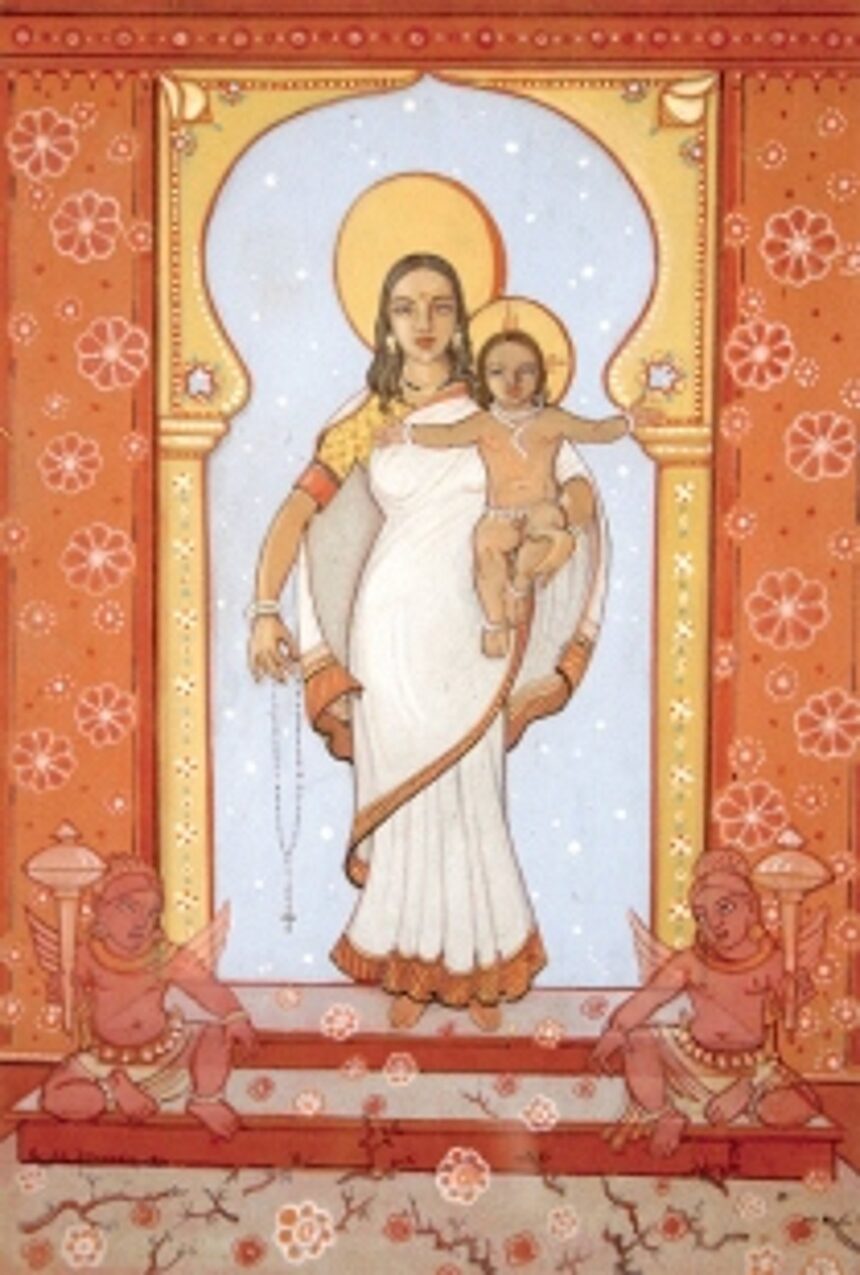
passionate, profoundly harmonious Indian Christian iconographywas criticized
for veering away from familiar colonial imagery. The artist left home in
dismay, and spend the rest of his life in monastic obscurity in Poona, where he
(even after marriage to Ivy, and the birth of his daughter Yessonda) looked
after the Christa Prema Seva Sangha residential ashram premises, often joined
by his close friend and countryman B. B (Bakibab) Borkar.
This is a hugely significant story, with many unresolved
implications. As Delio de Mendonça asks, with great power and feeling, “How
long will Goans who claim a modernist, global and discerning sensitivity,
continue to forget Fonseca, an artist they ought to be justly proud of? It is
also a matter of growing concern that Goans continue to ignore and permanently
lose masterpieces and treasures of their composite heritage. It is a loss for
Goa and the whole human family if Fonseca’s legacy continues to remain locked
in a chest. Fonseca’s artistic genius does not reside only in his presentation
of novel material or a new medium, but in inviting us to delve deeper into
ourselves, our culture, belief-traditions and rights, into what we truly are,
and can become.”
(Vivek
Menezes is a widely published writer and photographer, and co-founder and
co-curator of the Goa Arts + Literature Festival. You can follow him on
Twitter: @vmingoa)