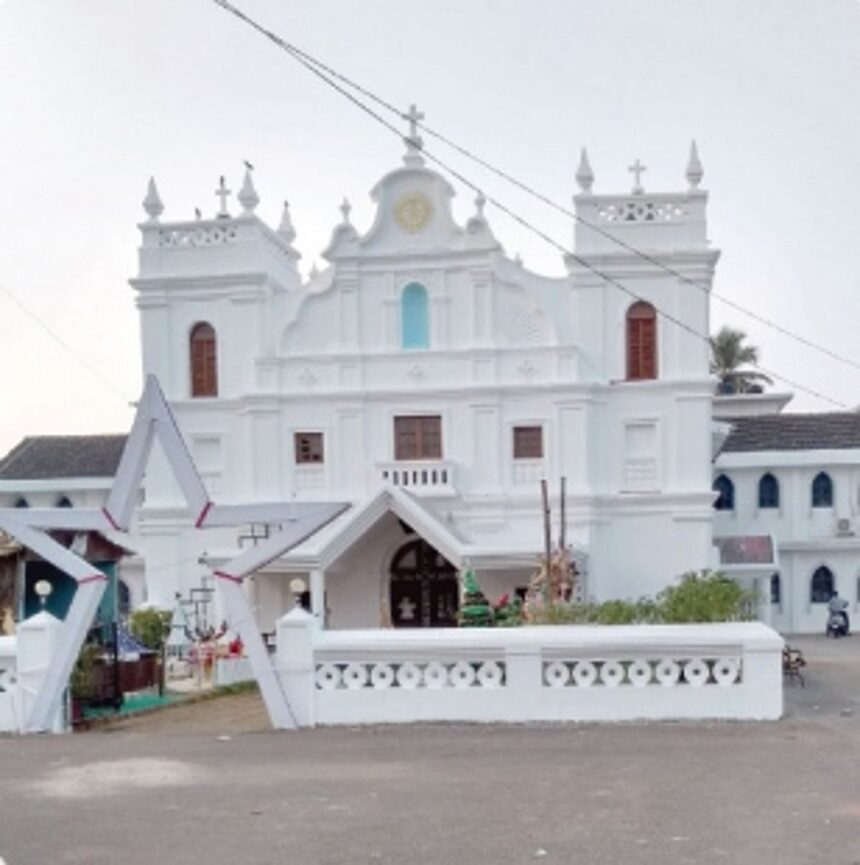
The Our Lady of Succour and Good Success Church, Nagoa, Verna, was originally a chapel built in 1755. It was dedicated to Our Lady of Succour and being a chapel, it was affiliated to the Church of Verna. This chapel was detached from the Verna Church and elevated into a separate parish of Our Lady of Succour and Good Success Church, Nagoa, on January 1, 1973, by provision No. 91/72. The Catholic population in the parish of Our Lady of Succour and Good Success Church, is around 2500.
The village has a wonderful history which dates back to the pre-Portuguese times. Nagoa (Nagvhay earlier) gets its name from Nagvhay or Nagve, literally meaning a village of serpents. According to Msgr Sebastião Dalgado, however, Nagve means an open place without natural defenses. As per legend, Lord Parashuram settled some Nagas (a grouping of Brahmins) in this village. Garuda, the evil eagle god, began to harass the Nagas. Parshuram prayed to Lord Shankar for deliverance of the Nagas. Answering his prayers, Shankar and his wife Uma settled in the village and the harassment stopped.
Garuda is otherwise known as an arch enemy of snakes and is the mount or vehicle of Lord Vishnu. Historically, Nagas are a non-Aryan tribe that worshipped serpents and were spread over a large area in ancient India. Many places are named as Nagapura, Naga (ra)khanda, etc.
Nagas are also an ancient sect of sadhus (ascetics) who ‘detach’ themselves from the world and perform extreme penances including staying naked even in freezing temperatures to achieve spiritual development. Their ‘detachment’ from the world begins by performing one’s own after-death ritual, pind daan, at induction. It is unlikely that such sadhus were the first Indo-Aryan inhabitants of the village.
The Rig Veda mentions Navagvas (literally, in a group of nine rishis or a group of nine ancient priestly ancestors) 14 times. Nagas are referred to as Naga-dvija (twice born Nagas). From this, it has been inferred that the settlers of Nagoa are Indo-Aryans.
The deity of the village was the male-female duo of Laxminarayana-Mahamaya. While the male was represented in a proper idol, Mahamaya by his side existed in the form of an anthill. On account of Muslim oppression in the year 1500, the villagers decided to emigrate with their gods. While the male idol could be easily shifted, how could an anthill be relocated? Imploring divine mercy, the villagers carried a coconut from the village in lieu of the anthill. They proceeded southwards.
When nearing Hanumatta in Ankola (coastal Karnataka, south of Karwar), darkness fell and the devotees with the idol and the coconut decided to break journey. They carefully placed the idol, the coconut by his side, and dozed off. Lo and behold: during the night, an anthill had grown over the coconut, by the side of the idol, in the exact manner the deities existed in Nagoa. Laxminarayana and Mahamaya have ever since continued at the spot, where later an elegant temple was built around them.
Village surnames were Pai, Nayak, Mahale and Keni. Some mahajan families returned to Goa during the Portuguese era, like the Bodkes (later known as Dempo) now of Kalapur/ Santa Cruz and a Mallya family now in Margao and Ponda. The village had resident jewellers like the ancestors of Prof Harishchandra Nagvenkar, who likewise returned soon after the persecution had stopped and settled in Comba-Margao.
A Nagvenkar Shet, a wealthy jeweller from Goa vowed to offer a gold idol if Mahamaya blessed him with a child. A girl child was born and the jeweller gifted a gold idol of a girl child to the temple. After some time, the child died. The distraught devotee was told at a darshan that all would be well. Another child was soon born to him and his wealth multiplied. The idol of solid gold is placed for public viewing and veneration at a special festival held once in five to seven years. Among the unique features of the temple is a special kind of music called bandi vadya played during Navaratri. Nagoa was a tribal settlement before the Indo-Aryan takeover. Survey No.50/1 of the village is still known as Mharbhat.
In Portuguese era, village surnames were, alphabetically: Cabral (including Furtado-Cabral), Costa Bir, Gama, Monteiro, Noronha, Ozorio, Pereira, etc. The family of late Floriano Machado, freedom fighter and former Speaker of the Goa Legislative Assembly, settled in the village from Carmona. The nice Chapel built in 1755 is from 1973 the Church of Nagoa, which jubilee the local population celebrated with great enthusiasm.