When it’s holiday time, everyone gets into vacation mode, usually conjuring images of lazing
by the beach with a huge sun hat, sipping on a mocktail served in a coconut
shell. Or maybe a relaxing spa. Not many would think of venturing to the mostly
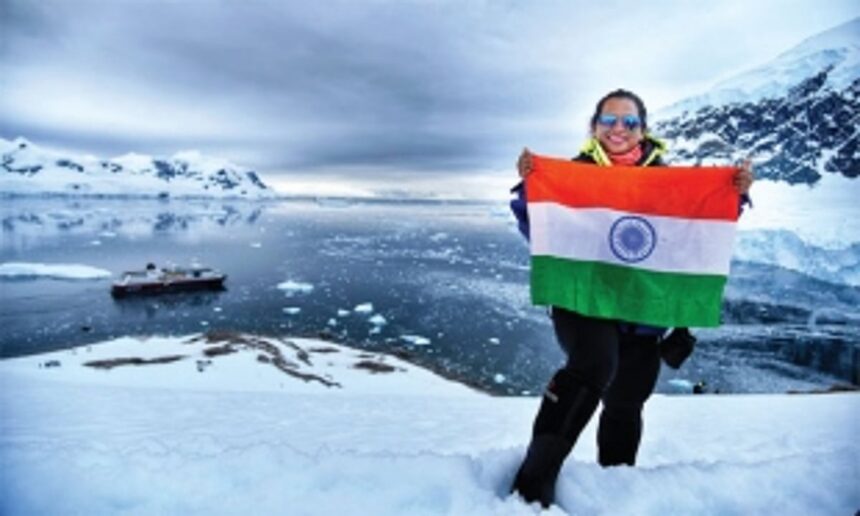
unexplored vastness that is the South Pole. But that’s exactly what Laxmi
Mordekar did a few years ago.
The Explorer
Laxmi is a lawyer by profession, an entrepreneur by aspiration
and an explorer by passion and a Goan to boot from Colva. Adventure-seeking was
not always on the cards but when the pressures of thick law books, law
internships and law competitions increased, it made her hop, skip and jump to
another dimension. She began exploring places and things beyond a common man’s
lifestyle with her first venture exploring the Himalayas. Laxmi has travelled to
almost every state in India, and internationally she has been to France,
Germany, Switzerland, Italy, Vatican, Brazil and Chile. Being born and brought
up in Goa, Laxmi started off along some of the most magnificent, untouched and
pristine beaches of the country but as she ventured out of the state, she
realised that she is a mountain person at heart. She has spent a lot of time in
the Himalayas and has seen an equal number of mountains, glaciers, crevasses,
snow and even the floating blocks of ice in Ladakh. But having it all together
in one frame is something that she has only witnessed in Antarctica.
The Frozen Land
Antarctica is known as the farthest continent, covered in
blankets of white and for kids, Santa’s home. Very few have the advantage of
visiting the South Pole and Laxmi was privileged to have traversed across the
globe to the frozen land.
According to her, on the continent of
Antarctica, everything under the 5-month-bright Sun is in shades of black and
white. Even the wildlife there comes in identical shades of black and white –
be it the penguins, whales, seals, albatrosses, petrels or the skuas. Penguins
fascinated her the most. “They’re simply the most curious, adorable, friendly
and fearless creatures I’ve ever come across while unfurling the Tricolour
against the punitive winds and frigid temperatures of the seventh continent.”
“When I first got there, all I could see
was white; snow, ice shelf, icebergs as far as your eyesight can reach. The
Icebergs form pretty patterns. It is quite a sight to see it in person!” she
exclaims. Shareing about the interaction with people on the frozen continent,
Laxmi says that Antarctica has no native population of its own. Most countries
have their research centres there, like India has Dakshin Gangotri, Maitri and
Bharati.
Food and Shelter at the South Pole
The travellers had to stay on the ship in Antarctica. There are
special permissions required for landing. Camping is prohibited unless you are
a researcher or explorer and have special permissions by the UN and is
permissible under the Antarctic Treaty System. “We stayed on the ship and were
intermediately taken a shore through small zodiac motor boats,” she says.
If you have landing permissions, you can visit the research
centre’s of various countries. The Antarctica continent has one post office,
operated by UK, from where you can send postcards and letters. “Those were the
only persons we could interact with,” says Laxmi. “Our ship showed us
documentaries that suggest that millions of years ago, there were people who
lived in Antarctica. However, there is no concrete proof to that,” she adds.
The
Antarctic Treaty System governs the rules to visit Antarctica, hence no food is
allowed on any of the islands. You can’t even pass urine on any island. In
fact, each time they went back on the ship after landing sessions, the clothes
were thoroughly brushed and dusted for any particles or germs/ insects/ virus
they may have accidently got. Even the shoes were sanitised in industrial
solution to kill any virus or bacteria before they visited the next island.
Through her experience, she affirms that the continent can be visited from
November- February as it is summer time during that time of the year and the
sun never sets. However, the frozen world is still very cold. Being a
mountaineer and an avid trekker in the Himalayas, Laxmi and the travellers
along with her travelled with proper gear to survive the minus freezing
temperatures.