On a blistering hot day, nothing is more satisfying than quenching one’s thirst with a cool glass of water that gurgles straight out of the mouth of a gurguret. Combo, como, gurgulet or maat are the few names you may know it by, but it all serves the same purpose of providing naturally cool water that boasts an earthy tone. This household item has been ingeniously crafted by local potters with the famous ‘Goenchim tambdi matti’. Today, this timeless artefact is available at the local fairs in their traditional form of a rooster, as a gurguret, as a saado gurguret (a dispenser not in the form of a rooster) and a novo dispenser that has been fitted with a tap for convenience.
The beauty of the gurguret is that it is artistically crafted in the shape of a rooster with wisdom handed down by our forefathers. Water in a gurguret is naturally cooled due to the porosity of the dispenser thus ensuring earthy and cooler water for the parched throat. The health benefits of this age-old practice are immense which include reducing the chances of sore throats and increasing metabolism. However, care must be taken to frequently wash and cleanse the gurguret thoroughly to eliminate the chances of stagnation.
Maendra Alvares, owner of the Big Foot Museum in Loutolim, speculates on the origin of the gurguret and its aesthetic value. “In the yesteryears, the kitchen was filled with clay pots and utensils. To solve the issue of a water dispenser, our forefathers crafted an item that was easy to handle and yet pleasing to the eye”. The most common animal in the Goan backyard back then and even now is the friendly rooster. The shape of the gurguret takes up after this animal which is beneficial to humans in more ways than one. “The rooster seemed like an apt animal to imitate in art as well as for utility. The mouth turned into a spout while the tail took the form of the handle. A rooster is often seen standing on one leg and that element culminated in its thick base” he states.
The Goan potter artistically crafts the gurguret by hand and then attaches it with a handle and rooster’s spout. Potter John Paul Valles from Socorro, Porvorim has a thriving business where people from far come to seek these gurgurets. He is one of the few traditional artisans who still makes the traditional gurguret alongside the modern ones. He shed light on the transition in the dispensers as he states, “Initially a brass tap used to be fitted to these dispensers. Over time it has been replaced with a plastic filter. The demand for these gurgurets from people who are health-conscious is still quite high.”
At the Patriarchal Seminary of Rachol, a unique celebration that focuses on the Goan heritage called ‘Amche Diaz’ is celebrated annually. In 2019, the focus was on Goan mud, and the event led to every room of the priests and seminarians being equipped with a gurguret of varying sizes. Fr Agnelo Rodrigues, who was a special speaker at the event, recounts the intricate procedure of making a gurguret. “The gurguret is made from soil which is extracted from Goan fields and one that contains a lot of moisture; it is later dried up and mixed with the powder from the stones used to build houses. Since the gurguret is prepared from natural elements you get cooler water than the normal temperature around you” he explains.
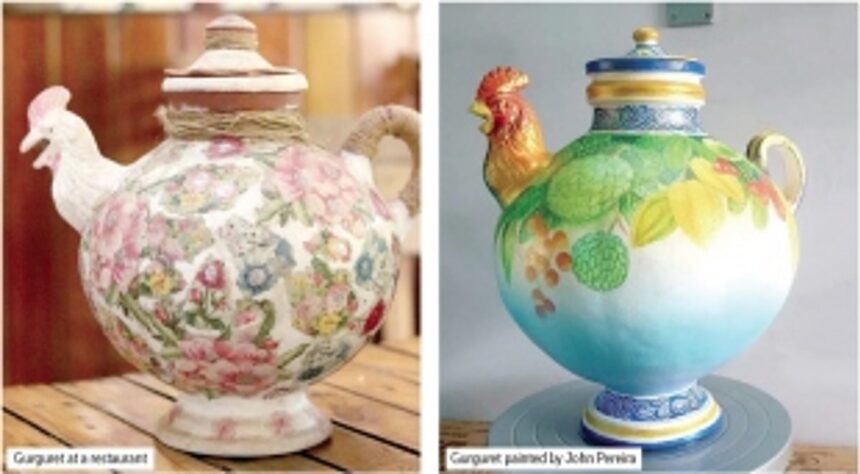
Artist John Pereira captures the essence of Goa of the bygone era in his watercolour paintings. His latest canvas was a gurguret. “I found a unique manner of painting the gurguret with the Goan fruits that capture the true essence of Goa”, he states as he painted a gurguret with tropical fruits for a restaurant in North Goa. Jaykishan P Valvaikar from Old Goa recalls his mother’s sound advice that drinking from clay pots would increase one’s stamina. “Drinking from the Como increases metabolism and most importantly it is chemical free. This cool water can be enjoyed at any point of the day” he expresses.
While museums boost the Goan Heritage with their varied artefacts and displays; restaurants aid in the effort as well. Many Goan restaurants try to blend in traditional Goan elements in the setting as well as in the serving of food. Sachin Fernandes who owns Flames Restaurant in Chandor comments “My restaurant is in a Portuguese styled house that’s more than a century old. All the traditional Goan items here, from the gurguret, buyaos to the mirrors are to pay homage to the aesthetic artefacts that our forefathers left us with”. So even if the tourists that frequent this coastal haven do not get a chance to visit a Goan house, surely the clay serving pots or the gurguret that peeks from the corner of a restaurant gives them a glimpse of a Goa that is beyond the sunny beaches.
The Goa Heritage Action Group will be organising and curating the much-awaited Goa Heritage Festival in November which focuses on celebrating Goa’s rich cultural legacy through events ranging from enriching lecture series, lively literary sessions, indigenous crafts bazaar, thrilling heritage walks, etc. In its posts that are doing the rounds on social media, the gurguret stands tall as one of the main symbols. “Our everyday and familiar gurguret is the perfect symbol of Goan culture and heritage at its best. It epitomizes deep ancestral wisdom, and indigenous solutions to everyday challenges, and also possesses great beauty and style that derives from the most basic ingredient of our identity: Mother Earth in the form of our sacred tambdi mati” opines Vivek Menezes, co-committee member of the Goa Heritage Festival.
Bruna Dias is one of many Goans who has preserved the gurguret as a symbol of the Goan heritage. She reminisces about the gurguret used during her childhood and has one at her home in Curchorem. “I’ve had the gurguret for eleven years now and we don’t use it as much anymore as a dispenser as it is difficult to maintain it but I have preserved it as it is an integral part of our Goan heritage”. One of the challenges of this artefact is that it is quite heavy, extremely fragile and takes a lot of place. Despite the challenges, many Goans continue to treasure it. In 2018, Shelton D’Mello from Vasco gifted his then fiancé a unique gift, a colourful gurguret. “Apart from keeping water cool, it also gives me a sense of tradition. It brings to mind a cherished memory in my grandmother’s house where I enjoyed the entire experience of drinking water from a gurguret. It is an experience that I hope to pass on to the next generation” he exclaims.
It is delightful to watch a child that has finally been allowed to operate the friendly yet fragile gurguret. Though filters and modern technology have slowly come to replace this traditional dispenser, we can still retain a little of our heritage by sharing the pleasure of the water from a gurguret with the younger generation. For the thrill of tilting the gurguret ever so slightly and watching it gurgle out water is truly exhilarating.