Preeti Verma Lal
Hiroshima,
Japan. August 6, 1945. Time: 8:16 am. It was just another morning for Kengo
Nikuwa, 59. He tucked the pocket watch that his son had gifted him, hummed a
song and was walking towards his work site when a mushroom cloud enveloped the
blue sky. ‘Little Boy’ had fallen off the sky. Nikuwa stopped humming. He
missed a heartbeat. He was blinded in yellow smoke. In less than one second,
the fireball had expanded to 900 feet. The blast wave shattered windows for a
distance of 10 miles and was felt as far away as 37 miles. Apocalypse, Nikuwa
was sure. His skin was singed. His right shoulder charred. He was 1,640 metres
away from the hypo centre of the world’s first atomic bomb. Two weeks later, he
succumbed to the burns. But Nikuwa’s pocket watch had died before him. On
August 6. At 8:16 am. In the Hiroshima Memorial Peace Museum, I ran my fingers
over the glass pane that framed Nikuwa’s watch. Time is trapped. Eternally at
8:16 am.
I
walked a few steps and stood numb in front of a lunch box. Shigeru Orimen was a
first-year student at second Hiroshima Prefectural Junior High School. On
August 6, 1945, he did not return home. His homework lay done. His clothes waited
in the closet. Three days later, his mother found a body with the lunch box
clutched under the stomach. The lunch that Orimen did not eat is still in his
tiffin box. Even 72 years after his death. Burnt. Black as soot.
A
punched water bottle, frayed uniform of a school girl, a pair of broken
spectacles, and the blackened shadow of a man sitting on the steps of a bank. A
diorama of skin falling off bones as people try to run away from the villainy
of an August morning and the depravity of a bomb called Little Boy that was
dropped by the American B-29 bomber, christened Enola Gay. At the Hiroshima
Museum, death hangs heavy. The hatred of war clings to the white walls. Black
and white photographs speak of savagery. And the heart wells in despair for the
day when more than 80,000 people died. On August 6, 1945, an entire city was
bereaved. In the black smoke, the dead could not be counted, the screams
drowned in louder shrieks. The city stared at falling bridges, crumbling
buildings and thousands of naked men and women with skin dangling like rags off
their bones. They had nowhere to go, except into death’s embrace. On August 6,
1945, in Hiroshima, Little Boy was the sinner. Hatred, its tool. Death, its
denouement.
For
nearly 50 years, nothing grew in Hiroshima. Not one green leaf popped out of a
brown stem, not one flower wore a sheath of red. The bomb had sowed death into
Hiroshima’s womb. The entire city was an open grave. A week after the bombing,
Hiroshima tottered back to life with a schoolgirl driving the tram that took
people back to work. The survivors picked up the threads of their lives. The
wounds healed. The offices opened. School teachers started drawing rainbows on
blackboards. Life returned. Hope sprung. Tomorrows got brighter.
Today,
Hiroshima has erased the wrath of Little Boy. Despair has been defeated. In the
Hiroshima Memorial Park, a flame flickers eternally and little children leave
behind paper cranes for peace. The boughs of the cherry tree get burdened with flowers. Red, Pink, Yellow. White. Cherry
blossoms blanket the promenades and the ponds. People pull out their mothballed
finery and picnic under the cherry trees. Children laugh, women sing and men
hum a tune. In Hiroshima, August 6, 1945, has not been forgotten. But life
thrives. Eternally.
Captions:
Hiroshima_1:
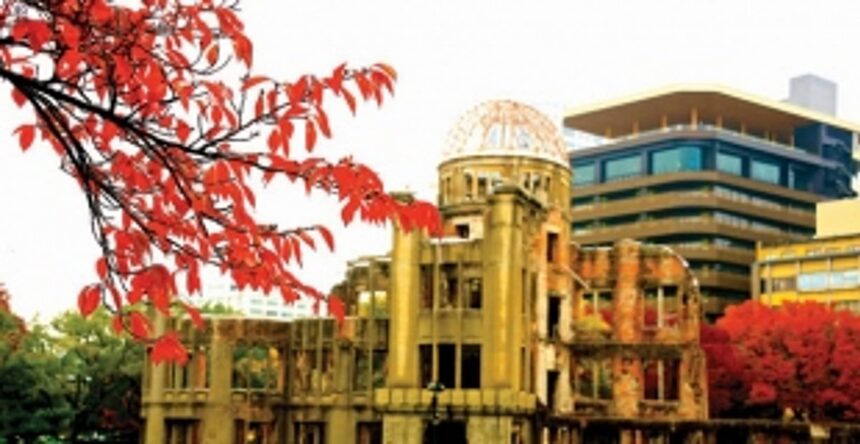
The remains of the Hiroshima Prefectural Industry Promotion Building, known as
the Atomic-Bomb Dome
Hiroshima_2:
A diorama in Hiroshima Peace Memorial Museum
Hiroshima_3,
4, 5, 6: Atomic Bomb day artefacts displayed in the Hiroshima Peace Memorial
Museum
Hiroshima_7:
A sculpture in the Hiroshima Memorial Peace Park