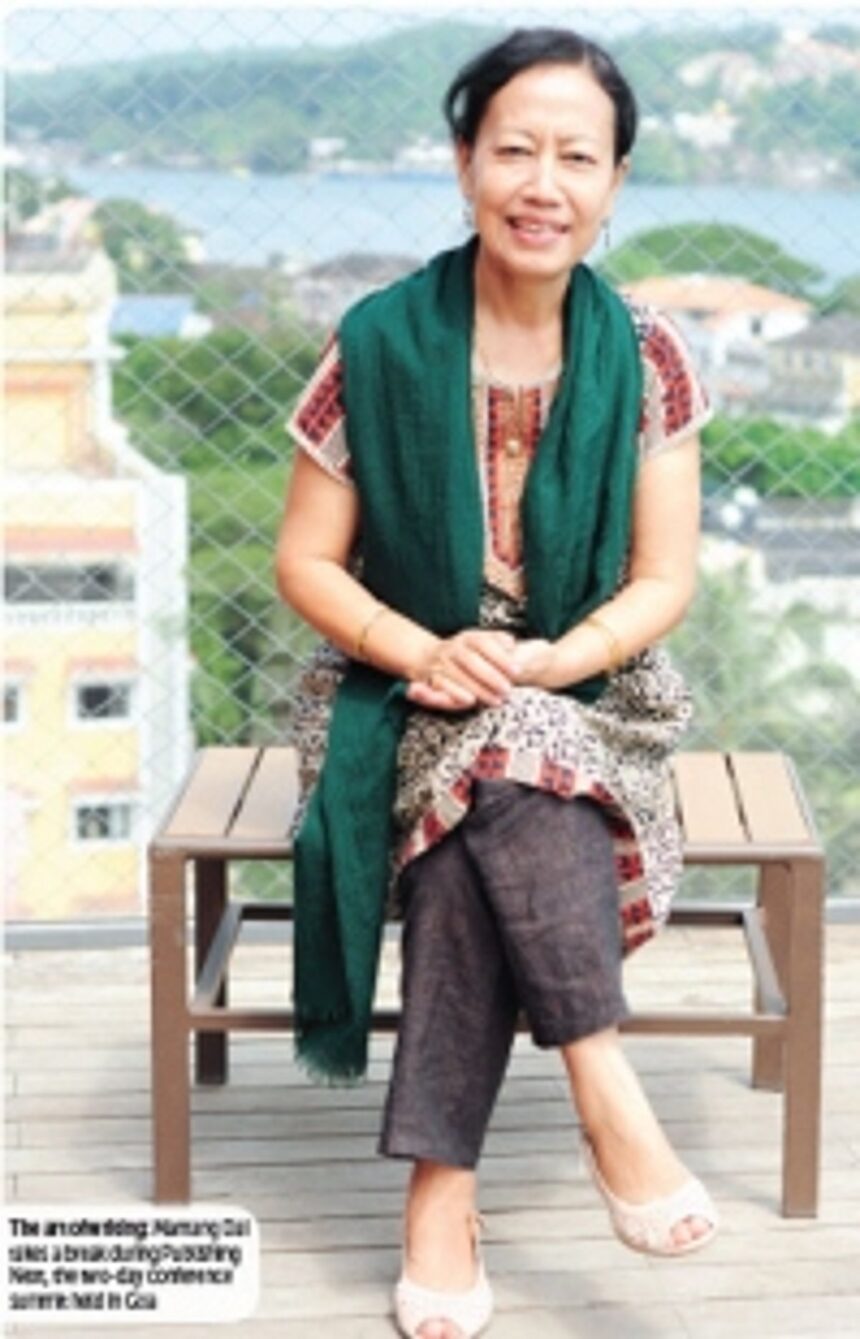
Noted poet and novelist Mamang Dai was the
keynote speaker for Publishing Next, the recently concluded two-day publishing
conference summit that was held in Goa. Describing her experience at the
conference, Mamang said, “It was an interesting and unusual conference with all
the new innovations in the world of publishing. I am not very up with the
technicalities of publishing. I was here to deliver the keynote address and to
learn more about publishing.”
“The city has beautiful architecture,”
added Mamang, who made it a point to visit some scenic spots of Goa, such as
Chorao and Betim, and also caught up with friend Githa Hariharan, a noted writer,
cultural commentator and activist who was also in Goa for her talk at Institute
Menezes Braganza, Panjim.
Mamang, who is gifted with the talent of
lacing her prose with the delicacy of poetry, had launched her latest book,
‘The Black Hill’, in December 2014 at the hands of Fr Victor Ferrao during the
Goa Arts and Literary Festival. “I tried to retrieve 200-year-old history about
two priests in the East India Company and their commitment and bravery. Fr
Nicolas Krick and Fr Augustin Bourry were French Jesuit priests who were on a
mission to reach Tibet. The made their way through a shortcut from Arunachal
Pradesh before being killed by a Mishmee tribal man. The book is about the
story of how the man was captured and who gave his name to the authorities. It
is a story about the labour of love and how this man was the first to be hung
in a jail in Assam,” explained Mamang.
Despite being a fictional biography, ‘The
Black Hill’ still needed proper research. “I collected pieces about Fr Nicholas
Krick and he also maintained a detailed journal with drawings as an
anthropologist which was published by the Asiatic Society of Bengal in 1913. It
was one of the biggest murder mysteries as their bodies were not found but
their Cross, flute and Sextant were recovered from a dealer in Tibet.”
Awards in the North East are huge
milestones for the region. It was a huge boost being awarded the Padma Shri in
Arunachal Pradesh because earlier, there were very few bookshops with only
English dailies. Now, there is a wider reading and as everyone is globally
connected, the young are reading and writing more. In Itanagar, the mother
tongue Adi doesn’t have its own script hence it is written in Roman script; it
has a huge body of literature. There is no link language to connect the
different regions of Arunachal Pradesh,” explained Mamang who writes only in
English. She adds that the people mostly speak in broken Hindi and English.
As a journalist who began her career nearly
two decades ago, Mamang was a correspondent for noted newspapers like Hindustan
Times, the Telegraph and the Sentinel. “It was much safer
when I was writing features and investigative stories. It was a thrill to
attend the Assembly and fax the story immediately. We had no internet so we had
to use a typewriter,” said Mamang, who is now working for the State Public
Service Commission.
Being a journalist helped her grow as a
writer, she said. “Journalism helps you question things and gives a wider
spectrum as more stories come in. It also helped me in editing. As a journalist, we have to report on fact
but as a writer, it can show different levels of truth which can be expanded
into a bigger story.”
When asked about her favourite literary
genre, Mamang said, “Currently, I love reading crime mystery novels as they
have short sentences and street language. The detectives are also interesting
characters as they have a philosophical outlook.”
Mamang is presently working on a book of
short stories.