The Holy Land or ‘La Terra Sancta’ is the territory comprising of the Modern state of Israel and Palestinian territories; and parts of Jordan, Syria and Egypt; where geography fuses with history and belief. The Holy land is a land sacred to all the Abrahamic religions – Judaism, Christianity and Islam, which makes it a major pilgrimage destination.
We first visited Mount Nebo at Syagha in Jordan – which is where Moses looked out and saw the Promised Land of Canaan; and is also the place where Moses spent his last days. Mount Nebo has a beautiful Memorial Church of Moses dating back to the 4th century AD with exquisite Byzantine stone mosaic art work. The church was partly destroyed by a major earthquake in the 8th century and re-discovered sometime in the year 1933 and has been reconstructed – retaining most of the original work. There is a spectacular panoramic view from the Mountain Ridge.

We also visited the beautiful Greek Orthodox Church of St George at Madaba (Jordan), which has exquisite icons and mosaic work of early Christian Art, and the earliest known depiction of the Holy Land map done in mosaic, sometime during the 6th century AD.
We thereafter crossed into Israel and visited Nazareth, the village where Jesus hailed from. Nazareth is a tiny village which has the large Church of the Annunciation (built around Virgin Mary’s grotto) and St Joseph’s Church – built over the workshop of St Joseph the Carpenter. The Church of the Annunciation has beautiful stained glass windows and mosaics and paintings of Virgin Mary which have been contributed by nations from all over the world.
We then visited Cana, where Jesus performed his first miracle turning water into wine. The Church still has one of the large six jars where the miracle was performed.
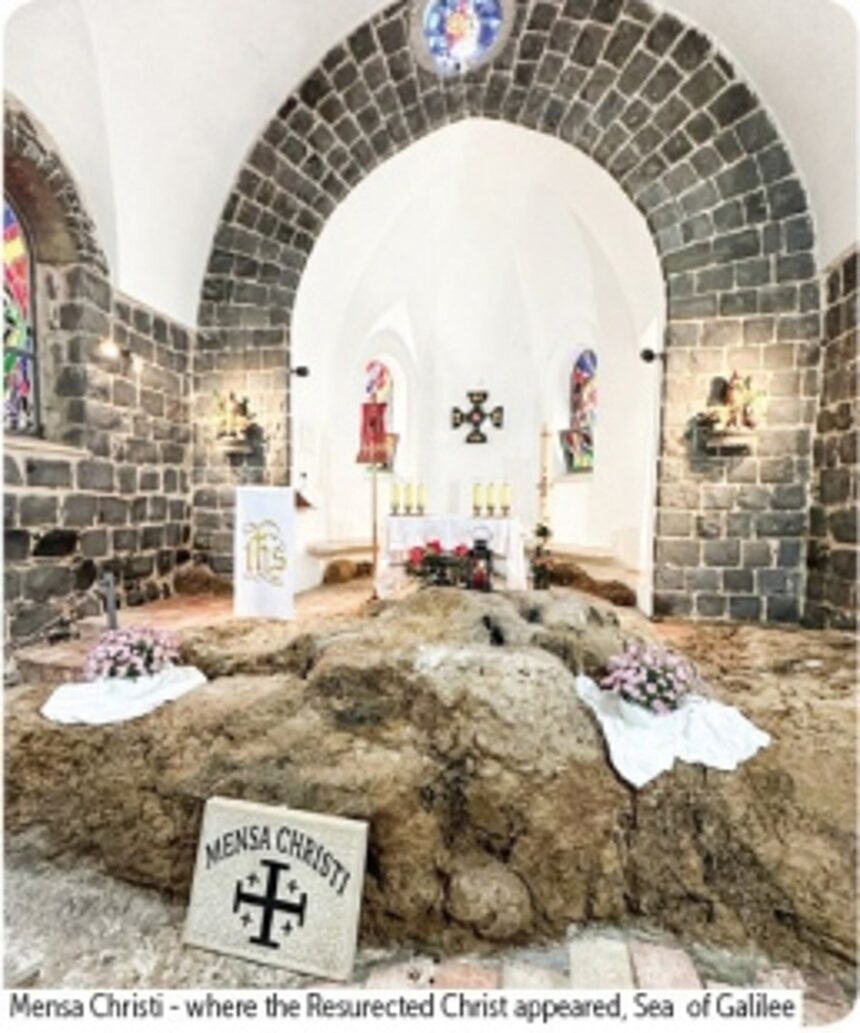
Our group of pilgrims visited the areas around the picturesque Sea of Galilee, – the Mount of the Beatitudes; the town of Caphernahum – where Jesus preached and performed miracles; and the Mensa Christi Rock where Christ appeared after his resurrection, and where the apostles netted the miraculous catch of 153 fish.
The churches in the Holy Land locations are beautiful, capturing the special essence of the spiritual landmark. The Vatican has given custody of the Holy Places that are with them to the special mission of the Franciscan Order who are known as ‘Custodia Terrae Sanctae’. There are several Holy locations under the custody of other Christian denominations as well.
We visited Mount Tabor where the transfiguration of Jesus is said to have taken place. The Church had a beautiful spiritual aura about it, with people from across different geographies engrossed in private prayer. We then moved on to Bethlehem, the place where Jesus was born. The Basilica of the Nativity built over the cave where Jesus was born is one of the most visited sites. The 14 point star over the cave marks the area of the Nativity. The Church has lamps ablaze and has a mystical air and positive uplifting energy about it. Close to the Church of the Nativity is the Church of the Milk grotto where Mother Mary stopped to nurse baby Jesus on the Flight to Egypt.
We then left in the early morning to visit Jerusalem. We first visited the Church of the Pater Noster on the Mount of Olives, the church built over the Rock where Jesus first taught the disciples the ‘Our Father’. It is interesting to note that Queen Helena (mother of Emperor Constantine II) who converted to Christianity, came to Jerusalem around the 4th century AD and commissioned the works of the major churches – Church of the Pater Noster, The Holy Sepulchre Church and the Church of the Nativity.
We then walked down the road and visited the Chapel of the Ascension where Jesus is said to have ascended to heaven after the resurrection. Then one gets the first breath-taking view of Jerusalem, which is on the opposite facing mountain. Jerusalem looked mesmerising with the domes reflecting the morning sun.
The walled city of Jerusalem, the most prized and fought over city ever in history has very important sites of all the three Abrahamic faiths. We could see the dome of the Holy Sepulchre sacred to Christianity; The Dome of the Rock and the Aqsa Mosque, sacred in Islam, The Western Wall (also known as the Wailing Wall) – sacred in Judaism, and Mount Zion – where in faith we all await the coming and reign of the Messiah.
Walking through the garden of Olives and Gethsemane (at the base of the Mount of Olives) left one with a sense of deep melancholy. There is a beautiful ‘Church of Nations’ built over the rock on which Christ prayed in great anguish. We then went further ahead into Jerusalem and saw the upper room where the Lord and his disciples had the ‘Last Supper’ and then walked to the Church of St Peter Gallicantu (the place where Peter denied knowing Jesus three times before the cock crowed and where Jesus was held captive in a dungeon for the night before His passion). The history and pathos of the place was palpable. We then went through the Via Dolorosa – the Stations of the Cross on the Lord’s final earthly journey.
The Church of the Holy Sepulchre, the spiritual focus of Christianity and its most sacred place, sits on the mount at the top of Via Dolorosa, and was originally built by Queen Helena in about the 4th century AD. It has witnessed a lot of pillage and damage with the many edicts, wars and conquests over the centuries and was rebuilt somewhere around the 12th century AD by the Crusader Church. It is a large area which houses Golgotha – the place where Jesus Christ was crucified, the Tomb of Jesus Christ where he was laid to rest, the anointing stone. The huge stone near the Cross which cracked with the earthquake that happened when Jesus died is glassed in and can be viewed clearly down to its base.
Standing in the Church, one is overwhelmed with the sacrifice and history of the place; and the fact that we have the privilege of seeing this sacred place today due to the sacrifice of countless many who have fought to defend this place and the faith for over two millennia. The Church had a charged atmosphere as there were large crowds of the faithful queuing to visit the tomb of Jesus and Golgotha. We were fortunate to have been able to visit both before closing hours – though of course because of the large crowds the personal time one gets there is limited, which however is understandable. The experience at the Holy Sepulchre was an experience of a lifetime and inexpressible.
We visited other Biblical sites – Ein Kareem where Mary visited Elizabeth; Bethany where Jesus raised Lazarus from the dead; Bethany beyond the Jordan where Jesus was baptised amongst others places. We returned via Egypt where we visited Mount Sinai, and the beautiful Cavern Church in Coptic Cairo- where the Holy Family lived for a while on their flight from the Holy Land to Egypt. It was a beautiful soul searching trip spiritually enriching and which provided living water.
In the words of Pope Francis – the story of the Holy Land is the Fifth Gospel. Our bus of pilgrims had a beautiful trip and it is a joy sharing our story – Our Fifth Gospel.