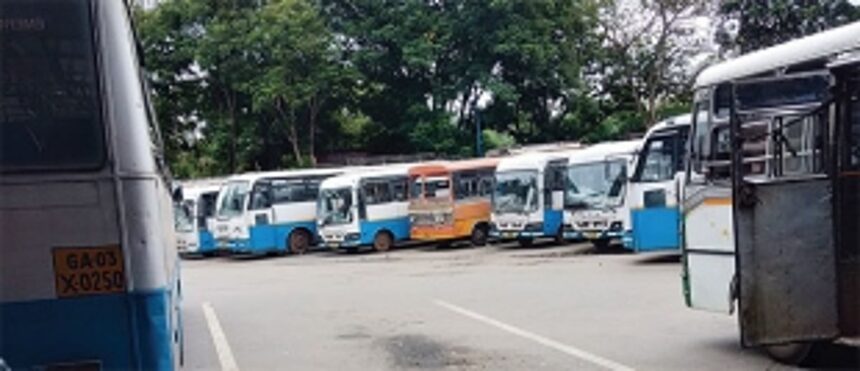
Now with fear having permeated through society following the
spread of the virus not many people are visible on the roads or more
importantly in the buses. Even then how are those who travel by bus feeling
using the services and what are those who run these services feel about the
current situation?
Sonali Pandit is a resident of Santa Cruz and uses public
transport to her college which is based in Pilar. She said “Even when the
lockdown was announced in the beginning, I remember having used public
transport without any apprehension. There were a number of people on the bus
and no one was following social distancing or wearing a mask. Neither was I,
now, of course, it is different”.
Mario Pereira who has a number of buses on the Panjim bus stand
to University route said his bus used to run on that route approximately
sixteen times in a day but now that had reduced to barely four or five rounds.
He said his hands were forced by the fact the number of passengers had reduced
dramatically. He said “There are times when the bus leaves the stand with just
one passenger. A journey that takes forty minutes can now be finished in half
that time because there is no one at the stops. People are worried and this
means our earnings per day have just collapsed. We are not even making money to
pay our diesel bill for the day”. Asked if buses were sanitized, he said buses
had a sanitizer and his staff would insist that passengers follow the sops of
the authorities but he said their task was made very easy by the fact that
there were hardly any passengers in the bus.
Another driver at the Panjim bus stand said earlier it was not
unusual to have seventy to eighty buses operating every day to various routes
in Panjim but now that had been reduced drastically to twenty or thirty buses
because it was not economically viable to do so because there were not many
passengers. When asked of passengers were following the sops issued by the
government, he said it was easy to maintain social distance in the bus because
the number of people travelling had reduced drastically but with regards to
masks, he said out of five perhaps two would wear them. When asked if he
insisted, they wear masks, he said he left it up to them because it was their
choice and he needed their business desperately.
Drivers assembled at the bus stand waiting for passengers said
now passengers were wearing masks and maintaining social distance in the bus
and some were very strict about it. Prakash who operates on the bus stand to
Taleigao, Bambolim and Dona Paula, Miramar route said earlier around forty
buses operated on that route and now it had been reduced to just twelve. Even
then earning decent money he said was very difficult these days. One of the
drivers who did not want to be named said earlier it was easy to earn at least
Rs 800 after all the expenditure but now he would be lucky if he took Rs.
150-200 home. The situation he said was made worse by the rise in the cost of
diesel.
There are approximately twenty-two bus operators running their
busses between Panjim and Mapusa. Now in these tough times, seven operators
operate on the route on one day followed by another group the next day. A
conductor on one of the buses operating on the route said, the buses were being
run just to keep the machine running and none of them was earning money to even
recover the cost of diesel.
Sudeep Tamonkar, General Secretary Bus Owners Association said
there were around 1460 buses operating in Goa every day and that had been
reduced dramatically to just 40-50 every day. Passengers he said were
scared and not travelling by bus. He said “Our main customers are government
employees who now use their own vehicles to travel, migrants who have all gone
back home and students who are now at home. We are running the buses because in
the monsoon if we keep it in one spot, it will start rusting and create more
problems. It is just not economical to run it now. We are spending money and
nothing is coming in.” He said sanitizers were kept in buses for passengers and
people generally followed the rules issued by the government but he said it
would be very easy because the buses were usually empty.
An employee of Kadamba Transport Corporation speaking on
condition of anonymity said KTC had helped sanitize the private buses to ensure
people travelling on the buses were safe. He said this had happened a number of
times in the recent past.
Raj Madekar who owns a bus and has now taken to driving it in
order to save on the expenses of hiring a driver said he was now driving in
from Valpoi and parking the bus in the bus stand and then leaving with a few
passengers in the evening at around 4.15. Earlier he said he would do around
two trips which would earn him decent money allowing him to pay his EMI’s and
other expenses. The passengers he said would easily sit comfortably maintaining
social distancing and since no standing rule was in place, it was a comfortable
ride for everyone concerned, though an uneconomical one.
The biggest stumbling block for normalisation of services is
passenger confidence. Sonali Pandit when asked if she would now travel in a bus
after knowing how the virus was spreading, she smiled and said “I would be
hesitant and if I stepped into a bus and noticed that it was crowded and no one
was maintaining social distancing I would get off. I don’t want to take the
risk.”
The
truth is that it’s no one’s fault. Just like restaurants, resumption of full
public transport services would depend on public trust and that has to slowly
earned.