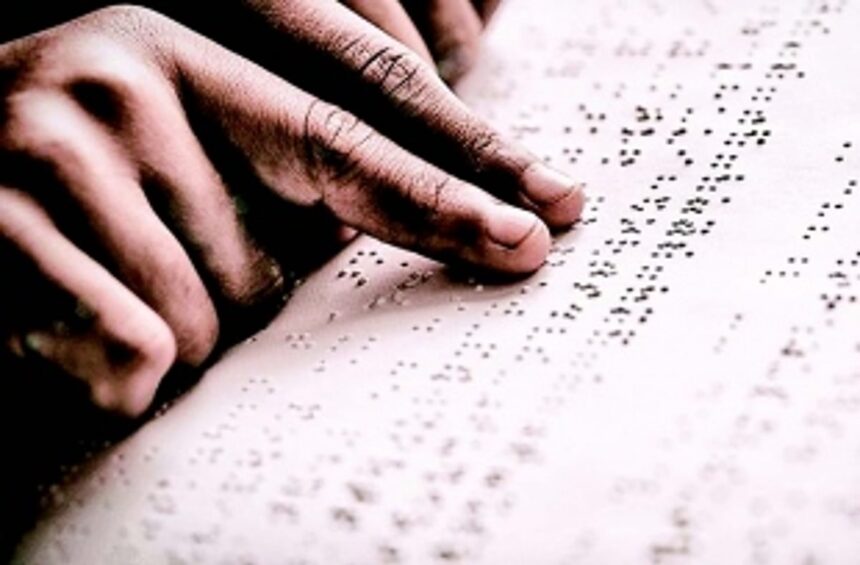
Today, the world celebrates World Braille Day and it emphasises the importance of braille as a means of communication in the full realization of human rights for the visually impaired members of society. World Braille Day celebrates the birth of Louis Braille, inventor of the reading and writing system used by millions of blind and partially sighted people all over the globe. The date for the event was chosen by the United Nations General Assembly via a proclamation in November 2018, and the first World Braille Day was celebrated on January 4, 2019.
The braille system works by representing the alphabet letters (and numbers) in a series of 6 dots paired up in 3 rows. The simplicity of Louis Braille’s idea allowed books to start being produced on a large scale in a format that thousands of blind people can read by running their fingertips over the dots. Sadly the Braille literacy rates across the globe are abysmal with less than 1 percent in India. India has the largest number of visually impaired people in the world. In Goa it is estimated there are around 4000 visually impaired people living in the State.
Prakash Kamat, member of the Goa State Advisory Board for Disability said one of the issues being faced by the visually impaired was the feeling that with ramps being available there was accessibility. That, he said, was not the case. Virtual accessibility on the net, he said, was important. Their education, he said, was entirely done in Braille but this was now evolving into ICT which stood for Information, Communication and technology. Accessibility, he said, was very important. He explained by saying that when visually impaired people visited an ATM, if there was no voice output then it was of no use to the person. He said with an estimated 4000 people in Goa with varying degrees of sight it was important that such facilities be made available to this segment of the population. He said some of them were born blind while others lost their sight after some sickness. In an elevator, he said it was important to have voice input and Braille. Braille he said could not be written off. ICT, he said, was empowering people and it was mandatory in the state.
Tukaram who is visually impaired and an attendant at a Braille library in a school in Ponda said public places were not easily accessible. Braille was not available. He said he learned the language at a local school for the visually impaired. He comes from a village called Vavurlem in Quepem. It is a place with very poor net connectivity and roads that are not easily accessible. He was once the captain of the blind cricket team of Goa. He said apart from the PanjimKadamba stand which had a braille system in place to help people like him, none of the other places had similar facilities. He also said the district hospital in the north and south was tough because there was nothing in braille and one could get lost in those facilities. It was also tough to get a sim card because all the photographs needed them to keep their eyes open which was not possible.
Rama Parsekar who was able to complete his graduation with sight but lost it when his retina got detached said learning braille was not difficult but it was not easy either. He said it was about practice and for those who learned it at childhood it was much easier. He said, “I am reading and writing but it is still a bit of a problem for me. I was once a teacher of computer science for the visually impaired in Bengaluru but am now working in Goa as a lower division clerk at the Government College of Arts, Science and Commerce in Sanquelim.” Goa he said was tricky for a visually impaired person. He said services like Ola, Rapido made it easy for him in Bengaluru and then the public service had a voice announcement system in the bus which was helpful. In Goa, he said occasionally the conductor would call out the stop which was helpful. He said he had adjusted to life and was living with his mother now.
The dream of joining the public service is available to everyone. Omkar Pawakar who is also visually impaired is preparing for the UPSC and GPSC exams. The 25 year old from Fatorda was born visually impaired and he felt travelling in Goa was a bit difficult when compared to Mumbai which had services like Ola and Uber which was not available in Goa. He said if the registered drivers in Goa miles did not respond he would have to fall back on family members or on private taxi operators. He strongly felt that there should be more institutions like Saksham which were not present in Goa. He said the government had to take more initiatives to become friendlier for the visually impaired. He said he did not prefer to read books in Braille for the exams he was preparing for. He said he would go online to the largest library for the visually impaired called BookShare which were audio books. There were around 10-15 lakh titles which were available on various subjects. He hoped the government would spend money on creating awareness about people with disabilities and improving the transport facilities.
The use of braille has to increase and the State has to ensure it uses the facilities at its disposal to ensure it happens.