Situated towards the north western side of Margão, Fátorda is home to a once picturesque village of Ambájim, which is gradually losing its charm through the hands of its own residents. Ambajim is a small village marked by laterite monoliths at each of its boundaries and was known for bakery being the major occupation of its residents. However, in today’s time with lack of awareness amidst the current generation, the boundaries of the village have unfortunately turned fluid. Christianity possibly reached Ambájim in 1730, when a Chapel consecrated to the Sacred Heart of Jesus was erected there. As one passes through the village to proceed to Arlem, one will see a Chapel built at the foot of a hill, having a series of steps leading to an open space in front of it, towards your right. This chapel was erected in 1930 and was consecrated by Fr Francisco Xavier Pereira from Nágoa-Verna, on December 21.
‘Santos Passos’ in Portuguese means ‘Holy Steps’ and signifies the journey of Lord Jesus Christ to Calvary. It is a depiction of the ordeal, contemplation and suffering of Lord Jesus before being crucified. Every year, the chapel in Ambajim observes the Santos Passos on the first Friday of the Lenten season. This year, the Passos will be held on February 16.
In Goa, the Santos Passos (enactment of the Holy Passion of Christ) is held in all parish churches and even some chapels, generally on a Sunday in Lent. “Santos Passos generally comprise of seven representations unlike the Way of the Cross, which has a total of fourteen. These seven include Agony in the Garden, Detainment, scourging at the Pillar, Ecce Homo or This is the Man, Death Sentence, Carrying of the Cross and Crucifixion, which is Good Friday and veneration of the Senhor Morte (the corpus of Christ),” mentioned late Fr Nascimento Mascarenhas. Interestingly, the chapel of The Sacred Heart of Jesus, in Ambajim contemplates on the last passos i.e. the veneration of Senhor Morte on the very first Friday of Lent.
According to Fr Francisco de Souza, who is the chronicler of the Society of Jesus, the origin of Santos Passos is attributed to Fr Gasper Barzeo, who was a Dutch Jesuit priest within the St Paul’s in Old Goa back in the 16th century. He made use of this ‘theatrical spectacle’ to strengthen devotion to Christ among the faithful. Fr Barzeo instituted the procession of ‘flagellants’ (public flogging) every Friday to stay up this fervor. He would preach on the words of the Psalmist: ‘multa flagella peccatoris’. He would then represent another half hour on some passage from the eagerness of Christ. This was followed by the display of the Cross to the people, who successively would cry and scourge themselves.
At the chapel, all expenses of the Santos Passos were traditionally borne by the newly married daughter-in-law of Ambajim and hence referred to as the ‘Santos Passos de Nora or Sunna-ge- passos’. Now, new daughters-in-law from the neighboring wards of Chondwaddo, Khursawaddo and Virabhatt are also allowed to organize the passos.
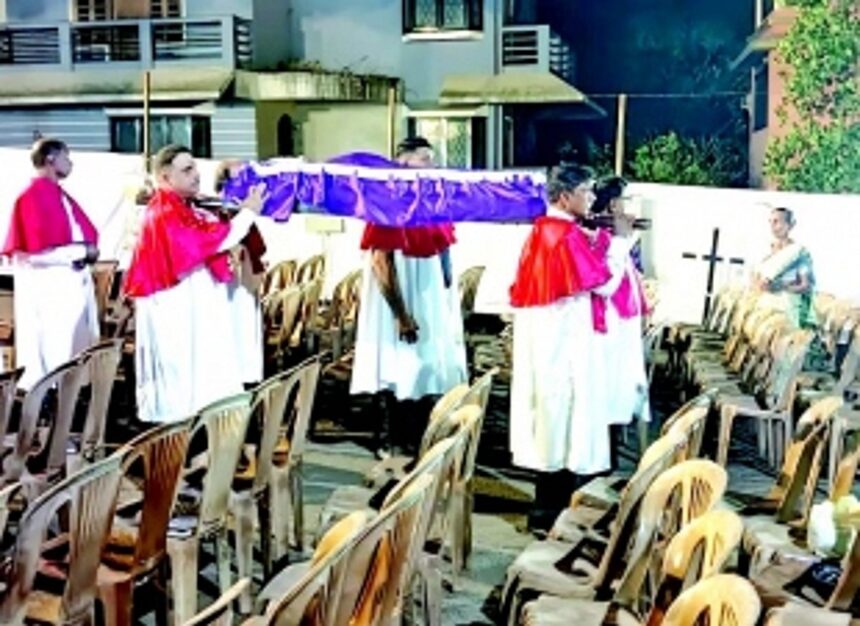
On this day in the evening, Mass was held inside (now held outside to accommodate larger number of faithful) the chapel which was followed by a procession in the village of Ambajim. The practice of having the procession most likely began in 1998. The procession begins at the chapel, proceeds towards the government primary school, comes towards the house of Bazilio Andrade and proceeds back to the chapel. Every household lights candles onto their compound walls, along the route of the procession. Some families even burn incense. At the end of the procession, the celebrant priest together with the new daughter-in-law of Ambajim, would walk along with the members of the ‘Confraria do Sagrado Coração de Jesus’ who would be given the privilege to hold the statue of Senhor Morte.
All the families of Ambajim would prepare a sweet called ‘Sojji’ also known as ‘Godshem’, comprising of gram, palm jaggery, and coconut. After the procession, the statue of Christ was placed right at the foot of the main altar where the faithful would come to seek blessings of Christ by kissing His feet. The whole altar would we covered in a black veil decorated with silver stars. Sadly today, the traditional practice of vailing the altar is not followed and the statue of Christ is placed in the nave of the Chapel for veneration by the faithful. During the veneration, the priest and the members of the confraria (irmãos) get the privilege to kiss the feet of Christ first, followed by the rest of the congregation. As the faithful proceed to kiss the feet of Christ, traditional 19th century motets were sung in Konkani. Sadly, hardly any of those traditional pieces are sung as of date. It is noteworthy to mention that the statue of Senhor Morte was once taken for the Santos Passos held at the Chapel of Our Lady of Perpetual Succor situated in the neighboring village of Kirbhat in Nuvem, on the next day after the passos in Ambajim, since the chapel there didn’t have a statue of its own and they commemorated their Santos Passos on the first Sunday of Lent. The statue was taken to the chapel by 4-6 men on their shoulders as they walked from Ambajim to Kirbhat through paddy fields along the way. It was then returned back to the Sacred Heart of Jesus Chapel on the day after their passos. This practice of borrowing the statue of Senhor Morte for the passos was most likely discontinued in 1993, when the chapel at Kirbhat made their very own statue of the Corpus of Christ, to be venerated during services held there.