Hello, and
welcome to Goa. We’re that place. You know, the place, the one with the cheap
liquor, bountiful beaches and expensive taxis; that one. We can’t blame you for
branding us that way. After all, the powers that be have done everything in
their power to perpetuate that same branding. There have been nearly no efforts
to highlight the things that truly matter. Well, almost none, anyway. However,
there are a few shining beacons of hope in the midst of it all.
One such
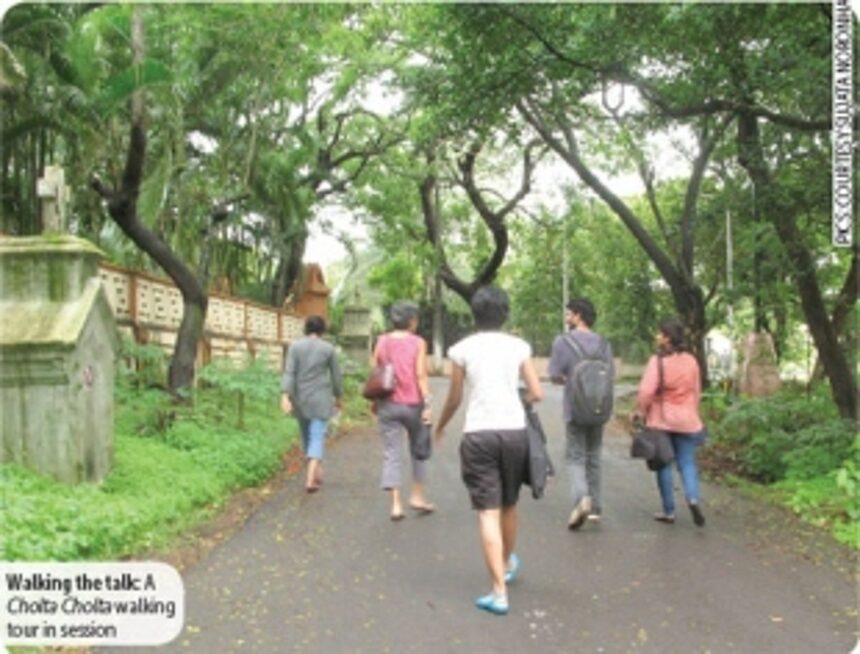
example is that of Sujata Noronha, Director of Bookworm, who organises heritage
walks called ‘Cholta Cholta’, which translates to ‘whilst walking’ in Konkani.
These walks are perpetuated by a few individuals, who look at keeping the heart
and soul of a culture that is truly Goan alive and allow travellers to explore
and experience the city of Panjim, its small streets, alley ways and remarkable
history couched in old buildings and forgotten structures in a meaningful way.
Sujata shares her experiences, saying, “I think the first step is in our
backyard, where each of us who live and love Goa need to understand and learn
more about our own history and heritage. We do this at Bookworm by reading as
much as we can about Goa, organising sessions around local, culturally
significant themes and our singular ‘Cholta Cholta’ walking tours.” The little
walking tours end with breakfast at a local restaurant
to experience the true flavour of a Goan morning.
Of course,
it is stakeholders like Sujata that are responsible for managing to weave
together the fabric of a true Goan experience. In the heart of Fontainhas,
Panjim’s most popular Latin Quarter, lies a touristic landmark for a heritage
experience: Panjim Inn. Run by Jack Ajit Sukhija, the current incumbent, Panjim
Inn delivers an experience par excellence for all who walk in through its
doors. However, Jack believes that certain measures need to be taken, if we are
to target being a heritage tourism destination on the whole. “To promote
heritage tourism, you need to have a policy which aims at making heritage
assets economically self-sustainable. Conservation of heritage buildings should
be done in such a manner that adaptive reuse is possible. Heritage buildings
and assets can generate revenue as event spaces, heritage hotels, restaurants,
boutiques, etc. Goa has architecture and houses which are unique in India.
These are a source of our identity and history. We must aim to conserve them
but at the same time see that they generate revenue to sustain themselves.”
Adding to
how he believes that this can be planned, Jack says, “Heritage tourism can be
promoted in two steps. The first is curating heritage experiences such as
walks, music such as fado, and a series of cultural experiences. The second is
to facilitate the setting up of heritage tourism products such as adaptive
reuse of forts, Adil Shah’s Palace, heritage homestays, serviced villas and
promoting them on the GTDC website.”
We have, in
previous stories, spoken of some hidden gems like the Khorjuve Fort (also
called Corjuem Fort) approximately four kilometres from Aldona, something that
most bodies don’t always aim to promote, and goes unheard of if not for the
attempts of a few private stakeholders to keep things going. In fact, Khorjuve
Fort is in many ways similar to the scarcely visited region of Rajasthan known
as Bundi. The latter is on the to-do list of many a European tourist,
especially those from Germany and France, however not so much the domestic
traveller, who opts for Udaipur, Jaipur, Jodhpur and Pushkar over the
art-centric little town. The rise of heritage tourism has brought Khorjuve Fort
to the attention of many foreign tourists. Over the course of a previous
conversation, Atish Antonio Fernandes of First Class Holidays pointed out that
his enterprise had pioneered an excursion called Forts and Heritage for
international visitors who came in on cruise liners, highlighting that Khorjuve
Fort was a part of it. The programme began in the year 2013 and already had
upwards of 400 international visitors to Khorjuve. Atish also went on to add
that he believes that the fort has great potential, if restored in a
historically accurate manner. “At First Class Holidays Goa, we constantly
endeavour to promote heritage tourism, both architectural and living heritage
as well. We have several options on day tours that we offer our guests. Also,
we try and actively support heritage hotels like Panjim Inn and others by
suggesting our clients to stay there,” Atish adds.
There are
many more unsung heroes like these. Perhaps their vision can be a call to
action. The work of these enterprising private-sector individuals can be taken
up by others. It can also be a method by which the public sector takes a leaf
out of their book, and goes a step further. Will it come to pass though? Only
time will tell.