He is a graduate of the prestigious
Goldsmith’s School of Art, London but for over three decades, British artist
Julian Opie has sought to push boundaries of portraiture, painting and
sculpture, breaking down what he believes to be illogical barriers between the
disciplines. Over the years, he has developed an instantly recognisable and
unique formal language through digital manipulation, reducing images to
simplified forms of line and colour. Portraits and animated walking figures,
rendered with minimal detail in black line drawing, are hallmarks of this
artist’s work. Yet, he desists from categorising his work, stating, “I am not
keen on notions of style. But I do know that every time I use a new technology,
it means months, if not years, of trial and error.”
Elaborating on his early experiments and
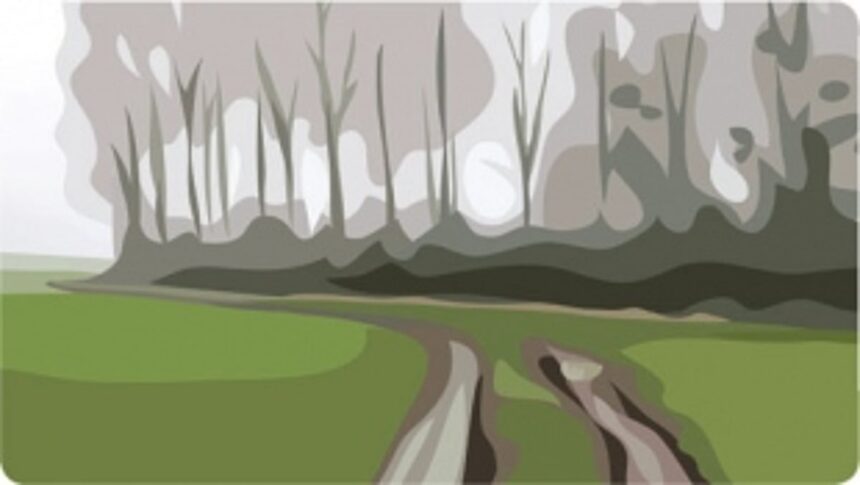
the genesis of the ‘Winter’ series, Opie was intrigued by the way Google Street
View worked as well as some early computer games where movement through space
was economically evoked by surging from one static position to the next. “I
thought I could make a different kind of film. I took a walk around my house in
France, finishing at the same spot I started from and taking a photograph every
forty paces. When seen in series, I think you can feel something of the way it
feels to move through space, the way you occasionally take stock of the view
and use landmarks to gauge your progress. I had to draw fast to keep the sense
of brief glimpses and movement, and once I got to the last image, I carried on
and redrew many of the first images as I had by then developed a rhythm and a
way of editing the infinite detail of nature. I made the first film in the
summer when the French colours are rich and the trees full, but I love the
landscape in winter too and although winter trees are very hard to draw, I made
this second set and used the 75 resulting images to make an edition run in
itself. This landscape has a lot of emotional attachment for me and the film
has a melancholy soundtrack sung by my wife, Aniela. For me, playing with and
thinking about ways of looking is central to making art. To put this project
together, I found myself referring to and looking at Google Earth and Sat Nav
systems, flight simulation programs and computer games, and also old master
Dutch landscapes (van Ruisdael) and 19th Century Japanese woodblock prints
(Hiroshige), ” explains Opie of his prints. He captures each stage on the walk
in a single digital print, coloured in a palette resembling army camouflage.
The works are then laminated to a glass façade and presented in a grid format
on the walls.
Of the belief that every artwork is a
narrative and a successful one circles endlessly, Julian feels that by using
actual movement he can draw a viewer in and invite a collaboration of looking
for its own sake, like a juggler!
(‘Winter’ will be exhibited at Sunaparanta
– Goa Centre for the Arts, Altinho from October 2 to 28, 2015 from 10am to
6:30pm)