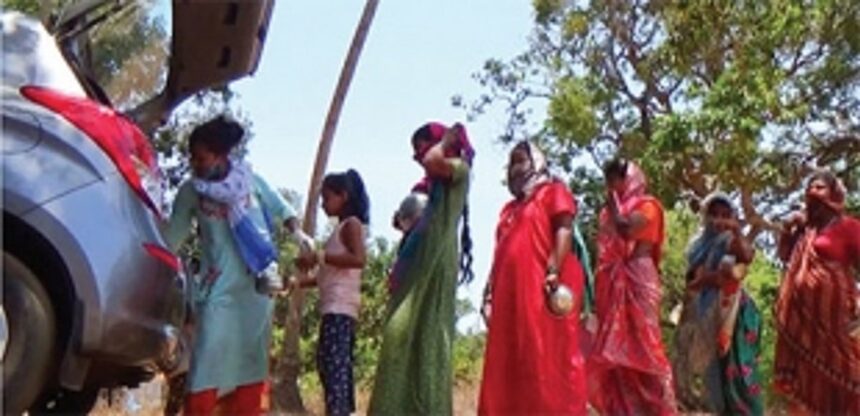
“What… are you going to let them be hungry?” The smile on Nupura Hautamaki’s face is filled with incredulity as she explains why she and others continue to feed migrants stuck in Goa despite volunteer burnout and depleting funds. In Aldona, as artist Rini Joseph re-visits the “platform” that inspired an artwork and a heart-wrenching poem, she recounts the helplessness she felt as a volunteer trying to help migrants get “basic resources”. Her “Facebook scandal”-causing poem that begins—“I have newfound spite for pity. It has the bitter after taste of privilege”—captures the “fruitlessness of pity and sympathy so often accorded to the needy by the privileged classes”. The “scandal” was over the assumption that the village was shown in poor light by this “outsider”—a tag hurled, albeit indirectly, at Jaydeep and Nandita Deosthale of Sangolda too who, Nandita says, were denied rations by their ward member because they were not voters. It of course didn’t stop the Deosthales from relentlessly feeding migrants through their Migrant Support Group. And it is this latter sentiment that ‘Trapped in Paradise’, made by Living Heritage Foundation captures in an emotion-filled, 41-minute documentary film. “My partner and wife (the film’s producer, Priya Sule) was volunteering with the Goa Humanitarian Helpline (GHH) trying to feed migrant workers in Moira when Vijaya Josephine Pais (also with GHH) asked if someone could record the efforts. We said we’ll do it,” says the film’s interviewer and editor, Marc Francis. The thought behind the deed, the Moira-resident explains, is to remember all the aspects of the Covid-19 pandemic “not just the statistics of deaths”. “And these aspects will be recalled in history through photos, videos, even poems,” says the 37-year-old. Cameraman Mohan Kumar recalls how the initial belief when the team started shooting on May 13, was that this would be a 5 or 6-minute video. “People had the idea that all was fine. But when we got down to good old on-the-ground reporting we realised things were not alright. The scenes were heartbreaking. Here we were storing food in our homes while these migrants couldn’t even get a meal,” says the 40-year-old former print media journalist. The serpentine queue of 1,300 migrants from Aradi ward in Candolim receiving rations started an avalanche of overwhelming moments for the team. “As we shot at one place, we got to know about an effort on another day at another place and we went there and this just continued,” recalls Francis. By May 27, the last day of shoot, the team had captured so many nuances of the migrant relief effort that the video stretched from 10 minutes to 20 to 30 and “finally, we stopped at 41 minutes for the sake of ensuring the message doesn’t get lost,” says the filmmaker. The message, summed up in the film’s final dedication shot—“To those who stood up and showed us what it means to be human”—also carries the GHH phone numbers to contact if you know someone looking for employment or if someone wants to contribute or support the cause. But before it gets to the end, the film captures the reality that overwhelmed the citizen volunteers too. Take the the moment in Candolim when Vijaya Pais, describing Aradi, says, “It’s just a tiny little area that none of us even knew existed with 1,300 people.” Or at the Bambolim stadium where Miriam Koshy-Sukhija of Covid Outreach Goa recalls how the desperation among migrants led them to have suicidal thoughts, forcing volunteers to include a dedicated counselling helpline as well. Or in Candolim where Mark D’Silva—having just faced an iraterlocal demanding that the feeding effort be stopped because the migrants “are not maintaining social distancing” and “can infect my village”—offers his “simplistic look” on how the crisis could have been avoided if people could have just taken an all-encompassing look that if my stomach has been fed make sure my neighbour’s is being fed. Or in Moira where Garima Roy recalls how the efforts expanded to feeding the migrants going back to their home states in trains as well after volunteers got to know that many had not been given food and some had even died of dehydration. Or at the ration-supply drive at Arpora where Shardha Kerkar, explaining how the citizens’ efforts were successful because of cooperation and coordination, says, “The government has all the infrastructure; all the resources. What they lack is the will to do something.” Francis reluctantly agrees, “Though we were following trails and even found someone (Priya Rathod in Arpora) who was feeding migrants everyday with support from family and friends, sadly, none of the trails led to any government effort.” Concluding with his most overwhelming take-home from the shoot, he says, “We noticed that while the migrants stood in queues for half an hour got their rations and went home, the volunteers were there through the day, skipping food and even water. It was the most touching aspect of this sordid reality.”
Those who showed us what it means to be human
‘Trapped in Paradise’ is a 41-minute film that captures the back-breaking efforts of citizens’ initiatives that battled volunteer burnout, fund crunches and ‘outsider’ tags to relentlessly feed thousands of hungry, jobless, penniless and suicidal migrants stranded in Goa during the Covid-19 lockdowns