SUBODH KERKER HAS CARRIED THE COCONUT ACROSS THE SEAS
Looking at an
installation is not merely seeing the
work on display but understanding the deeper meaning behind each piece of
creation. Now imagine a 14- foot in diameter disc with coconut husks standing
in a forest in Yorkshire, England. It is surely a conversation starter that
will raise questions on how the humble coconut husk has travelled across the
oceans to bear the winters in England.
Subodh
Kerkar, a conceptual sculpture artist and the founder of Museum of Goa, Pilerne
has been creating works that form an East West connect. Now, seven of his major
sculptures are adorning the forests in Yorkshire as they are set up permanently
at The Himalayan Garden and Sculpture Park, Yorkshire, England, owned by Peter
Roberts and his wife Caroline.
Four
works were exclusively executed in Yorkshire – ‘The Oceanic’, ‘The Dialogs’,
‘The Library’ and ‘The Pineapple Disc’ while ‘The Cotton Field’, ‘Laterite
Stone Head’ and ‘Karimeen’ were created in Goa and shipped to Yorkshire. Subodh
explains how the six-month-long artistic journey began. “Peter Roberts, who
commissioned me to do the work, had come to Goa and was staying at a boutique
hotel. These hotels request me to take their guests for walks. Peter came for a
walk with me at 6:30am and ended up buying a few works from me.
When my works were
shown at London’s Royal Academy Summer Exhibition, he invited me to spend a few
days in his home,” says Subodh. He adds, “This time, he took me for a walk in
the forest that he owns. I saw a lot of logs lying in the forest and I asked
him what he will do with these logs; he said he would sell them for firewood. I
told him, ‘why don’t we plan something for sculptures with the logs?’ He liked
the idea and asked me to give a plan. I came back to Goa and started thinking
about what sculptures I could do with these logs and I gave him my proposal,
which was accepted and then I went to Yorkshire. I was supposed to go with my
team from Goa but since their visas got rejected, I had to form a team in
Russia. I had two carpenters from Russia, who had done workshops at Museum of
Goa and 5-6 people from England. We worked with cranes and other machinery.”
The first work that
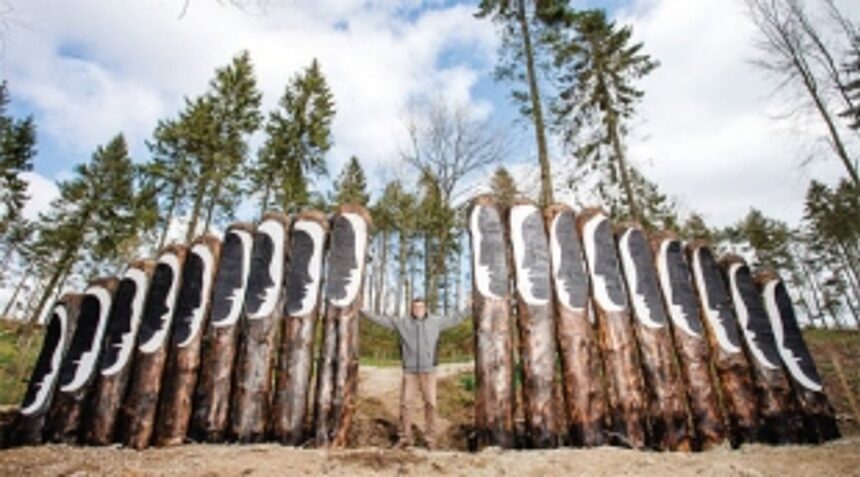
was done with these logs was the ‘Oceanic’, which is a temple of the ocean. “In
Goa, I came up with the idea that I will create a temple of an ocean in
Yorkshire because oceans have played a very important role in shaping cultures.
All that I took from here was a deity, a disc of cowrie shells. But what shape
this temple would take was essentially influenced by my Russian colleagues,
Katia Menshikova and Slava Shvaikov. We worked together, ideas germinated and
these pillars were carved by Slava using his chainsaw. This is just the
beginning of the first temple of the ocean,” says Subodh.
Another installation
with the logs is ‘The Dialogs’.
The ‘Pineapple Disc’
is also an interesting piece of work showcasing the marriage between the raw
materials of Yorkshire and Goa. “This is a 14-foot diameter disc, one side of
it covered with pinecones from Yorkshire and the other side covered with
coconut husks from Goa.
The husk travelled
all the way from Goa. It crossed the Indian Ocean, the Red Sea and the Swiss
Canal, crossed the Mediterranean to arrive in England,” says Subodh.
Speaking
about using the materials from Goa and shipping them across the continent for
meaningful art, Subodh says, “I am the messiah of ‘kottios’ (coconut shells).
Even the Goan laterite stone is getting a new experience as I have used it for
the installation ‘Laterite Stone Head’; the stone, which is used to living in
the Goan heat, will experience -10 degrees temperatures and snow in Yorkshire.
It is truly an exchange of cultures.”