We all grew up listening to stories. There was
a time when kids would not go to sleep without
their bedtime dose of stories. Whether it was to
teach their kids a lesson, impart a value or scare
them, stories always came in as a handy tool
for parents. Going to their grandparents’ house
during the summer vacations was a special treat
for children, as apart from all the pampering, they
could also explore the treasure chest of stories their
grandparents had. But as they say, time has changed
the habits and lifestyle of the people, as well as the
ritual of storytelling.
If you peep into the homes of today, a parent
tucking their child in for the night with a story is a
rare sight. Parents are so busy nowadays, and with
no grandparents around in a nuclear set up, most of
the kids come in contact with stories only after they
learn to read. There are some folks who introduce
their kids to storytelling through digital media, but
the wonderful traditional family ritual of storytelling
seems long gone.
Thankfully, all hope is not lost as efforts are
being make to breathe life into this much loved
practice. Storytelling is evolving from being a
traditional parenting ritual, to an art form to be
presented on the public platform.
Ratnamala Diwkar, assistant teacher at Holy
Rosary Convent School, Nuvem and an active
member of Konkani Bhasha Mandal – a body that
organises a storytelling competition every year –
feels that it’s the insurgence of technology that, in a
way, has taken us away from this interactive activity.
“Today’s busy parents hand over television, internet
and smartphones to their children as the means of
entertainment. Due to this, we are missing out on
this beautiful communicative activity. So, I think,
taking stories to a public platform is the need of the
hour,” she states. The storytelling competitions, she
thinks, are an exercise not just for the child who
is participating, but for the whole family as well.
“Children start reading more books to find a brilliant
story. Parents revisit their childhood in order to
search for a tale their parents might have narrated
to them. Some enthusiastic ones also come up with
their own stories. Thus, these competitions become
a very lively and innovative activity,” Ratnamala adds.
“Storytelling is a very important factor as far as
a child’s development is concerned, as stories take
you to a different place altogether. They allow kids
to imagine, to think, to feel,” says Andrea Crasto,
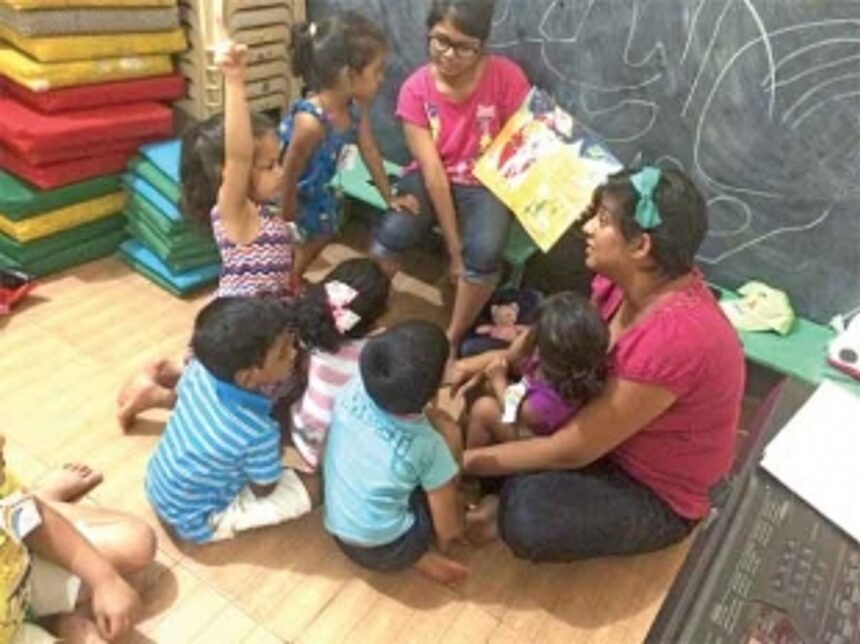
Founder of The Hungry Mind Activity Centre,
Margao, an activity centre for kids that organises
regular storytelling workshops. She reveals,
“Formal education is more about mugging up and
reproducing the facts. It doesn’t provide much scope
to develop the imagination. I think here is where
storytelling plays a major role as stories let the kids
reason, interpret and find out stuff on their own.
Storytelling is even more involving than reading as
it lets the listeners experience the excitement of the
narration. As parents in the nuclear family don’t really
have time for this activity any more, workshops like
ours do the needful.”
Mahendra Faldesai, a retired teacher, shares an
interesting example of how the traditional arts we
have pursued for centuries are dying out or taking
different forms. “In Canacona, the Velip-Kunabi
community has an interesting tradition. On a specific
day, the villagers belonging to this community gather
and spend the whole night narrating and listening to
stories, mainly from mythology. A group of around 5
to 6 people, comprising singer, narrator, musicians
and chorus, tell stories, both in the form of prose and
poetry, throughout the night. However, majority of
the youngsters belonging to this community do not
seem to be interested in this festival, and thus, it is
feared that it will die out after the few enthusiastic old
participants stop performing.” According to him, it’s
the new-age technology and fast life that is depriving
the kids from taking in the pleasures of these
activities like storytelling.
Sujata Noronha, Director of Bookworm Goa,
shares a slightly different opinion. “Though earlier,
storytelling was more prominent in the households,
it did have a public platform in the form of travelling
storytellers. The only difference is that this practice
was prevalent in a few communities only. Today,
the real shift has taken place. Earlier, kids were the
listeners., now they are becoming the storytellers as
we can see in different workshops and competitions,”
she explains. So, as opposed to the popular belief
that children are drifting away from stories, she
thinks that kids today are becoming the carriers of
the stories.
Sujata concludes, saying, “Stories are a very
important part of our lives, as important as breathing.
It’s the medium through which we share our
thoughts, emotions and information. We must
cherish and pass on this beautiful world full of
knowledge, imagination and dreams.”