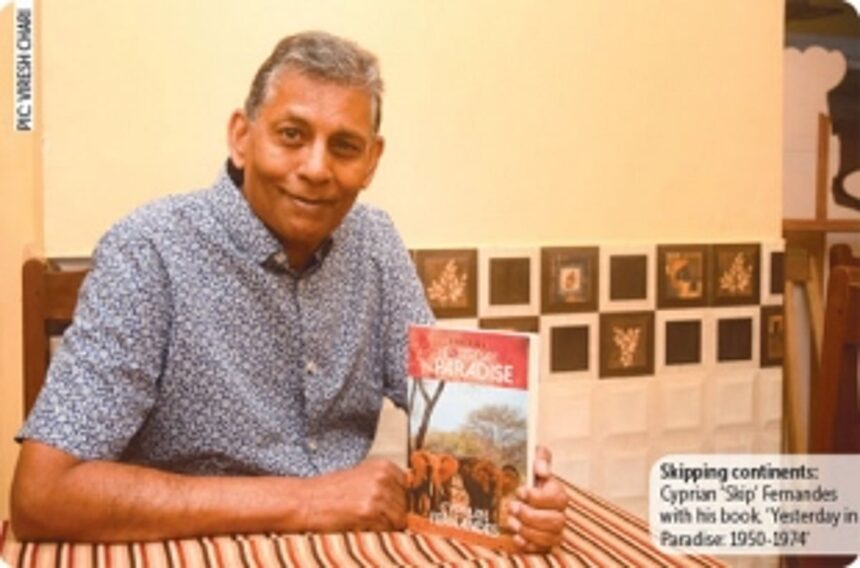
At the age when children are still studying in
school, the whole of 13, Cyprian Fernandes, who was in Kenya, Africa, left
school because his integrity was questioned and he refused the punishment. Yet
he was full of determination and walked into the office of the Nation, the
first newspaper in Africa to use computer generated copy. He lied about having
an appointment with John Bierman, the fearless founding editor of The Nation,
who called him ‘the biggest conman I have ever seen’ and yet gave him the job.
He lied about his age, stating he was 22 when he was just 16. He also lied that
he had completed high school. But it was his boldness and willingness to learn
more that made him excel in the field of investigative journalism.
Now settled in Australia, Cyprian wants to share
his journey with the readers through his book, ‘Yesterday in Paradise: 1950-1974’, which is a fascinating,
book full of drama, with never a dull moment.
“The media in the 1960s was probably my sacred
sacrament. The Nation was made up of African writers and reporters, sub editors
and a lot of Fleet Street journalists, like all good journalists, devoid of
prejudice and discrimination. The newsroom became the most multiracial place
for the first time in the history of Kenya. We had white guys who were talking
our kind of language and we suddenly had to learn a new language called freedom
to really understand what was going on. For me, it was little easier because I
grew up while life developed and Africa matured towards independence. From 1950
to 1963, I lived with the Mau Mau, so journalism gave us the prescription of
pure unadulterated journalism. There was one news editor who made me write the
intro 25 times when he had already given my original intro to the chief sub,”
reminisces Cyprian.
“I started as a sports reporter but my soul was
always in general news and I moved very quickly. I made new inroads and I met
trouble wherever I went. I was the voice of hockey and I had trouble with the
hockey union, I became a soccer reporter and exposed corruption in the football
association. When I got the job, my first report was on an annual Europeans vs
Asians cricket match which was the top match in East Africa. I did not know
anything about cricket and I bought an MCC Rules Book of Cricket and read it.
The next day, I spoke to the two captains about what they expect and what’s
going to be happening on the pitch. I spoke to the other journalists who were
very secretive and wondered who is this brat that has turned up? I was just 17 when
I moved into journalism,” he explains.
When it comes to writing about Goans in Africa,
Cyprian talks highly of Fitz de Souza, the former Deputy Speaker of the Kenyan
National Assembly. “The whole of the East African Goan or even the Asian
community has not catalogued any of all the wonderful things that happened or
were achieved. One of the things that we have a very slight opportunity to do
is to really recognise Fitz De Souza. In my mind, he is probably the greatest
Goan to come out of Africa. This man was absolutely impeccable in the manner in
which he did things. He was the ultimate African Kenyan. Fitz was the first guy
who actually became an African to the point where he stood with the people and
he said to the Goans, ‘One of these days, they will ask you to leave. So you
better be ready or you can take a step forward and sign up.’”
He further adds, “When it did happen in Africa,
nobody was ready. There was this colossus of human emotions exploding all over
the place and these really shameful and heartbreaking scenes of people leaving
at the airport and going to England. They feared for their lives because the were
raised believing that the country they were heading to was a block of ice and
snow; it was a frightening experience. We had separate developments and we
lived a life that was separated, as Europeans, Asians and Africans. We Goans,
unfortunately, mimicked the Brits because they told us because we had this
beautiful connection with Portuguese that we were better than the rest of the
other humanity in Africa.”
The 250-page book is published by Goa 1556 and
brings to life his experiences,
news reporting and the Goan diaspora especially in East Africa. Cyprian’s
book takes the reader on a safari as he brings institutes, people and events to
life through his chapters. He sheds light on personalities like Joe Rodrigues,
Joe Zuzarte Murumbi, Pio Gama Pinot, Egbert Fernandes and his interview with
Idi Amin soon after coming to power. With black and white photographs taking the
reader back in time, the book is difficult to put down.