Two of the biggest annual religious celebrations in the
state will be celebrated on the same day this year. April 24 will see Catholics
at the St Jerome Church celebrating the feast of Our Lady of Miracles while
Hindu brethren will observe the five day long Shirgaochi Zatra.
People flock to Mapusa for the feast of Our Lady of
Miracles, some for the novenas, for the High Mass of the feast and even after
the feast for the next few days to pray to the miraculous Mother Mary. The
statue of Our Lady of Miracles standing gracefully carrying Infant Jesus in her
left hand while blessing her devotees in the right hand, is venerated for
devotees who want to pray for petitions or have returned with hearts filled
with gratitude.
The church of St Jerome was constructed in 1594 and was
dedicated to St Jerome but with the feast of Our Lady of Miracles or Milagres
Saibinn gaining more popularity, it has since been re-dedicated to Our Lady of
Miracles.
The church feast falls on the Monday following the third
week of Easter. This year, the feast will be celebrated on April 24, at St
Jerome Church with masses being held at 5.30 am, 6.45am, 8 am, 11 am (English),
4pm and 5pm with the High Mass at 9.30 am which will be concelebrated by Fr
Leonardo Moraes, parish priest and assistant priests, Fr Savio Pinto and Fr
Agustin Alfonso.
Devotees offer oil in spoons, container and even small
gallons according to their promises. The oil is even taken home in small
containers by the devotees. Both Catholic and Hindu devotees stand in long
queues patiently as they silently say their prayers to Our Lady of Miracles.
This practice has been followed for generations and still followed fervently.
The wax and oil stall will be open till April 30 from 7 am to 9.30 am and 3 pm
to 9.30 pm and throughout the day from 5.30 am to 9.30 pm on the Feast day.
Miguel Braganza, a Goankar of Mapusa reminisces his
childhood days visiting the feast and the fair. “A Goankar member of the parish
carries the spectre leading the procession for the High Mass. Earlier, the sari
of the statue of Milagres Saibinn would be changed for every Novena, Vespers
and the feast day. Goddess Mirabai which is now known as Milagres Saibinn and
Devi Lairai are considered as twin sisters and their feast and Zatra are also
celebrated within the same week,” says Miguel.
He further adds, “The fair in Mapusa is known as the
Purumentachem Fest as it is celebrated 16 days after Easter and the concluding
Purumentachem Fest for the feast of Holy Spirit Church in Margao is celebrated
50 days after Easter. The most highly anticipated item was the ice cream which
was offered only in vanilla or rasberry flavours. Items like salt fish,
tamarind, Kokum would be available. Furniture and other items made their way to
the fair in the 1980s. The fete in the church courtyard began in the 1990s by
Fr Roque Barretto.”
Lenny D’Souza, treasurer of the Confraria for two tenures,
says, “This year, the feast is celebrated by the Confraria de Nosa Senora Dos Milagres Da Igreja. This year,
there will be three tiatrs as we are expecting a lot more crowd compared to
last year. It is amazing to see so many families coming to offer oil at the
Church and since the Confraria is handling the stall this year, we get to hear
their stories of faith.”
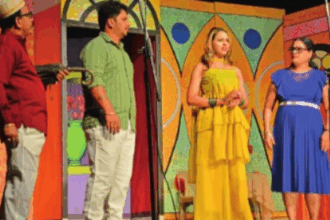
In the evening of the feast day, Roseferns will be staging his
tiatr, ‘Hem Oxench Choltolem?’ at 7.30 pm. On April 25 and 26 from 7.30 pm onwards,
there will be a performance by children, youth and other members of the parish
who will exhibit their talents and entertain the crowds. On April 27, Com Ambe
will be staging his tiatr, ‘Faleam’ at 7.30 pm. The concluding day of the five
day fete, Alexin De Morjim will be staging his tiatr, ‘Sorry’. All programs
will be held at the St Jerome’s Church Compound, Mapusa.
Just as the Feast day comes to an end in Mapusa, the Zatra in
Shirgao will be gaining momentum. One of the biggest zatras in Goa, devotees
from all across Goa as well as the neighbouring states of Maharashtra and
Karnataka travel to the Goddess Lairai to pay their homage at the annual
Shirgao Zatra which is also known as ‘Dhonanchi zatra’. Goddess Lairai is known
as the deity of the forest. Though the zatra of Goddess Lairai is celebrated in
Shirgao, the residing Goddess is Sateri. While the goddess of Lairai is in the
form of a ‘Kalash’ or pitcher, Goddess Sateri is represented in the form of an
anthill.
It is believed that seven sisters and one brother made their way
over the ghat region from Maharashtra to Goa and they met Goddess Shantadurga
in Bicholim who told them to go to Mayem and then proceed to the villages of
Goa. The seven sisters are Devi Mahamaya in Mayem, Devi Mirabai also known as
Milagres Saibinn in Mapusa, Devi Lairai in Shirgao, Devi Morjai in Morjim, Devi
Anjadeep on Anjediva island, Devi Kelbai in Mulgao and one brother, Khetoba in
Vainguinim.
A month prior to the festival, the dhonds maintain a strict
vegetarian diet and stay away from any unclean objects. Ten days prior to the
festival, they get together in their respective villages and reside in a place
close to the river known as ‘Tol’ and on the night of the first day of the
festival, the devotees await their turn to walk on the holy path of hot coals
in the tradition of Agnidivya.
The zatra is open to
men and women dhonds and those who were dhonds and passed away, the next year,
their decorated stick or benth is brought and placed near the fire which is
eventually burnt. Jatesh Gaonkar from Shirgao has been a dhond since he was 16
years old. Once you become a dhond, it is a commitment of a lifetime. “We begin
with the fast five days before the Zatra and follow a strict diet. Before
consuming any meal and even water, we have to take a bath. There is no record
of how many people visit the temple and pray to Godess Lairai during the Zatra
but villagers from all over Goa, Maharashtra and Karnataka come here over the
five days of Zatra. The embers burn till the fifth day of the festival. While
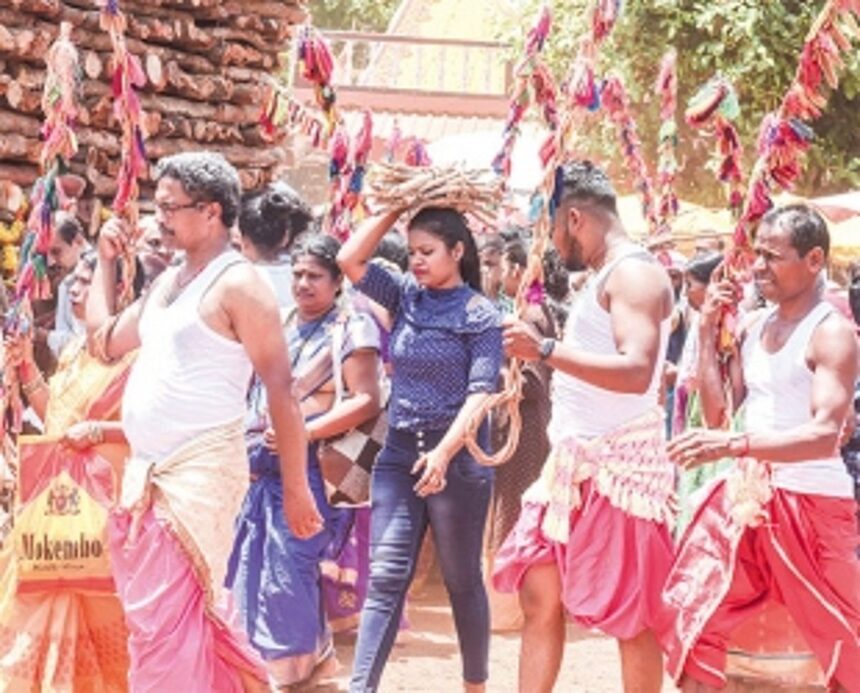
the dhonds and villagers of Shirgao only wear a pudve, a Goan dhoti, the dhonds
from the other
villages wear a pudve and carry a colourfully woven cane stick
called as benth which is decorated with colourful bunches of wool,” says Jatesh,
who will be accompanied by his father, brother, paternal uncle and his cousins
as dhonds.
Earlier, dhonds and devotees whose petitions were fulfilled,
would offer wood for the ‘homkand’, a heap of wood that was burnt to make the
path of burning coals. However, now they are advised not to bring the wood and
instead buy from the temple vicinity where specific tree wood is sought from a
certain forest. “When different wood is burnt, sometimes the resin or sap
sticks to the feet. Since big logs of wood are required for the ceremony, now
the villagers source the wood and keep it ready for the festival,” add Jatesh.
To connect with the youngsters and showcase the beauty of Goan
festivals and devotion to the Goddess Lairai, Mithil Lingudkar from Mapusa and his
friends created a reel on Instagram which went viral before the Zatra. The team
behind the reel include Zeeshan Khan, Rajat Amarkatti, Sumeet Kambli, Shamith
Sarmalkar and Karisha Shirodkar. The team had previously created their first
reel on Lord Bodgeshwar.
“I like to create reels on different social issues, Goan culture
and new ideas that make funny videos. I work on the concept and the editing of
the videos. There are many great aspects of Goan culture that many people don’t
know in other parts of the state. This becomes like a talking point and it
encourages people to visit and see the place for themselves. We have heard a
lot of stories on how Goddess Lairai has helped people in their hour of need.
There is no written history but these stories have been passed down orally from
generation to generation,” says Mithil.
Two great religious celebrations, the Feast of Our Lady of
Miracles and the Shirgao Zatra of Goddess Lairai for generations has been a
harmonious balance among the Christian and Hindu devotees.
com