In an ever
changing world, our treadmill existence hardly gives us a chance to notice the very stark changes
occurring around us. If we stop to observe, it soon sinks in that among other
things, traditional occupations, even the ubiquitous ‘dhobi’ or the ‘kalaiwala’
(tinning of vessels in copper) and even ‘mattress fluffers’ who were once part
of our urban existence, are soon becoming obsolete. Globalisation and economic
restructuring have rendered trades that were carried on from one generation to
the next, totally redundant.
Making sense of this
change and archiving these disappearing professions in photographs, Clare Arni
– a passionate heritage, travel and culture photographer with over three
decades of work has documented these dying professions in six cities of Mumbai,
Bengaluru, Delhi, Chennai, Kolkata and Goa over six years. Having grown up in
Madurai, Tamil Nadu from the age of 6 and based in Bengaluru, Clare is more
Indian than British. The author of several books, Clare uses her innate
sensitivity and empathetic approach to document social situations. “I started
ten years ago and kept revisiting my list. In fact a lot of what I have is
archival material, now,” she shares. Having travelled extensively in India and
knowing many local Indian languages, Clare resignedly states, “Earlier, every
city used to have its unique charm and flavour. With globalisation and
consumerism, they are beginning to look the same. My attempt was to study the
historical professions in each city and document its present status to see if
they have vanished or adapted to survive.”
Her point is
validated through her pictures that details professions like film billboard
painters in Mumbai and Chennai who are now extinct giving way to digital flex
or the Chinese immigrants in Kolkata who made customised shoes, with wooden
moulds for each client to blacksmiths who have all but disappeared in
Bengaluru.
She has also
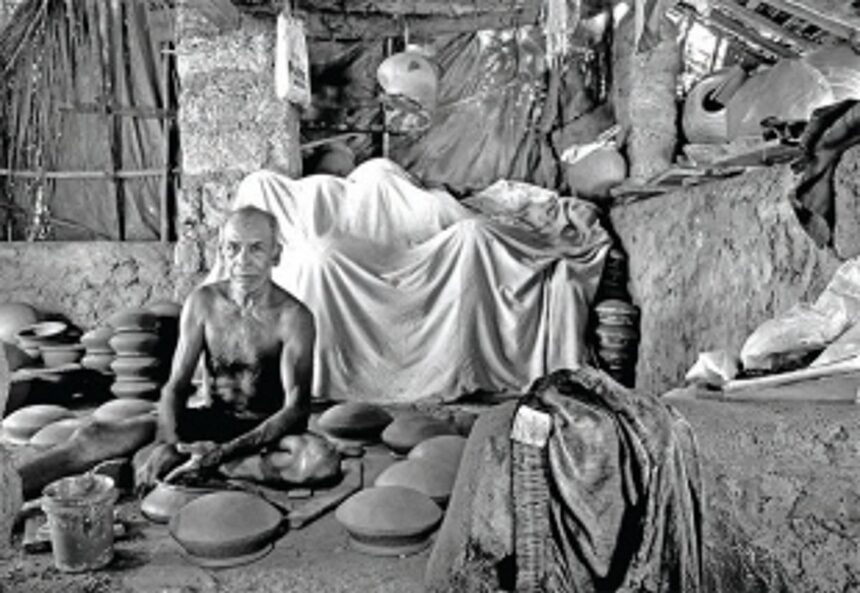
documented the Koli community and the soon vanishing Irani cafes. In Goa, Clare
touches on the traditional potters who produce hand-pinched pots without using
electric wheels or kilns. Clare is matter of fact about the need for upgrade in
some lines of work, “Some professions need to be modernised since it’s very
hard for people to work in those conditions of acrid smoke and steam like the
silk dyeing business in Bengaluru.”
Exploring each of
these cities extensively by foot, Clare tells us fascinating stories of cities
especially Kolkata, a city that is known for its old world charm and deep sense
of culture. “In Kolkata, I was told that nothing has or will change,” says
Clare bemused and adds, “I decided to document professions that other migrant
communities brought to Kolkata – wig makers, musical instrument makers, the
Chinese shoe makers.” She narrates interesting anecdotes of quaint single owner
run spaces like the old book shop, Dasgupta & Sons that was established in
1886 where no browsing was allowed! Her photographs of India Coffee House, is a
story in itself of a bygone era of a characterful place that was the meeting
ground for the intelligentia during India’s freedom movement.
She
is particularly forlorn of the state of the weaving industry and its effect on
peripheral economies. Making a case for patronising handmade products, she
says, “Progress is good but we must sustain local markets, buy from craftsmen
otherwise like in Europe, this skill will have vanished.” Some professions
although threatened have had a way to sustain. The miniature calligraphy
artists from the Mughal Court who were brought to Delhi eons ago have found a
new market for high end miniature painting work. Similarly, the handmade
jewellers of Chandni Chowk continue their work, where it takes six craftsmen to complete one piece even though machine
made jewellery is now more popular.
Hopeful
for Goa – a place that she believes has a strong sense of history and identity,
Clare says, “Places like Barberia, a barber shop in Calangute or the shell makers
to the local feni makers and homemade Goan sausages, give me hope.” Wanting to
explore unique Christian practices in Goa and perhaps the old tavernas in
future, Clare concludes, “India is so varied; there is always something to
photograph and document.”