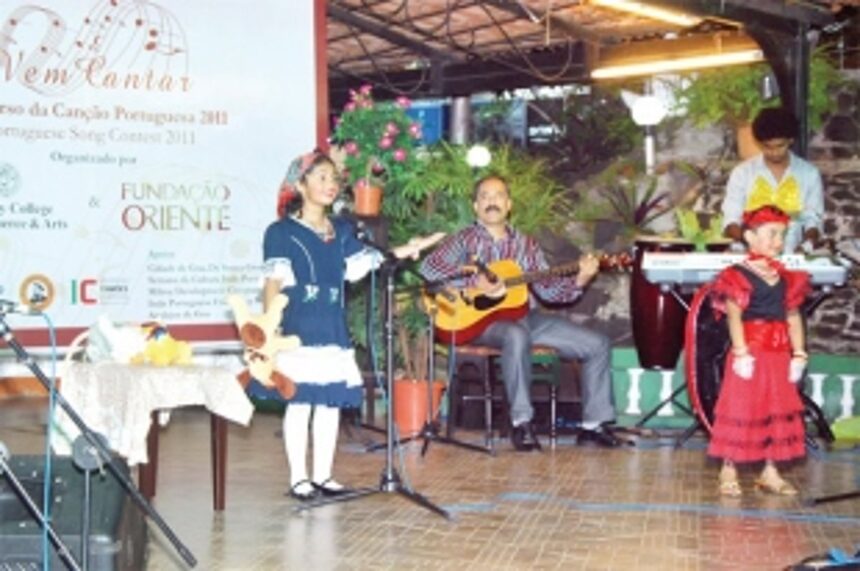
Every year,
around the August-September period, Goa gathers itself up in preparation of a singing competition of
a very different kind. Vem Cantar is the only Portuguese singing contest of its
kind in the country, and over the years, has only seen its popularity virtually
explode on to a stage that is larger than life.
The original contest
was started by the Heritage Cell of Rosary College of Commerce & Arts,
Navelim all the way back in 1998, and to be fair, it wasn’t even called Vem
Cantar then. The name was coined by former director of Fundação Oriente
(India), Sergio Mascarenhas, when the institution joined hands to promote the
contest on a bigger scale, in about 2001. It started off with solo contests for
schools, higher-secondary sections; seniors and groups were added later.
As an event in its
own right, the growth of the contest has been phenomenal. Speaking on its
development over time, Inês Figueira, the current director of Fundação Oriente
(India), says, “In the 4th edition (2001), there were 31 contestants (all
solo). The group category was introduced in 2005 and had a total of 12 groups
participating. This year, we have 82 solo contestants and the number of groups
is estimated to be 26. It took some experimenting to get the age groups more or
less right, but I think that we’ve managed to get the mix right.”
Across both North Goa
and South Goa, Vem Cantar has been held in a host of venues that include the
likes of Kala Academy, the NIO Auditorium, Clube Nacional, Clube Harmonia de
Margao, Institute Menezes Braganza, Taleigao Community Centre, Ravindra Bhavan
(Margao) and Gomant Vidya Niketan. This year’s edition will be held at Menezes
Bragança Institute and Kala Academy.
The sheer numbers in
terms of participation itself suggest a notable change in the dynamic of the
competition, over time. Speaking about her observations, Inês adds, “The
greatest observation I have made on this front, I would say, is the crazy level
of enthusiasm to participate and definitely the engagement of the participants.
Along the years, it became a much more professional setup, with the
participants having their own routines that were well-rehearsed, and matching
wardrobes, even though these are not part of the judging criteria. Every year
we have more contestants. To put things in perspective, for the solo category
in 2015, we had 23 solo singers and 35 groups; in 2016 we had 51 solos and 42
groups and in 2017, 82 solo contestants thus far.
Inês points out that
there is a lot of work undertaken behind the scenes, by various benefactors,
who, she regrets, never get the credit they deserve. These include the likes of
the Heritage Cell of Rosary College of Commerce & Arts, the organising
committee of Semana da Cultura Indo-Portuguesa, Clube Harmonia de Margão, Clube
Nacional, Clube Vasco da Gama, Centro de Língua Portuguesa – Instituto Camões,
Cidade de Goa, Indo-Portuguese Friendship Society, Azulejos de Goa, Martins
Restaurant, Navtara, Fernando’s Nostalgia, Marcou Artifacts, O Coqueiro, Poshak
and Walk-Over.
There is much to be
gained as well, from events such as these. For instance, Goa’s gift to the
world of Fado, Sonia Shirsat, was born from a chance participation in
the competition, which led to the creation of something much greater, which
nobody could have imagined at the time. Apart from Sonia, other noteworthy
faces at the competition, who have gone on to do something significant in
Portuguese music include the likes of Nadia Rebelo, Franz Schubert Cotta,
Orlando de Noronha, Carlos Meneses, Siddharth Cota, Selwyn Menezes and Victor
da Costa.
One
can only hope that more such talent is unearthed this year, in what is clearly
the biggest edition of the competition yet.