What do countries with the best
Coronavirus responses have in common? Women leaders – indicated a Forbes
article published recently. From Germany to New Zealand, Denmark, Iceland,
Taiwan and Norway, women leaders who helm these countries have shown great foresight
in taking radical steps even while their male counterparts like Donald Trump of
the USA and Boris Johnson of the UK were stuck in a state of prolonged denial.
70% of the world’s healthcare staff
is made of women. Closer home, in India, the rockstar Health Minister, K.K.
Shailaja of Kerala has made an example of Kerala’s healthcare management
through her deft handling of this crisis. In Goa, the numerous volunteers
who emerged to undertake various relief efforts across the state were expectedly
and admirably mostly women. The COVID 19 Humanitarian Helpline number (080-4719-2600) that was formed as a citizen initiative
saw 70% of women volunteers sign up. Says Sanjiv Khandelwal, who heads the team
behind the initiative, “Women bring vital skills, resources and experience in
responding to a humanitarian crisis . They are inherently endowed with
compassion and kindness.” He quickly clarifies, “It’s not just about the soft
skills. Their role isn’t just limited to managing the backend SOS calls. Our
Operations team in the packaging and delivery of meals is almost entirely run
by women. They have taken care of all the logistics of nearly 10,000 packages
of ration and food so far. We have some incredible women technology wizards
also managing our backend processes remotely.”
Rashmi Krishna who is the backbone of
the tech support team happily shares, “We are a core team of five women, two in
tech support and the other three who handle social media outreach, press
engagements and volunteer management.” Explaining the process, Rashmi
impressively shares, “I handle all the backend data. My colleague, Charmaine
Pereira manages Exotel, a Cloud Call Management software that helps us to
manage the volume of calls and record call drops enabling us to track and call
back. Ninoschka and Luanna monitor incoming and outgoing call logs
respectively. Asmita and Ishita collect and verify vulnerable community data,
Nisha manages the inventory of the food truck while Marishia supports
Corporation of the City of Panaji (CCP) with their grocery delivery system and
Trella handles Finance.” She jokes, “It takes a fem powered village to power
this outreach!”
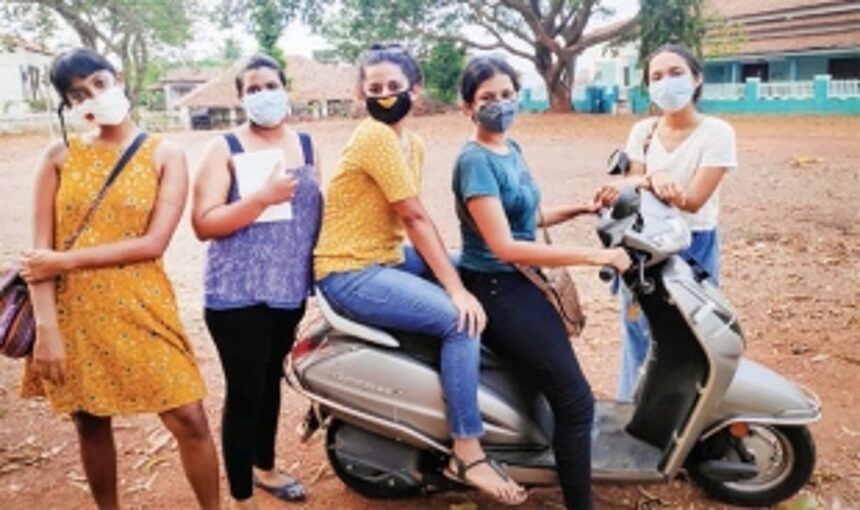
Another motley group of empowered
women – all in their 20s who reside in Aldona extend support to the
Humanitarian helpline as its local arm besides undertaking relief measures for
over 500 migrants in their area of Aldona, Moira and Nachinola on their own. As
they get together for a meeting to define the future course, given an extended
lockdown, they share responsibilities, display calm leadership, empathy and
strong local connection with people in their area. There are no imperious signs
of dominating the conversation or even giving themselves undue
importance. The men in the group are happy to share and comply .
Says Pakhi Sen dismissively, “This
isn’t a noble act. We just had to rally together and help those stranded in an
unfair system. This crisis revealed to us that a lot of people really don’t
care.” Disillusioned with the system, she adds, “How can a government not know
or take into account a sizable number of people who constitute the migrant
labour class and daily wage earners before announcing a lockdown?”
CR Niyati, the only
one with some prior experience in fundraising and organizing, explains,
“We were hit by the sheer numbers of migrant workers with no food or money and
are just about getting the hang of coordinating this task despite being part of
relief work since the lockdown was imposed.” Giving us an indication, she
continues, “Imagine, coming across one family of migrants with 35 members
who live in Nachinola, accidentally”
Adds Renuka
Figueiredo, a psychologist at The Owl House, “It’s worse when people question
us for prioritising migrants because they are not from Goa. So many of them,
especially daily wage workers have been dumped by their contractors and despite
the Prime Minister’s appeal to pay the wages due to them, many have been asked
to pay rents or are even evicted.”
Niyati along with the others have
documented, verified and submitted a list of the people they were servicing in
their area to the Deputy Collector, Shashank Tripathi. Says Niyati, “Government
officials have now stepped in with aid. We have offered our assistance to
them since we know the people and the areas most affected”
Ending their meeting with
instructions to the group to keep those whom they reach out to apprised of the
current situation, remind them of precautionary hygienic measures to wash hands
and check if they’ve got their rations from the government authorities; these
women are process-driven and display empathy, leadership skills and purpose
beyond their years.
Is it any surprise that women really
do rule the world? It’s time we believed it.