Goa is no stranger to the good work of
‘banglanatak dot com’. Many people in the state are rather familiar with its
major peace-based music festival that happens in Goa at the start of every
year, formerly known as Sufi Sutra, now rechristened, Sur Jahan. However, there
is much more to the organisation than just that. The social enterprise has long
since been working across India, with a mission to push forward sustainable
development, using culture-based approaches, all with an aim to work towards
the protection of rights of women, children and indigenous people. It’s latest
initiative took them to the northern of the state, with this very goal in mind.
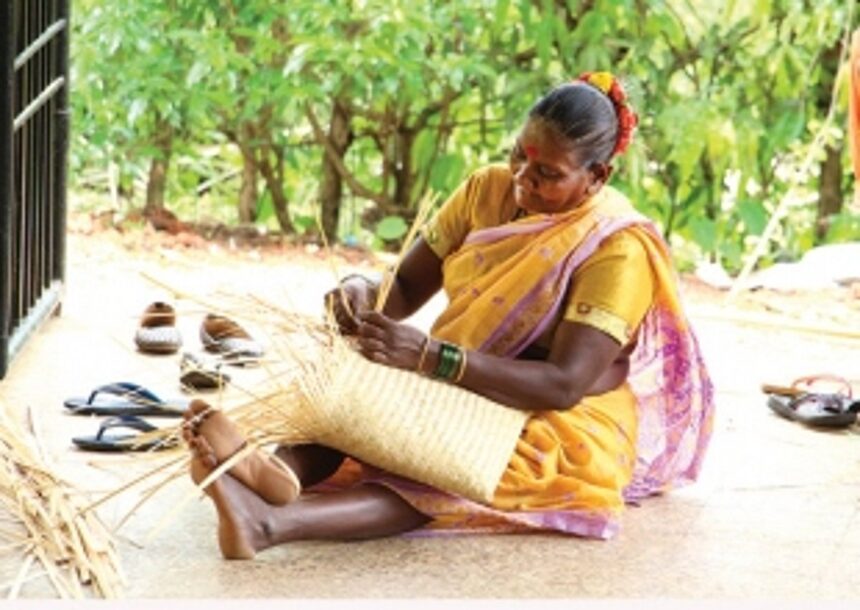
A bamboo workshop was held in
Harijanwada at Thanem, Valpoi from June 4 to June 10, 2017, its main being the
building of skill and capacity amongst the artisans. There was a total of 26 participants,
all of which were women, and most of them belonged to existing self-help
groups. With no fixed age group for participation in the workshop, the
attendees were a mixed bunch and the age of the participants in the programme
ranged from 19-62, though the majority of the group was of an older bracket.
The workshop was conducted under the guidance of Jotil Tudu, a Master Trainer
from Maldah, West Bengal and Mariona Pereira, a young Goan designer.

The workshop saw the imparting of new
skills and techniques amongst the artisans involved, such as the incorporation
of the hacksaw, in lieu of the traditional coito, or chopper, to cut bamboo. Not only does the use of the
hacksaw make cutting bamboo easier, but it also helps in yielding a better
finish and reduces wastage of raw material. In addition to the hacksaw, they
were trained in regularising size with the use of a measuring tape, which will
help to standardise end products for the market’s needs. The last of the tools
they were introduced to was a customised knife, devised by Jotil Tudu, which is
not very sharp but splits the bamboo accurately. Along with the usage of new
tools they learnt to make new products as well like lamp shades, roti boxes,
laundry bags, storage boxes, bags and vases.
“I think that we can safely say that the
artisans were quite enthusiastic and cooperative, which is a huge source of
inspiration to us as facilitators. One of the most important steps for us was
our continuous encouragement of the young generation of the community to
involve themselves in this traditional craft, throughout this workshop,” shares
Rajyashree Mukherjee, an Assistant Manager with banglanatak dot com, speaking
on the event in hindsight.
The workshop began with an exercise was
conducted to develop the concentration and focus of the participants, after
which they were divided into groups, so that every group could concentrate on
building and mastering products thought to them. The master trainer then taught
all the participants to create a specific stand that would be helpful in making
strips with ease, which is one of the important tools of the bamboo craft. Over
the next few days, the participants learnt how to tweak the bamboo further and
create products from it. In conclusion, the workshop worked on the finishing of
the products, before distributing certificates amongst its participants.
“On the same day, a group of nine
American students from the College of William and Mary in Virginia, USA
participated in the workshop with their local faculty, Anibel Ferus-Comelo,
based in Goa, accompanied by the Program Director, Dr Iyabo Osiapem from
Virginia. The presence of guests at the workshop, working together along with
the artisans, was inspiring for them, and it helped create a very positive
atmosphere,” Rajyashree adds.
The event has seen perhaps new life
being woven into what is a dying art form, and one can but hope that this new
life takes form into a movement that is even greater, so as to enable it to
live on for generations to come.