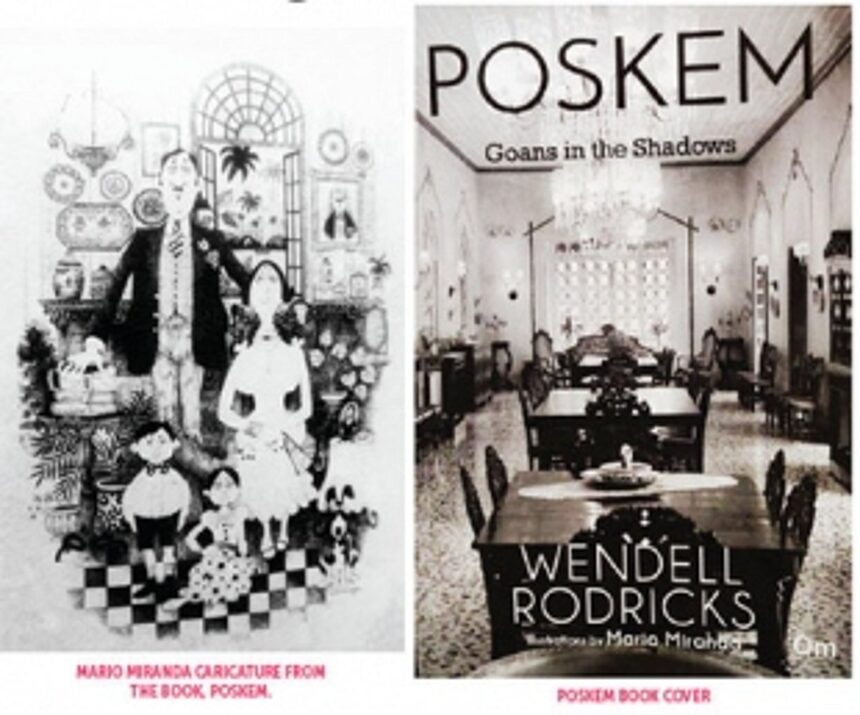
The Late Wendell Rodricks, noted fashion designer, food connoisseur and environmental activist was also an accomplished author. Not surprisingly, a few months after his untimely passing, his last book, ‘Poskem’, first published in 2017 is still making waves in Goa’s literary circles.
In this interesting book, the much loved fashion designer handles the ‘hush-hush’ topic of ‘Poskem’ (adopted children in the Konkani language) with quite a bit of ease as he narrates the lives of four children and their respective destinies. ‘Poskem’ were usually children from underprivileged backgrounds who were adopted by rich, Goan Catholic families and in many cases, made to work as house help all their lives. Fortunately, this practice has disappeared in modern day Goa.
If Wendell’s easy prose keeps you engrossed on one hand, as he moves from village Goa to town Goa to Portugal and back in a matter of few pages, it is the Late Mario Miranda’s spell-binding caricatures which keep you glued to the book also. Before Wendell became a professional fashion designer, he had trained to be chef. This training in the culinary arts and his love for food, finds an expression in this unusual book, where he shares many a recipe from good friends across the world, as the protagonists in his book work up sweat in their kitchens.
Sahitya Akademi awardee and noted Konkani author, Damodar Mauzo is all praise for Wendell’s book. Says the Majorda based writer, “Wendell has thrown light on an aspect of Goan life that is hardly discussed threadbare in our society. To make the novel highly readable, Wendell has interwoven various factors like love and hatred, crime and revenge, eroticism and magic realism. For the first time in Goan fiction, we find a sprinkling of a few mouth-watering Goan recipes too.”
While the Carmona based, academic and author, Savia Viegas says, “When I first read the book, it reminded me immensely of a Spanish novel titled ‘Like water for chocolate’ by Laura Esquivel. However, I realised that Wendell had taken a bold step in critiquing the social structures of everyday Goan life.
Growing up in Goa, one was only too familiar with the Poskem in every Goan elite house. It was a terrible custom engineered to allow the elites to maintain their lifestyle at zero cost labour and total subjugation of these poor souls. Later in the course of some research, I learnt that very often the birth of illegitimate children through servants was dealt with in this way. They were given backdoor entry and their labour was harnessed. I loved the book and because Wendell espoused this cause, people took notice.”
Aldina Braganza, the Benaulim based academic and clinical psychologist is another reader who is impressed with Wendell’s last novel. She says, “I really liked Poskem. It is an easy read and the language is beautiful yet simple. I think two things about the author get reflected in this book. His love for the underdog and his interest in cuisine. Many of the young children given up for adoption were illegitimate children born out of wedlock or abuse faced by the working class from the landlords. Adoption was not for adoption’s sake, but more as free house-help. Many did not receive any education nor family rights to property. However, the delicious recipes, which Wendell delicately crafts into the narratives is able to soften the punch and the darkness of the story.”
Margao based copy writer, Tamara Pinto, an avid reader is the Gen-Next of Goa. She feels indebted to Wendell for examining this topic. Says Tamara, “It is upsetting to think that we treated human lives as commodities. It is upsetting to know that such dark shadows existed in our family closets. But it is good to know that we have managed to unlearn the Poskem tradition and not blindly carried it forward.”
Not surprisingly, there is all-round praise for Wendell for handling this difficult topic in a deft manner. Says Mauzo, “Within the framework of literature, Wendell has done justice to the issue that was always pushed under the carpet. Poskem tradition comprised the ugly side of our social life that needed to be brought to the knowledge of our present and future generation. It is to the credit of the Catholic community of Goa that they have displayed the generosity of progressive spirit by discarding this evil practice.”
Aldina is also all praise for Wendell’s honest approach. “The adoptees
( Poskem), especially the girls were often abused by the landlords. This dysfunctionality was considered as part of their rights. I think in Goa and in other parts of India there is so much sexual abuse within the walls of the house that needs to be spoken about. If we do not talk about these issues, then the problem manifests itself in a bigger social dysfunction.”
Likewise, Tamara believes that Wendell did a good deed by introducing the tradition of Poskem to a new generation of readers. “With this book he broadened our understanding of the tradition, with the four different stories showing us that not all Poskems were treated poorly,” she says.