Once upon a time (and it is appropriate that this
story begins in such fashion) Goa had many clubs of
repute. Well before the nightclubs that have brought
Goa much fame in more recent years, the state
played home to some of the finest social clubs, that
beyond a shadow of doubt, exemplified the concept of
gentrification. Panjim’s beloved institution, through its
legendary dances of yore, has probably been the finest
matchmaker the city has ever seen, bringing couples
(and friends) together in a manner that Tinder and other
social networking options could never aspire too.
However, over time, the bulk of these clubs
fell into a state of disrepair, structural as well
as policy wise. Many members of the younger
generation could get themselves enrolled for ages,
because of administrative policies. In 2014, Clube
Nacional brought the roof down, quite literally, and
it hasn’t ever been the same since. However, let us
bench the gloom momentarily, and on a lighter note,
turn the attention down south.
In recent times, led by three key members at the
fore of a rather young committee – Ameet Pinto, the
club’s President, Jonathan Costa, the club’s secretary
and Brian Fernandes, the club’s treasurer – Clube
Harmonia de Margao has seen a revival of sorts, after
years of seemingly being in a slump which didn’t
see much going forward. They have reinitiated the
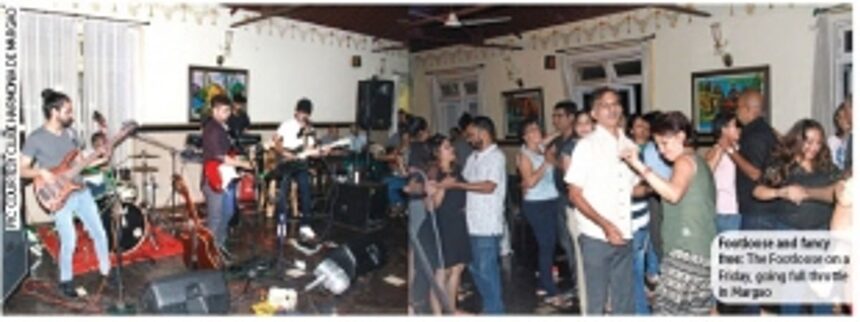
club’s weekly event, called Footloose, in an attempt
to get the club back to its chief principle, being a
social endeavour. Footloose Fridays was an event that
was initiated a few years ago, with a core of young
members and a few supportive members of the
establishment. Reminiscent of rock and roll-based
gatherings of the 1970s, the club’s endeavour lasted
for a while, and even saw musicians of all shapes
and sizes crawl out of the woodwork to make their
presence felt at the ‘jam’, which went well into the
wee hours. As the committee changed, the endeavour
died a natural death, before emerging once more, in
apparently what is its strongest avatar yet.
Speaking on the club’s revival, Ameet says, “The
key is to embrace change. If one does not realise that
one has to adapt to survive, one won’t survive. 30
years ago, things were different, and the club was a
go-to place because it offered what was wanted at that
time, but one has to also see what is required now. 30
years from today, things will have evolved once more,
and at that juncture again the club will have to evolve
to keep up with what may be trending then. We, as the
current generation, may not like that evolution, but we
will need to accept it, for it will no longer be ‘our time’,
but that of the future.”
However, it isn’t about only catering to a young
element. The club also has a series of events called
Friday Forum. Here, a talk is delivered on a given topic,
by an eminent industry expert of the field. This draws
an older audience, Ameet finds and is pleased about,
as it draws people across the board.
But this does beg the question, if the clubs of the
south can make their presence felt, then why not
the ones in the north? One young member of Clube
Vasco da Gama, who requested anonymity, believes
that the absence of a youth element is the key factor
in the decline of such age-old institutions. He shares
his point of view, saying, “The generation gap is
something that is the clubs’ creation in many ways. For
instance, members’ children can only use their parents’
membership benefits until the age of 21, after which
they lapse. Those same children aren’t being enrolled
as club members from that point onward, so how
are they to continue their association with the club?
Southern clubs have a young representation as well,
which makes all the difference.”
Tony Dias, the president of Clube Nacional, points
out that while this may have been the case in the past,
it isn’t so anymore, with the club attempting to bring
about change. “We have recently offered membership
to a fair number of individuals, especially as the club
will be reopening very shortly, come the beginning
of November, at the very latest. Our activities will
recommence, including youth-centric ones.”
Furthermore, the age-old rivalry between the
two clubs and their respective members was a factor
that pushed the boundaries of each club to excel.
Over time, the members of one club also joined the
ranks of their rivals, blurring these boundaries in the
process. The aforementioned member adds, “At one
point, the biggest issue was how to outdo the efforts
of the rival, when it came to events. Let’s take the
clubs’ annual picnics, for instance. It used to be about
each club finding the best location, zeroing in on the
entertainment that was desired, and putting on the
best show. Over time, as members merged, the picnics
would be spaced shortly apart from each other, the
location would be the same, and the entertainment
would overlap too. Whoever held the first event came
out on top, because many members would miss the
second one, if they had gone to the first, given that
everything else remained the same. It reached a point
where there would just be one large event held in the
names of both clubs.”
Tony counters this once more, pointing out that
the overlap in members ensured that in order for clubs
to put on the best possible show, an arrangement that
saw harmony between the two was the need of the
hour. “This agreement to have joint events allowed us
to utilise the funds at our disposal in a way that made
the event great, as opposed to having a smaller event.
Hence I believe it was the right call.”
Tony is a household name in Panjim, and no event
is complete without him. However, there is also a need
to have other younger ‘Tonys’ come forward and help
him. For perhaps the time has come to accept that
without an injection of new blood, these veritable
institutions would not survive much longer. And that
statement in itself is plenty of food for thought