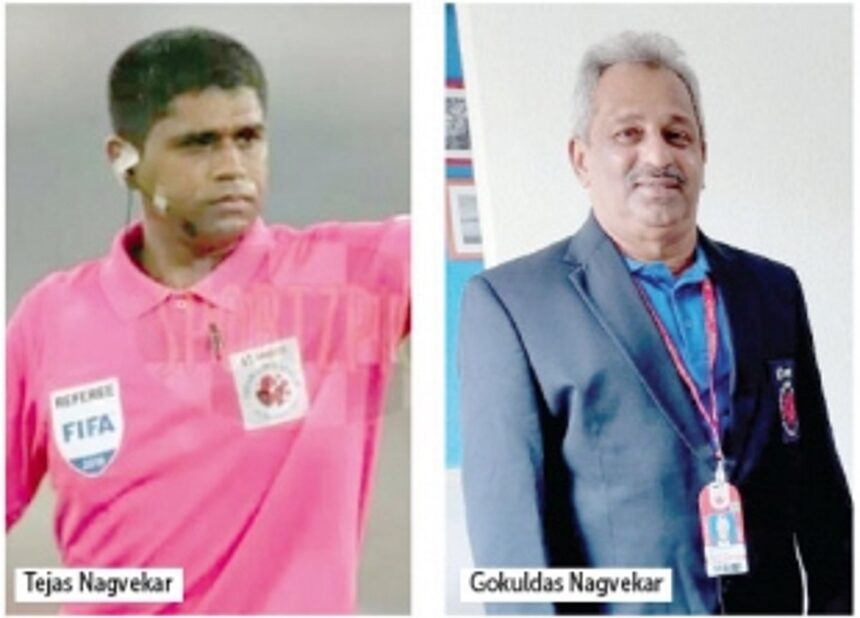
At any point of time there are twenty two strong energetic players on the field. Trying to control a ball that has a mind all its own. These players will kick it, caress it and on occasions be able to send it in to a goal. Controlling the proceedings is an individual who ensures the game is fair and does not result in unnecessary stoppages. This year for the very first time an Indian referee or rather more specifically a Goan referee controlled proceedings during the finals of the ISL tournament that resulted in a victory to Mumbai Fc in the finals. For Tejas Nagvekar and his uncle Gokuldas Nagvekar it was a case of a family being in charge of one of the most important tournaments in the country.
Tejas Nagvekar controlled proceedings on the ground and his uncle Gokuldas Nagvekar as match commissioner controlled the proceedings overall. For Tejas it has been quite a journey from the time he started refereeing in 2004 in the lower leagues in Goa. Now 33 he is certainly enjoying the responsibility that comes with umpiring at this level. On contract with the All India Football Federation for five years he is an AFC Elite referee. He has refereed matches all over the country and abroad but will never forget why he took it all up. Like any one in Goa, he loved football and even played the game whilst in college but he quickly realised he was not good enough to make it into the higher echelons of the sport. But he loved the game passionately. It was at this point in time his uncle Gokuldas Nagvekar who was a player and was part of the team that won the Santosh Trophy for the first time advised him to take up refereeing. Tejas said the early years were very rough with senior players in teams very reluctant to take orders from a much younger man in authority. However with time, Tejas slowly but steadily made his mark and gained experience. And slowly and steadily, he started moving up the ladder. He said it was important to have the support of family and friends. Players, he said, received training on how to deceive the referee and influence a decision in their favour. As a referee he had to be very fit. It is not unusual for a referee to run anywhere between 12 to 13 kms in a match. Sometimes they were required to sprint to keep pace with the action. This he said required very high levels of fitness and this required practice everyday. He was also required to watch videos and analyse his performance. He said focus on the job was everything. His uncle Gokuldas Nagvekar has been part of the game for several decades. Playing at the highest level i.e. representing the state at the national level and winning, Gokuldas decided to move into officiating as his playing career slowly started coming to an end. He was a referee from 1979 under the Goa Football Association. In 1993 he became a national referee and then in 1996 an international referee under FIFA. He has officiated matches all over Asia and even in qualifying games for the Olympics. Gokuldas said he saw in his nephew a passion for excellence at a very early age and thought he would go far as a referee and subsequent events proved him right. He said he wanted his nephew to move ahead and stand for matches in the World Cup and that would come with great focus and determination. He said he took to the role of a referee like fish to water. He said “He scored 98 out of 100 in the exams and it was just fantastic. He has to remain focused on his job.” Tejas said he had seen several people he knew who were good at refereeing unable to focus because of the pressures of work. This he said was a battle he did not have to fight but anyone he said who wanted to go far would have to sacrifice. Gokuldas ended by saying he hoped all his dreams would come true in the future. One can only wish him all the very best.